Sales-order fulfilment exception desk for Singapore SMEs: named HOLD PICK when confirm, pick, pack, or ship disagrees
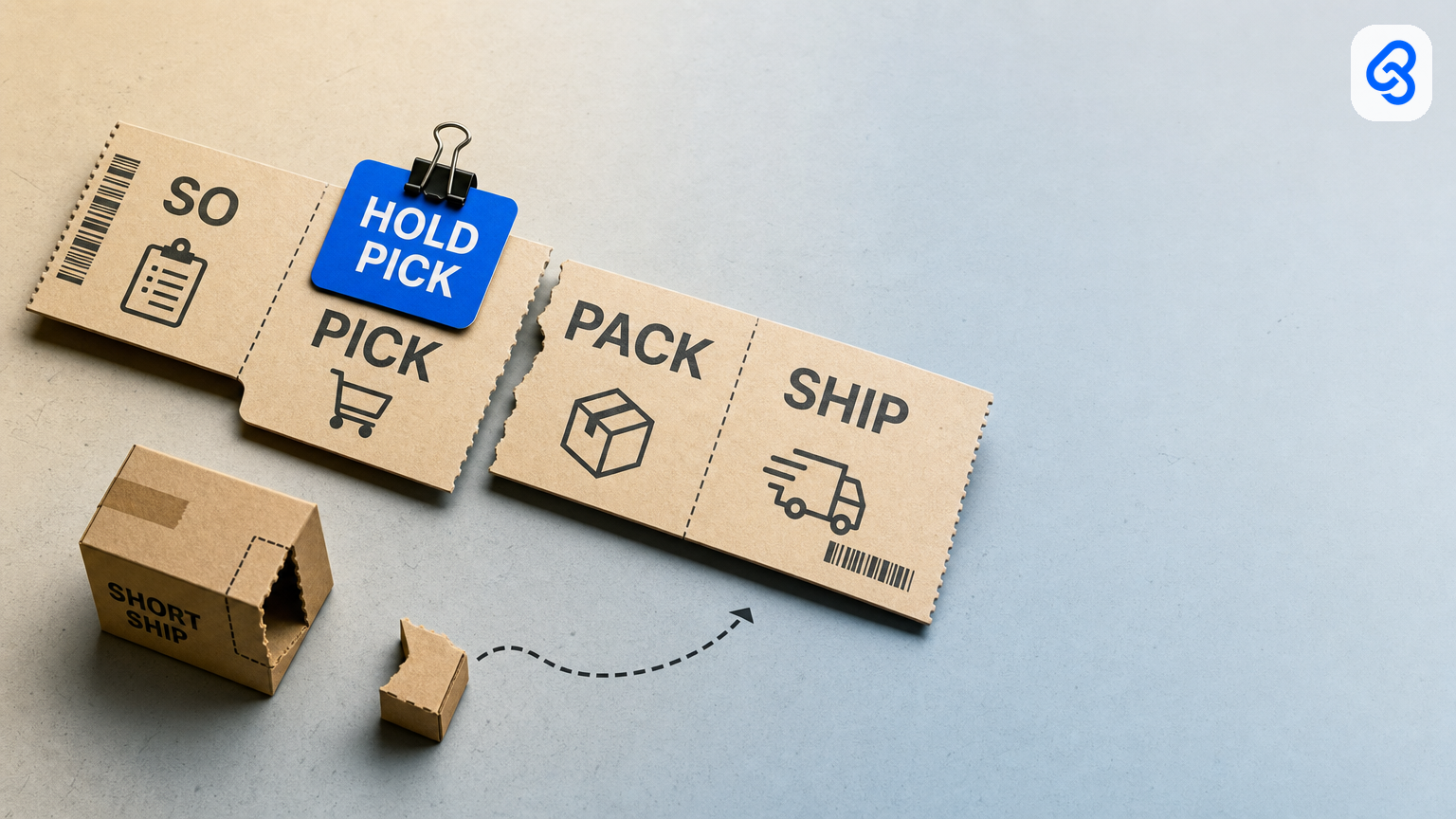
Sales-order fulfilment exception desk for Singapore SMEs: named HOLD PICK when confirm, pick, pack, or ship disagrees
The customer WhatsApp lands at 10:18 — “SO-3912 confirmed yesterday, still no courier pickup?” Ops opens the Sheet: order looks Confirmed. Warehouse opens the pick list: SKU-C is short by four cartons. Sales replies “ship what we have lah, balance next week.” Finance asks whether to invoice full or partial. The fulfilment lead who usually holds short-ship and split-pack decisions is on MC. By 15:40 the same thread has a partial van photo, a customer chasing ETA, and nobody can say whether HOLD PICK is still on, whether a split ship was approved, or whether the balance line even has an owner. Goods that should have left this morning are still a scrollback — not because the firm lacks an OMS checkbox. Because the moment sales order → allocate → pick/pack → ship disagreed lived as a group habit, not a named desk.
That is the sales-order fulfilment exception problem for a Singapore trading, wholesale, or light ecommerce SME. Not a missing “auto-fulfil every order” feature. Not a second delivery-order, GRN, or invoice tutorial. A lived desk — confirmed SO on one trail, stock and pick reality on another, named HOLD PICK / SHORT SHIP / HOLD SHIP, route to the owner who can clear it — that stalls or silently ships wrong the week one named person is away, and that still lives in chat.
This guide is the operator version of sales order fulfilment exception workflow for Singapore SMEs. Named runbook: trigger, extract, route, human gate, tracker. Automation flags mismatches and chases the hold. A named fulfilment / ops owner still holds pick and ship. Named sales, warehouse, or finance owners clear by reason code. It binds the customer-side trail that already ships as delivery order (DO document when goods move), GRN / goods-receipt exception (inbound contrast), invoice workflow, and three-way match exception (AP bind after) — link those chapters; do not rebuild them. Not a silent auto-ship tip. Not a WMS / OMS module pitch that forgets who taps HOLD PICK.
Wider frame: workflow automation services. Optional: customer returns / RMA (post-delivery AR), leave cover, quote-to-PO (buy-side commitment — different desk). Subcontract / project billing stays queued after this chapter.
What this guide covers
- What “sales-order fulfilment exception automation” means for a 10–80 person trading / wholesale / light ecommerce firm here — a desk that binds confirm → pick/pack → ship, not a new OMS
- Why Singapore SME fulfilment culture matters without marketplace theatre
- A named SO confirm / allocate / pick / pack / ship exception → extract → route by reason → human gate HOLD PICK / HOLD SHIP → tracker runbook you can print and mark up
- Who owns HOLD PICK vs who clears stock vs who approves short-ship / split vs who invoices
- The trail map: quote / SO → allocate → pick/pack → DO / ship → invoice / three-way (link siblings — no DO / GRN / AP rehash)
- When Sheets, Gmail/Drive, Telegram, and Xero are enough — and when they are not
- Steal-this-build DIY that stops before judgement (no silent short-ship, no auto-invoice full on partial pick)
- Failure modes, consult → build → train, checklists for this week
What sales-order fulfilment exception automation means here
Search “sales order fulfilment automation Singapore” or “pick pack ship exception SME” and you will mostly get global OMS / WMS demos, marketplace seller-centre tips, or thin local posts that jump to a tool list and a funding footnote. Useful as a sketch. Thin as an operating manual for a trading or wholesale firm that already lives in Gmail, Drive, Sheets, Xero (or QuickBooks / MYOB), and WhatsApp or Telegram — with a confirmed SO, a stock sheet nobody fully trusts on a busy Tuesday, a pick list that may or may not match the SO lines, and a customer already asking whether the slot still holds.
For an SME operator, sales-order fulfilment exception automation is simpler:
Automation extracts SO, allocation, pick, and ship lines, flags mismatches, routes by reason code, and chases the hold. A named fulfilment owner still holds pick and ship. Named sales, warehouse, or finance owners clear the exception. Nobody auto-ships because two of four cells matched, and nobody auto-invoices full because a bot saw “ship what we have” in Telegram.
Anything that marks every SO “fulfilled” because the header said Confirmed, releases a van because a Sheet said Ready while qty was short, or invoices full because a partial pick photo landed in a group is not a productivity win. It is a control failure with a notification sound — customer trust and cash leaving while nobody owns the exception row.
Three purchases get confused under the same phrase:
- Software — OMS / WMS pick-pack screen, ecommerce fulfilment SaaS, Power Automate template. Fine when SO lines, bins, and cutoffs are already clean.
- A service — maps *your* SO confirm → allocate → pick/pack → ship exception → HOLD PICK / HOLD SHIP → clear path in tools you already use, trains owners, stays reachable on leave week.
- A chat habit — SO PDF, “ship lah” in a group, short-ship or freeze the wave. Dies when that person is on MC — wrong cartons leave or clean orders starve.
Buy software if the process is clean. Leave it with a careful human if volume is tiny. Hire a service when the same fields wait every week and a wrong ship (or a freeze-everything panic) moves customer trust or cash.
This desk binds the customer trail — it is not a sibling rehash
Do not rebuild sibling legs:
- DO document / exception release / POD — delivery order workflow. Open when the DO itself stalls.
- Inbound receive / GRN mismatch — GRN exception. Opposite direction; link, do not copy.
- Invoice / pay tap — invoice workflow.
- PO × GRN × invoice bind — three-way match exception. After goods and invoice exist on the buy side.
- Post-delivery customer return — RMA.
This chapter starts when a customer sales order is confirmed (or should be) and the firm must decide: clean fulfil → pick/pack/ship; or named HOLD PICK / HOLD SHIP → route by reason (stock, short-ship approval, address, cutoff, invoice partial). The desk binds; it does not replace those chapters.
Why Singapore SME fulfilment context matters (without marketplace theatre)
You do not automate SO fulfilment exceptions because a press release landed. You automate because “ship what we have / freeze the wave / invoice full anyway” lives in Telegram, leave gaps turn a short pick into a silent short-ship (or starve every clean order), and the person who “just knows” whether a variance needs a split, a substitute, a backorder, or a HOLD SHIP is the same person who goes on MC.
Fulfilment touches customer promise after confirm already moved. Shipping a van that matches the SO header while pick qty is short is wrong goods. Freezing the whole pick wave for one line is the twin failure. One loop — SO → allocate → pick/pack → DO / ship → invoice — most SMEs notice only when the customer asks “where is it?” and the answer is a thumbs-up or a freeze from last Tuesday.
Trading / wholesale without marketplace theatre. You need SO#, line SKUs, allocated qty vs pick qty, ship status, and a reason code when something disagrees; a named HOLD PICK / HOLD SHIP; and route-by-reason so the right owner clears stock vs short-ship vs address vs invoice partial. Enough for most 10–80 person firms on Sheets and Xero — not enterprise OMS theatre or seller-centre penalty folklore as the whole article.
Telegram is the real fulfilment desk. “Ship lah??” with no owner, reason code, SLA, or backup on HOLD PICK is how shorts become silent vans or total freezes. Name primary and backup; leave cover is the overlay, not a re-teach here.
Labour and AI adoption (named surveys only). SBF 2024: manpower top challenge for 66% (n=519). MOM AI report (30 Apr 2026; 2,560 firms): 71.5% yet to adopt; only 3.8% of adopters integrate AI into core processes. IMDA 2025: SME AI 14.5% in 2024 (from 4.2%). Permission to stay practical: one trusted fulfilment exception desk with a named HOLD PICK owner beats an OMS migration sold as readiness.
The named sales-order fulfilment exception desk runbook
Print this. Write real names in the blanks. No owner on a step means you do not have a process yet.
Trigger
- Customer SO is confirmed (or confirmation is disputed) and allocate / pick / pack / ship should move — or is stuck.
- Also: pick finds short / wrong SKU / damaged; address incomplete; carrier cutoff missed; customer asks ETA while status still Confirmed; finance asks “invoice full or partial?” before ship.
- Rule: one intake path — `fulfil@…` / shared label, form, or SO-row status that creates the same FulfilID. “Sometimes Telegram ship-lah, sometimes Sheet hope, sometimes freeze the wave” births silent short-ships and panic freezes.
Extract
- Fields: customer, FulfilID, SO#, line SKUs, qty ordered vs allocated vs picked vs packed, ship method / cutoff, reason code(s), HoldPickOwner, RouteTo (STOCK / SALES / ADDRESS / INVOICE), DO ref when goods move, attachment links.
- File to company Drive/SharePoint: `YYYY-MM-DD_customer_SO####_FULFIL` (one path the backup can open).
- Flag: confirmed with no allocation, allocate > available, pick short/wrong/damage, address incomplete, cutoff miss, “ship what we have” with no named approval, invoice-full while pick partial.
- Do not DIY DO release or rebuild GRN / three-way here — those seats stay on DO, GRN, three-way. Use fields your Sheet already holds; flag missing attachments.
Route
- Clean fulfil (within written qty / SKU / address / cutoff rules) → Ready for pick/pack/ship — still a named human on ship release when your risk says so; clean ≠ silent van.
- Exception → named HOLD PICK and/or HOLD SHIP, and route by reason:
- `SHORT` / `NO_STOCK` / `WRONG_SKU` / `DAMAGE` / `BIN_MISS` → STOCK / warehouse
- `SHORT_SHIP_OK?` / `SPLIT` / `SUBSTITUTE` / `BACKORDER` / `CUSTOMER_ETA` → SALES / CS (named customer approval)
- `BAD_ADDRESS` / `CUTOFF` / `CARRIER_FAIL` → ADDRESS / logistics (often hands to DO when the DO document is the stall)
- `PARTIAL_INVOICE` / `HOLD_INVOICE` / `CREDIT_LATER` → INVOICE / finance (invoice; post-ship returns → RMA)
- Missing info → fixed reason code back to sales / warehouse / customer / finance — not a mute “pls check.”
- Multiple reasons → one FulfilID, multiple routed tasks; HOLD PICK / HOLD SHIP until all blocking reasons clear (or named partial-ship rule with written customer OK).
Human gate
- Named fulfilment / ops owner holds pick and ship (HOLD PICK / HOLD SHIP / release / reject / partial-ship within written rule). The Zap does not. A Telegram “ship lah” is not a fulfil; “freeze everything” is not a desk.
- Named warehouse owner clears stock-side exceptions — recount, bin check, damage photo — not sales authority to promise ETA.
- Named sales / CS owner clears short-ship / split / substitute / backorder with customer-visible approval recorded on the FulfilID.
- Named finance owner clears partial invoice vs hold invoice on the invoice runbook — do not collapse ship release and invoice into one mute group.
- DO / POD stays on the DO workflow when the document of movement is the stall.
- Automation may remind, update status, escalate to backup. It does not silent-short-ship, auto-invoice full on partial pick, or invent customer approval from Telegram.
Tracker
- Sheet, mailbox labels, or review screen the backup can open without the primary’s phone.
- Columns: FulfilID, Customer, SONum, QtyFlag, Reason, RouteTo, HoldPickOwner, Backup, SLADue, Status, Exception, Link, PickOK?, ShipReleased?, InvoiceMode, Notes.
- Statuses: New / Needs info / Allocating / HOLD PICK / Routed-Stock / Routed-Sales / Routed-Address / Routed-Invoice / Pick OK / Packing / HOLD SHIP / Shipped / Partial shipped / On hold / Cancelled / Waived (named sign only).
Worked example (one SO, one Thursday)
SO-3912 from East Coast Tools is Confirmed — 12 × SKU-C for Friday slot. Allocate shows 12; pick finds 8. Workflow writes Fulfil-44: QtyFlag `short`, Reasons `SHORT` + `SHORT_SHIP_OK?`. Status → HOLD PICK. Routes: STOCK task to Mei (warehouse recount / adjacent bin); SALES task to Raj (customer OK on split 8 now + 4 Monday). Fulfilment owner Farah does not release the van and does not freeze every other pick for the day. Mei confirms only 8 available. Raj records customer WhatsApp approval on the FulfilID for split ship. HOLD PICK clears → Pick OK on 8 → pack → ship release on partial; balance line stays open with SLA. Finance sees InvoiceMode `PARTIAL` — not full — on the invoice queue. DO for the 8 links out on the DO path when the document moves. Wednesday Farah is on MC — backup Sam sees the same HOLD PICK queue, same SLA, same written limits. Nobody treated “ship what we have lah” as a silent approve. Nobody invoiced 12. Nobody froze the whole wave for one line.
That shape — trigger, extract, route, human gate, tracker — is what you buy as a service. If a vendor cannot walk it in those five words, they are selling a stack.
Who owns HOLD PICK vs who clears stock vs sales vs invoice
Write the names before anyone mentions models or Zaps.
- Fulfilment / ops (HOLD PICK / HOLD SHIP): holds pick and ship, releases on Pick OK / Ship OK, authorises written partial-ship. Owns the FulfilID. Does not silent-fix stock or invent customer OK.
- Warehouse / stock: clears `SHORT` / `WRONG_SKU` / `DAMAGE` / `BIN_MISS` — stock truth, not customer promise authority.
- Sales / CS: clears `SHORT_SHIP_OK?` / `SPLIT` / `SUBSTITUTE` / `BACKORDER` with recorded customer approval — not a substitute for HOLD PICK.
- Logistics / address: clears `BAD_ADDRESS` / `CUTOFF` / `CARRIER_FAIL`; hands to DO when the DO document is the stall.
- Finance / invoice: clears `PARTIAL_INVOICE` / `HOLD_INVOICE` on invoice.
- Automation: labels, files, flags, routes, pings, escalates. Does not ship, promise ETA, or invoice.
- “Ops group”: not a signer. Five people who “usually look” is how shorts leave as vans and clean orders starve in the same thread.
Trail map (link siblings — do not rebuild)
1. Quote / confirm SO — commercial promise; this desk starts when confirm should become allocate / pick.
2. Allocate / pick / pack — this chapter’s core.
3. DO / ship / POD — delivery order when the DO document itself stalls.
4. Invoice / AR — invoice workflow. Partial vs full follows FulfilID, not Telegram hope.
5. Buy-side contrast — inbound receive is GRN; AP bind is three-way. Do not collapse customer fulfil into AP match.
6. Returns — RMA after delivery.
SO cannot confirm → fix sales intake first. Dock short on inbound → GRN. DO PDF stalls at the gate → DO. Confirmed SO, pick short, chat ships or freezes → you are here.
When Sheets + Gmail + Telegram + Xero are enough
Most Singapore trading and wholesale SMEs already have an inbox, a Sheet, a chat app, a ledger, and some SO / stock list. The failure mode is not “we lack fulfilment software.” It is “nobody can see which SO is on HOLD PICK, who owns short-ship vs stock vs invoice partial, and whether the rest of the wave can still move.”
Stay on Sheets when: volume is human-scale, one warehouse or simple bin list, reason codes fit one tab, primary/backup can open the same FulfilID on leave week, and DO / invoice siblings already have homes.
Consider a deeper OMS / WMS layer when a consult shows the stack cannot carry it — multi-channel marketplace sync, scan-mandatory pick at volume, multi-site allocation, or a productised trail Sheets cannot hold. Prefer a queue that feeds ledger + sibling runbooks over a rip-and-replace sold as “fulfilment automation.”
Steal-this-build (four Zaps — stop before judgement)
Illustrative only. Change names to yours. Stop before silent ship or silent full invoice.
1) Intake → FulfilID row
Trigger: Form / shared `fulfil@` / SO status → Confirmed (or Exception requested).
Action: Create Sheet row FulfilID, SO#, Customer, lines, Status `New`, HoldPickOwner, Backup, SLADue (e.g. +4 business hours or before carrier cutoff). File attachments to Drive folder.
Does not: allocate stock, release pick, or message the customer.
2) Flag short / mismatch → HOLD PICK
Trigger: Pick qty / allocate qty / address completeness updated.
Action: If short / wrong / damage / bad address / cutoff risk → Status `HOLD PICK`, set Reason + RouteTo, ping HoldPickOwner once.
Does not: auto-short-ship, auto-split, or invent customer OK.
3) Route task by reason
Trigger: HOLD PICK with RouteTo set.
Action: Create one task per reason to STOCK / SALES / ADDRESS / INVOICE owner; link FulfilID. On all blocking tasks Closed + named release → Pick OK / Ship OK path.
Does not: close HOLD PICK because Telegram said “ok.”
4) Escalation then stop
What it does / does not: HoldPickOwner misses SLA → Backup once; optional RouteTo still open; then silence. Does not auto-ship, auto-invoice full, or auto-clear.
Zap: Delay Until SLADue + 2–4 business hours (or next 09:00 SGT) → still `HOLD PICK` → Backup once → optional RouteTo → stop. No hourly nags. No “freeze all waves” automation.
Where these four stop
They change a shared inbox and a Sheet. They do not replace judgement.
Stop and talk to a firm when the next sentence is: invent pick qty from a shelf photo, absorb a short with no named customer OK, silent-ship under a tolerance with no HOLD PICK, auto-invoice full because headers matched, or rebuild DO / GRN / three-way to “save a seat.” That is the service. Sibling judgements stay on sibling pillars.
Failure modes worth designing against
Speed is not the same as control. Automation that only notifies can accelerate a bad ship — or a panic freeze.
Silent short-ship / “ship what we have lah.” Partial leave without recorded customer OK and InvoiceMode is how trust and AR both break. HOLD PICK and sales clear stay human.
“Freeze the whole wave.” Twin failure. The desk holds the FulfilID, not the company. Partial-ship only with a named tap and a written rule.
“Ship lah??” as queue / no backup. A thumbs-up is not a fulfil. Name backup and where HOLD PICK lives — leave cover lightly.
Collapse siblings into one mute approval. Keep DO on DO, inbound on GRN, AP bind on three-way, pay/invoice on invoice. This desk routes; it does not absorb their judgement.
Rehash OMS demos / ChatGPT hobby. More capture does not fix an unowned fulfilment desk — link siblings; do not rebuild them. Do not paste live customer SO packs into a public model to “decide” ship.
Invoice full while still HOLD PICK / waive without a name. ShipReleased and InvoiceMode only after Pick OK / Ship OK (or named Waived). Exception log beats a “touchless fulfilment rate.”
Hard stops: no silent short-ship, no auto-invoice full on partial pick, one escalation then stop, human HOLD PICK / HOLD SHIP, human clear on stock / sales / address / invoice legs, SO + pick + ship status on every FulfilID (or reason code). Subcontract billing stays queued.
Consult → build → train (lightly)
You do not need a 40-slide methodology. Three honest phases.
Consult. Map one live SO → allocate → pick → HOLD PICK → short-ship / split clear → ship / invoice mode with ops, warehouse, and sales. Count volume, reason codes, owners, leave cover, file homes. Baseline “exception → HOLD PICK cleared” and “Pick OK → ship.” If the DO document stalls, send to DO; inbound stall → GRN; AP variance → three-way.
Build. One workflow in tools you already use. Parallel-run beside Telegram “ship lah.” HOLD PICK release and ship stay behind named taps. Route tasks link to sibling trackers — do not duplicate judgement screens unless the consult says one view is safer.
Train. Owners and backups explain every HOLD PICK and route without the builder on the call. Park subcontract / project billing until this desk is lived.
That is partner work. It is not “we build AI agents” as a homepage line. The product is a runbook that still works when the fulfilment lead is on AL — flags and routes move; ship still has a named human on HOLD PICK.
Practical checklists
This week (no new software)
- Draw trigger → extract → route → human gate → tracker for HOLD PICK → Pick OK → ship / invoice mode.
- Write “clean fulfil” + reason codes + RouteTo in one page.
- Primary/backup for HOLD PICK; named stock / sales / address / invoice owners; SLA before cutoff.
- One shared intake (`fulfil@` or form); stop “ship lah” only in personal WhatsApp.
- Drive folder + one-tab Sheet; every row carries SONum + pick qty + InvoiceMode (or reason).
- No silent short-ship / no auto-invoice full — escalation pings a person.
- Mark three painful SOs with the FulfilID / reason / route each would have carried.
- Confirm the wave will not release HOLD PICK lines — and will not freeze clean Pick OK rows for one open exception.
Before you buy anything
- Can they walk *your* fulfilment-exception runbook without a product slide — and without rehashing OMS / DO / GRN demos?
- Where do fulfil packs live, and who opens HOLD PICK on leave week?
- What is never auto-shipped / auto-invoiced full — how are SHORT, SPLIT, BAD_ADDRESS, PARTIAL_INVOICE routed?
- Who trains the backup; who is reachable on a new exception type?
- New OMS — or Gmail/Sheets/Telegram/Xero first? First conversation: your queue — not a funding tour.
Red flags in a demo
- “Touchless fulfilment” / auto-ship every Confirmed header with no exception taxonomy; no named HOLD PICK owner.
- Group chat as system of record; “ship lah” or “freeze the wave” as the only tools; leave cover as a later toggle.
- DIY that pastes customer SO packs into a public model or rebuilds DO / GRN / three-way to “save a seat.”
- Collapses stock + sales + DO + invoice into one mute approval; parallel-run discouraged; pivots into subcontract billing before this desk is lived.
Soft next step
If confirmed orders stall as “ship lah??” in Telegram when the fulfilment lead is on MC, vans leave short without recorded customer OK (or the whole wave freezes for one line), or SO → allocate → pick/pack → DO → invoice cannot be read as one trail with a named HOLD PICK — bring one real week of that queue to a free consult. We will map the fulfilment desk, name who holds pick/ship and who clears stock vs sales vs invoice, keep siblings linked not rebuilt, and say plainly whether Sheets and Xero can carry it. No platform tour first. No invented case-study numbers.
Sources
- SBF National Business Survey 2024 (Annual Business Sentiments Edition) — manpower 66% (n=519)
- MOM — AI adoption among firms (30 Apr 2026; n=2,560) — 71.5% yet to adopt; size split 23.9% / 76.4%; core-process 3.8%
- IMDA — Singapore Digital Economy Report 2025 (6 Oct 2025) — SME AI 4.2% → 14.5% (2023→2024)
- Context: workflow automation services, delivery order, GRN, invoice, three-way match, RMA, leave cover, quote-to-PO