Quality inspection and NCR disposition workflow for Singapore manufacturers: hold, decide, correct
Quality inspection and NCR disposition workflow for Singapore manufacturers: hold, decide, correct
A failed inspection is usually the easy part. The gauge says the bore is out, or the coating is thin, or the supplier's material cert does not match the heat number on the bar. What goes wrong comes after. The part sits on a bench with a handwritten note, someone ships the rest of the batch because the customer is waiting, the "use as is" call is made by whoever is on shift, and three months later an auditor asks who approved it and why. Nobody can find the record.
This guide covers the workflow around a failed check in a Singapore machine shop, fabricator or contract manufacturer: how to hold the parts, who decides what happens to them, how the non-conformance report (NCR) gets an owner, and how the corrective action is chased until it actually closes. It starts with the manual version you can run on a tag, a log and a shared folder. The last main section shows where a custom agent fits, with a named person still making every disposition and every external return.
The ISO and Enterprise Singapore facts below were checked against the linked pages on 4 November 2026. Read your own copy of the standard and your customer's quality requirements before you change a procedure. This is an operating guide, not certification advice.
What ISO 9001 asks of inspection, nonconforming parts and corrective action
Most of this workflow follows from four clauses. ISO published the sixth edition, ISO 9001:2026, on 16 September 2026, and its table of contents keeps the clause numbers that shop procedures usually cite: 8.6 Release of products and services, 8.7 Control of nonconforming outputs, and 10.2 Nonconformity and corrective action. Continual improvement moves up to 10.1, so a procedure that quotes clause 10.3 needs a small edit.
Release (8.6). You plan the checks that prove a part meets its requirements, at the stages that make sense, and nothing goes to the customer until those checks are done, unless a relevant authority and, where applicable, the customer approve it. The record has to show conformity with the acceptance criteria and who authorised the release. Name a person: a shared login or a generic "QC" stamp makes that hard to show.
Nonconforming outputs (8.7). Parts that fail have to be identified and controlled so nobody uses or ships them by mistake. The standard gives four ways to deal with them: correction; segregation, containment, return or suspension of supply; informing the customer; or getting authorisation to accept the part under concession. A corrected part has to be verified again. The retained record describes the nonconformity, the actions taken, any concession obtained and who decided the action. ISO 9001 does not require a written procedure for this, though most manufacturers keep one because several departments touch each decision.
Corrective action (10.2). This clause covers any nonconformity, including process slips and supplier problems. You react to it, then evaluate whether action is needed to remove the cause: review it, find the cause, and check whether similar problems exist or could occur. You carry out what is needed, review whether it worked, and update risks or the quality system if the cause points there. The record shows what went wrong, what you did and the result. Not every NCR needs a full root cause study, but the decision not to open one should be written down with a name on it.
Floor language and standard language differ. "Rework", "repair" and "regrade" are forms of correction. "Use as is" on your own drawing is a recorded decision by someone with that authority; on a customer's drawing it is a concession, which the customer usually has to grant. "Return to supplier" is the return route under 8.7. Many plants say CAPA, but ISO 9001 has no separate preventive action clause. It handles prevention through actions to address risks and opportunities in clause 6.1.
Certification timing. Global ACI (Global Accreditation Cooperation Incorporated), whose transition rules accreditation bodies and accredited certification bodies follow, set the ISO 9001:2026 transition: from 31 March 2028, new and initial accredited certificates can only be issued to the 2026 edition, and firms certified to ISO 9001:2015 have until 30 September 2029 to transition. Your certification body sets the audit that does it.
The Singapore Standard. Enterprise Singapore's Standards Division has put Draft SS ISO 9001:2026, an identical adoption of ISO 9001:2026, out for public comment until 3 December 2026. It will revise SS ISO 9001:2015(2023)+A1:2024. To check that a certification body is accredited in Singapore, search the Singapore Accreditation Council directory.
The manual NCR workflow: check, hold, disposition, NCR, corrective action
Six steps cover a small plant. Each has one owner. In a firm of thirty people the QA lead may hold three of them, which works once it is written down and someone else can cover.
1. Write down the checks and who may release
List the inspection points you actually run. For most job shops that means incoming inspection on material and bought-in parts, in-process checks at set operations, and final inspection before packing. For each one, note the drawing or spec it checks against, the method or gauge, the sample rule, and who may pass a lot. Final release should name a person or a short list of people, not a department.
Incoming inspection sits next to receiving. When a delivery is short, damaged or against the wrong PO, that is a goods receipt exception for the store. When the quantity is right but the parts fail the check, it is a quality hold, and it follows the steps below.
2. Hold on fail, and look for the rest of the batch
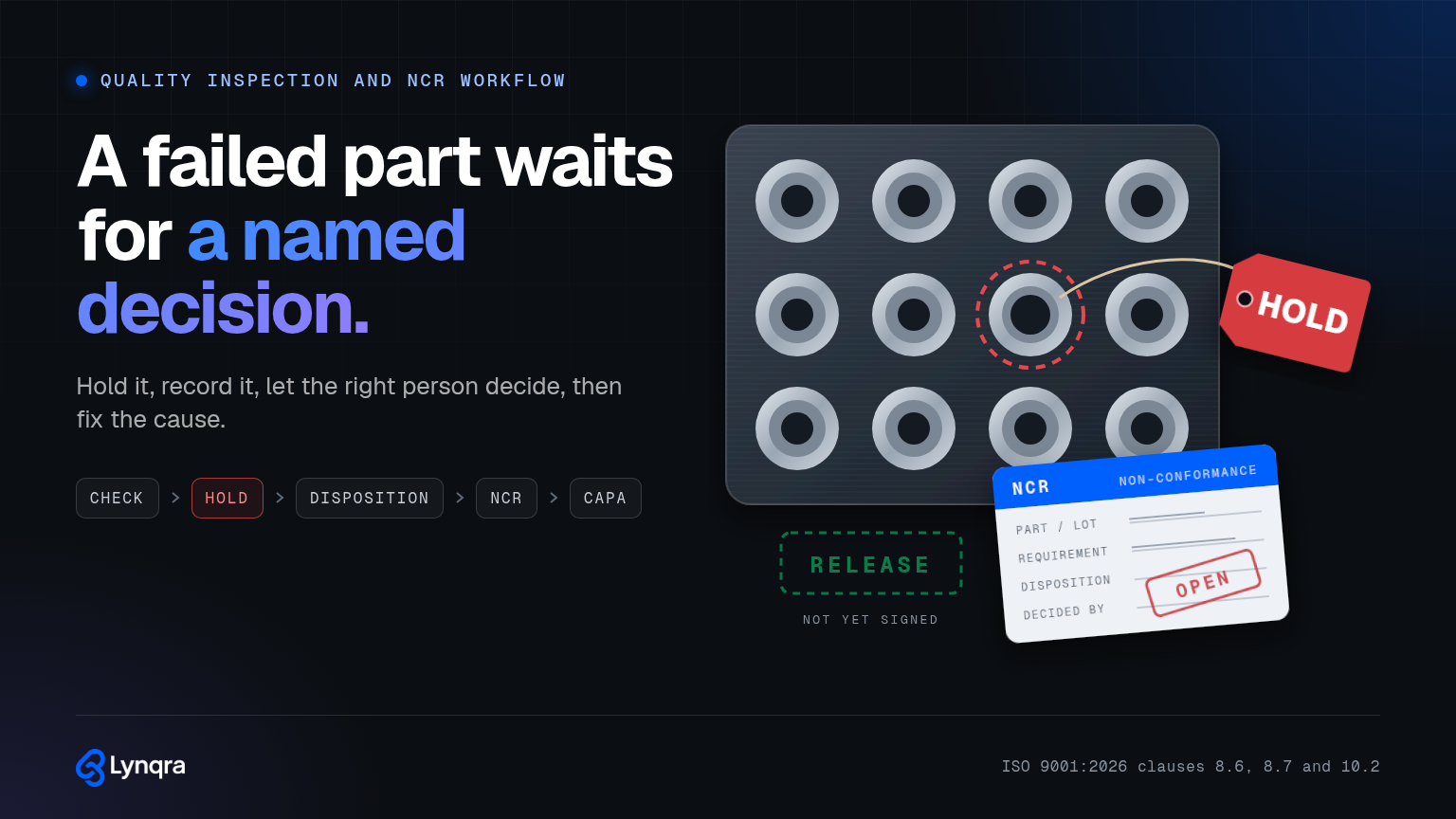
A fail starts a hold straight away. Tag the parts with a red HOLD tag that carries the job or lot number, the date and the inspector's name, and move them to a marked quarantine shelf or cage. In the ERP or stock sheet, put the lot on hold so nobody picks, issues or ships it. Physical tags and system status should match.
Then ask where else the problem might be. Are there more parts from the same lot in WIP, in finished goods, or already on a truck? Did the same machine, operator, program or material heat make other jobs this week? Containment is part of 8.7, and it is easy to skip when the customer is waiting.
3. Open the NCR with one owner
Open an NCR for each nonconformity, with an ID and one owner. The owner is usually QA, and their job is to get the NCR to a decision. Other people make most of the decisions on it. Record:
- NCR number, date found and who found it
- Part number, revision, job or lot number, quantity checked and quantity failed
- Where it was found: incoming, in-process, final, or a customer complaint
- The requirement that was not met, quoted from the drawing, spec or PO
- What was found, with measurements and photos
- Containment done, and where the held parts are
- Supplier or internal source, if known
Keep one NCR log, a sheet or a register in your QMS, with a status on every row: Open, Contained, Awaiting disposition, Disposition approved, In rework, Awaiting customer, Closed. Photos and measurement sheets go in a folder named by NCR number, so the evidence survives the bench being cleared.
4. Get a named disposition from someone with the authority
The disposition says what happens to the held parts. Use a short fixed list and decide in advance who may approve each option:
- Use as is. The part does not meet the drawing but is judged fit for use. On your own design, engineering or QA approves with a written reason. On a customer's design, raise a concession request and wait for the customer's written answer. Parts stay on hold until it arrives.
- Rework. Bring the part back to the drawing through a defined operation. Rework needs an instruction, a job reference and a fresh inspection against the original requirement before release.
- Repair. The part will still not fully meet the drawing after the fix. Treat it like use as is after a correction: it needs the same approval and, on customer designs, a concession.
- Scrap. Record the quantity and the reason. Finance needs to know, because it is a stock write-off, and the stock variance desk should see the NCR number instead of treating the gap as a counting error.
- Return to supplier. For bought-in parts or material that failed incoming inspection. Purchasing raises the return with the supplier, the NCR travels with it, and any replacement goes back through incoming inspection.
Every disposition records who decided, when, and on what evidence. If the customer has to be told, record who told them and what they said. If a disposition is given verbally on the floor, write it on the NCR before anyone acts on it.
5. Decide on corrective action, then chase it
Once the parts are dealt with, the NCR owner asks the 10.2 question: does the cause need action? A one off caused by a damaged gauge might not. A repeat on the same feature, a supplier with a second rejection this quarter, or anything a customer found always should. Write the decision down either way.
If corrective action is needed, open it with its own owner and due date and link it to the NCR number. The owner works out the cause with the people closest to it, checks whether the same cause affects other parts, lines or suppliers, and puts the fix in place: a program change, a fixture, a revised work instruction, a training record, a supplier corrective action request. Then set a check. Decide in advance what evidence will show the fix worked, such as the next few lots passing on that feature, and who reviews it.
Closing a corrective action with "operator retrained" and no cause is a common audit finding, so the review step needs a real owner.
6. Close the NCR and release what was held
The NCR closes when the disposition is done (parts reworked and re-inspected, scrapped and written off, returned and credited, or accepted with the approval on file) and the corrective action question has an answer. Release held parts through the same release rule as any other lot, with a name on it. Take the hold off in the ERP and remove the physical tag in the same step.
Once a month, the QA lead reviews the NCR log: open items by age, repeats by part and supplier, and corrective actions past due. It is also the record your management review and your next surveillance audit will ask for.
Where NCRs meet receiving, purchasing, stock and customer returns
An NCR touches other desks, and each one keeps its own decision.
Receiving owns the goods receipt. If incoming inspection fails a lot that arrived complete, the GRN stays accurate for quantity received, and the hold status stops the lot being used.
Accounts payable should not pay a supplier in full for parts on hold or returned. Put the NCR number on the invoice hold, so the three-way match exception desk can see why the receipt and invoice will not clear until purchasing agrees a credit or replacement.
Stores and finance need scrap quantities with NCR numbers, so write-offs trace back to a quality decision.
When a customer sends parts back, the customer returns (RMA) workflow handles the return and any credit. The quality complaint opens an NCR of its own, and the customer's corrective action request is answered from the same record.
Where NCR workflows go wrong in small plants
The tag and the system disagree. The parts are tagged on the shelf, but the ERP still shows the lot as available, so it gets picked. Put the hold on in both places in the same step.
Containment stops at the bench. The failed parts are held, but nobody checks finished goods or the delivery that left yesterday. Make "where else is this lot?" a required field on the NCR.
Use as is without a name. A supervisor accepts a deviation to keep a job moving, and the NCR says "UAI" with no approver or reason. For customer designs, it also means a concession nobody asked for.
Rework without re-inspection. The part goes back to the machine and then straight to packing. Corrected parts need to be checked again against the original requirement.
Supplier returns lose the paper. Purchasing sends the parts back, but the supplier never sees the NCR, the replacement skips incoming inspection, and the invoice is paid in full.
Corrective actions that never close. The CAPA list grows, due dates slip, and the effectiveness check is a tick. One owner per action and a monthly review fix most of it.
Where a custom agent helps
Once the manual workflow is written down, much of the work is reading results, filling forms, chasing people and keeping records linked. That is work an AI agent can carry inside your existing systems, and in the way we design these builds the agent keeps the paperwork moving while named people make every quality decision.
Drafting the NCR from the fail. When an inspection record, a CMM report or an inspector's photo comes in with a fail, the agent drafts the NCR in your format: part, revision, job, lot, quantity, the requirement quoted from the drawing or PO, and the measured value. It suggests the hold and lists other open jobs from the same lot, machine or material heat for QA to check. The inspector confirms the draft before it becomes the record.
Keeping hold status in step. The agent checks that every open NCR has a hold in the ERP and a quarantine location, and flags any lot that is on hold in one place and free in the other. It does not lift a hold.
Routing the disposition. It sends the NCR to the person allowed to decide that kind of disposition, with the evidence attached, and records the answer with a name and time. For a customer design, it drafts the concession request for your QA to review and send. It never chooses use as is, rework, scrap or return, and it does not contact a customer or supplier on its own.
Return to supplier, prepared and stopped. For an incoming reject, the agent assembles the return pack (NCR, photos, measurements, PO and GRN references) and a draft message to the supplier, then waits. Purchasing reviews and sends it. The agent then puts the NCR number on the supplier's invoice hold and watches for the replacement delivery so it goes back through incoming inspection.
Chasing corrective actions to closure. The agent tracks every open corrective action against its due date, reminds the owner, escalates once to the QA lead when it slips, and prepares the effectiveness check when the evidence period ends. A person reviews and closes it. Each month it drafts the NCR summary by part, supplier and age for the QA lead.
What the agent never does. It does not release parts, accept a deviation, sign a certificate of conformance, approve a scrap write-off or close an NCR. Those stay with the people your procedure names.
Some plants are better served by a QMS or the quality module in their ERP, and if yours matches how you work, use it. Firms usually come to us when they have a system, but inspection results and supplier certs still arrive as PDFs, photos and emails that someone retypes, and the chasing lives in one person's inbox. That is the kind of work our precision engineering automation builds cover. Where we build it, we work as a partner to your quality team: we map how NCRs run today, design the agent around your people and approval limits, run it next to the manual process until QA trusts it, and stay on to maintain it as your procedures change.
If you are looking at Enterprise Singapore's Catalytic AI Solutions, the media release of 21 October 2026 lists inspection and quality control among the solution areas for advanced manufacturing, and names the Singapore Manufacturing Federation and SPETA as the trade associations to approach. Our Catalytic AI Solutions guide for manufacturers covers how to prepare for that conversation. Lynqra is not an approved Catalytic AI Solutions provider, so confirm scope and funding with the programme contact.
Before anyone builds it, check a few things. Can QA read and export the NCR log without the agent? Is every disposition, concession and closure logged with a person's name? Can anyone skip the disposition approval? If the agent stops one day, does QA still know which lots are on hold?
Questions manufacturers ask about NCRs
Does ISO 9001 require an NCR form?
No form is prescribed. Clause 8.7 requires retained documented information that describes the nonconformity, the actions taken, any concessions obtained and who decided the action. An NCR form or log is the usual way to keep it, and it is what auditors expect to see.
Who should approve a "use as is" disposition?
Someone your procedure gives that authority, usually engineering or QA, with a written reason. When the drawing or specification is the customer's, use as is means accepting the part under concession, and the customer normally has to approve it in writing before the part ships.
What is the difference between correction and corrective action?
Correction deals with the parts in front of you, such as rework, sorting or scrap. Corrective action removes the cause so it does not happen again. ISO 9001 covers the first in clause 8.7 and the second in clause 10.2, and an NCR can need both.
When do we need to move to ISO 9001:2026?
ISO published the 2026 edition on 16 September 2026. Under the Global ACI transition, new and initial certificates can only be issued to it from 31 March 2028, and organisations certified to ISO 9001:2015 must complete the transition by 30 September 2029. Your certification body will plan the audit with you.
Can an AI agent decide what happens to a nonconforming part?
In the way we build it, no. The agent drafts the NCR, keeps the hold status in step, routes the case to the right approver and chases corrective actions. A named person decides every disposition, every concession request and every return to a supplier.
Related workflows
- Catalytic AI Solutions for manufacturers: preparing an AI problem statement for Enterprise Singapore's programme
- Precision engineering automation: RFQs, travellers, certificate packs and NCRs for job shops
- Goods receipt exceptions: short, damaged and wrong-PO deliveries at receiving
- Three-way match exceptions: holding a supplier invoice while a reject is resolved
- Stock variance and cycle counts: keeping scrap and write-offs traceable
Map your NCR flow with us
If your NCRs live in a spreadsheet that only the QA lead updates, or the last audit turned up a corrective action nobody closed, bring one recent NCR from fail to close. We will map the workflow with you, show where an agent would take over the drafting and chasing, and point out where a person needs to sign. If a log and a monthly review are enough for your size, we will say so.
Sources
- ISO, ISO 9001:2026 Quality management systems: Requirements, standard page, publication 16 September 2026
- ISO, ISO launches update to world's most widely used quality management standard, 16 September 2026
- ISO/TC 176, ISO 9001:2026 has been released, with transition guidance
- Global ACI, Transition requirements for ISO 9001:2026 (TECH-3-TR 2029-09-30), issued 4 September 2026
- Enterprise Singapore, Calls for public comments on Singapore Standards, 2 October 2026
- Singapore Standards eShop, Draft SS ISO 9001:2026
- Singapore Accreditation Council, SAC accredited organisations
- Enterprise Singapore, Catalytic AI Solutions media release, 21 October 2026
- A.P. Lyon, Nonconformity vs corrective action: ISO 9001:2026 clauses 8.7 and 10.2, clause explainer