AR collections and debtor-chase for Singapore SMEs: from overdue invoice to a named escalate
AR collections and debtor-chase for Singapore SMEs: from overdue invoice to a named escalate
Thursday 09:15. Client INV-4482 for job `ACME-04` hit 30 days overdue yesterday. The Sheet still says "follow up." Someone pastes the PDF into the ops Telegram with "chase pls??" and a thumbs-up. The named AR owner who usually decides whether this is a polite reminder, a chase pack with evidence, or HOLD CREDIT on new work, is on MC. By Friday a junior has sent three increasingly sharp emails from a personal Gmail, finance has already written "maybe write-off?" in the Notes column with no signer, and sales is about to ship another order to the same account because nobody flipped a credit flag. Cash is still out. The trail is a Telegram scrollback.
That is the AR collections / debtor-chase exception problem for a Singapore SME. Not a missing "auto-dunning every overdue invoice" feature. Not a twin of the supplier invoice workflow (AP: supplier PDF to named tap pay). Not a twin of the supplier-side credit note / AP adjustment desk. Not a twin of customer returns / RMA AR CREDIT HOLD after goods come back. A lived queue that starts *after* the client invoice already left: overdue invoice to chase pack to named escalate or HOLD CREDIT, that stalls or misfires the week one signer is away, and that still lives in chat.
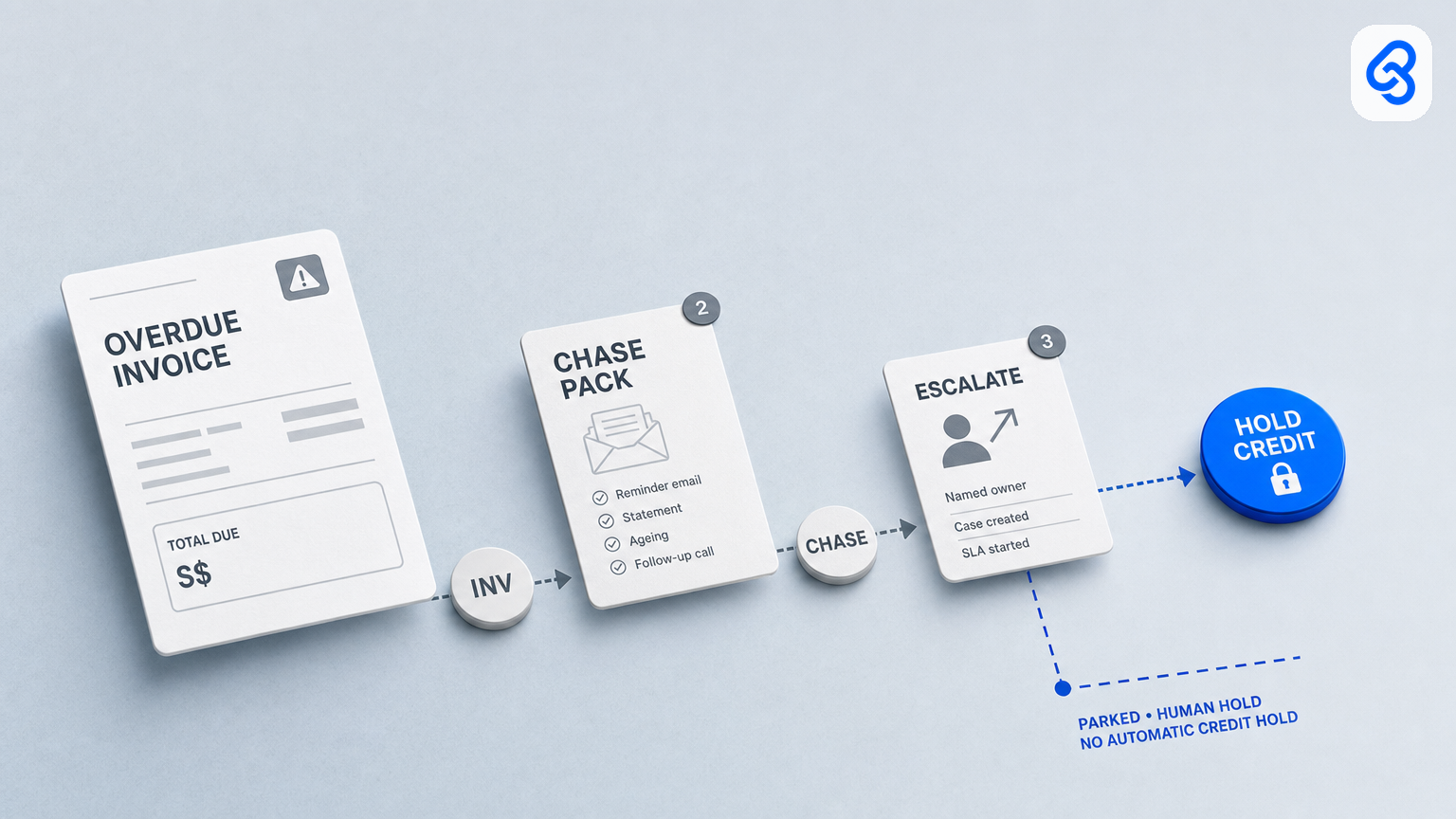
This guide is the operator version of AR collections workflow and debtor-chase exception desk for Singapore SMEs. Named runbook: trigger, extract, route, human gate, tracker. Automation files, flags, and chases. A named AR or ops owner still decides chase, escalate, and HOLD CREDIT. Finance still owns credit notes and write-offs. Nobody silent-holds customer credit because a Sheet aged past Net 30, and nobody auto-sends a legal threat because a Zap saw "OVERDUE." Upstream: the subcon / project billing handoff (billable pack to client invoice) and project variation / change-order (scope signed before bill). Wider frame: workflow automation services. Visitor induction stays parked.
What this guide covers
- What "AR collections / debtor-chase exception automation" means here: chase pack after client INV, not supplier AP pay and not RMA credit
- Why Singapore SME collections culture matters without a news roundup
- A named overdue INV to extract to route to human gate (chase / escalate / HOLD CREDIT) to tracker runbook you can print and mark up
- Who signs chase vs escalate vs HOLD CREDIT vs credit note / write-off
- Trail: billable pack / VO to client INV to AR chase (link siblings; label AP invoice as contrast)
- When Sheets, Gmail/Drive, and Telegram are enough, and when they are not
- Steal-this-build DIY that stops before judgement (no silent auto-hold credit; no silent write-off; no auto-legal threat)
- Failure modes, consult to build to train, and checklists for this week
What AR collections / debtor-chase exception automation means here
Search "AR collections workflow Singapore SME" or "debtor chase exception desk" and you will mostly get global collections SaaS demos, "AI dunning sequence" pitches, or thin local posts that jump to a tool list and a funding footnote. Useful as a sketch. Thin as an operating manual for a trading, agency, construction / fit-out, or IT-services firm that already lives in Gmail, Drive, Sheets, Xero (or QuickBooks / MYOB), and WhatsApp or Telegram, with client invoices that already left, and a named human who still decides whether this overdue is a reminder, a chase pack, a credit hold, or a real escalate.
For an SME operator, AR collections / debtor-chase exception automation is simpler to name:
Automation files overdue invoices and chase packs, extracts aging and evidence fields, flags dispute / promise-to-pay / partial pay / missing PO, and chases incomplete packs. A named AR or ops owner still decides chase, escalate, and HOLD CREDIT. Finance still owns credit notes and write-offs. Nobody silent-holds customer credit because a Sheet said "30 days," a Telegram said "chase harder," or a Zap auto-drafted a legal letter.
Anything that freezes every overdue account because aging crossed a threshold, writes off a balance because Notes said "maybe," or sends a solicitor template because a bot saw OVERDUE is not a productivity win. It is a control failure with a notification sound: relationship damage, or cash already written off while nobody owned the chase row.
Three purchases get confused under the same phrase:
- Software - collections / dunning module, AR aging SaaS, Power Automate reminder chain. Fine when credit policy and chase tiers are already written.
- A service - maps *your* overdue INV to chase pack to named escalate / HOLD CREDIT path in tools you already use, trains AR and ops, stays reachable on leave week.
- A chat habit - paste overdue PDF into a group, chase from personal email, call it "collections." Dies on MC week: wrong tone, silent hold, or write-off from hope.
Buy software if the process is clean. Leave it with a careful human if volume is tiny. Hire a service when the same fields wait every week, the work spans chat + Sheet + ledger, and a wrong chase or silent hold moves customer cash and trust.
Operator definition in one breath: the desk starts when a *client* tax invoice is already issued and aging (or a promise) breaks. It ends when a named human has signed the next move: chase pack, HOLD CREDIT, escalate, or close after pay. Everything between is filing, flagging, and chasing incomplete packs. That is deliberately boring. Boring is how leave week survives.
Not supplier AP twin (once, clearly). The invoice workflow is supplier AP: supplier PDF in, named tap to pay. This chapter is the AR chase desk after *your* client invoice already left. Same ledger possible. Different gate. Supplier PDF pile to pay run: AP chapter. Overdue client INV to chase pack to named escalate: here.
Not AP credit-note twin (once). The credit note / AP adjustment desk is supplier-side HOLD CREDIT after *their* invoice moved. This chapter may end in an AR credit note or write-off, but the queue starts as debtor chase on *your* issued INV, not netting a supplier pay run. Link once for contrast. Do not rebuild.
Not RMA AR CREDIT HOLD twin (once). Customer returns / RMA parks AR credit after goods come back and inspect. This chapter is collections on an overdue issued invoice that may have no return at all. Credit adjacency only. Different trigger.
Not billing-pack twin. Upstream subcon / project billing handoff ends when finance issues the client invoice. This chapter starts when that invoice goes overdue. Same cash loop. Different desk.
Why Singapore SME AR collections context matters (without a news roundup)
You do not automate debtor chase because a press release landed. You automate because "chase pls" lives in Telegram, leave gaps turn aging into silent credit holds (or silent write-offs), and the person who "just knows" whether this client gets a polite reminder or a hard escalate is the same person who goes on MC.
Overdue invoices are a queue that touches cash and relationship. A chase that never opens is delayed cash. A chase that jumps to legal tone without a named escalate is lost trust. A silent HOLD CREDIT with no owner leaves sales shipping into a freeze they cannot see. One loop (client INV issued to overdue to chase pack to named escalate or HOLD CREDIT) most SMEs notice only when month-end aging is ugly or a key account asks "why did you stop supply?"
Trading, agency, construction / fit-out, IT services (light). Many SG SMEs run Net 30 / Net 45 off milestone or T&M invoices that came from a billable pack. You need OrigInv / job / PO on the chase row, named chase tiers, HOLD CREDIT that is not a vibe, and escalate that is not a junior's personal Gmail. Sheets + Xero is enough for most 10 to 80 person firms. Not a collections-suite migration sold as readiness.
WhatsApp and Telegram are the real collections desk. "Chase pls" with a screenshot, no owner, no SLA, and no backup on HOLD CREDIT / escalate is how accounts age into hope, worse when AR is offline and sales still promises Friday delivery.
Promise-to-pay without a row is not a process. Customer says "Friday" in WhatsApp. Nobody writes the date on the chase pack. Friday passes. A junior escalates tone while sales still quotes a new job. Put promise date, owner, and next status on the Sheet the backup can open. Reminder Zaps may ping. They must not invent escalate.
Partial pay needs a reason code, not a shrug. Short remittance with no advice is PARTIAL_PAY on the pack, not "close enough" in Notes. Automation can flag amount open vs amount received. A named human still decides whether to re-chase the short, raise a credit note path (finance-owned), or HOLD CREDIT on new work.
Leave is not an edge case. In a 15 to 40 person firm, AR and ops on AL the same week is normal. If "how hard to chase" lives in their heads, you have people, not a process. Leave cover overlays the chase-signer gate. Link it. Do not re-teach here.
Labour and AI adoption (named surveys only). SBF 2024: manpower top challenge for 66% (n=519). MOM AI report (30 Apr 2026; 2,560 firms): 71.5% yet to adopt; only 3.8% of adopters integrate AI into core processes. IMDA 2025: SME AI 14.5% in 2024 (from 4.2%). Permission to stay practical: one trusted chase-pack runbook with named HOLD CREDIT and escalate owners beats a collections-suite migration sold as readiness.
The named AR collections / debtor-chase exception runbook
Print this. Write real names in the blanks. No owner on a step means you do not have a process yet.
Trigger
- Client invoice overdue: aging crosses Net 30 / Net 45 / custom terms, or promise-to-pay date missed, for an issued AR invoice (not a draft, not a quote).
- Also: partial pay with unexplained short; customer dispute email ("wrong qty / VO not signed / PO missing"); sales flags "they said paid" with no bank match; finance asks "are we still shipping?" before another DO.
- Rule: one intake path. A form, shared mailbox `collections@…`, or aging export that writes one ChasePackID. "Sometimes Telegram chase pls, sometimes junior emails from personal Gmail, sometimes finance invents write-off from Notes" births silent holds, double chases, and legal-tone accidents.
Extract
- Fields: customer, OrigInv#, job / WBS / milestone ID if used, amount open, aging bucket, terms, last chase date, promise-to-pay date, dispute reason code, PO / DO / billable-pack link, exception tier, attachment links (INV PDF, delivery proof, signed VO if relevant, prior chase trail).
- File to company Drive/SharePoint: `YYYY-MM-DD_customer_INV####_CHASE`.
- Flag: missing OrigInv link, blank amount open, no PO when policy requires it, dispute with no evidence pack, partial pay with no remittance advice, related-party / owner account, first escalate on a strategic account.
- Do not DIY "AI decides they are a bad debtor" or invent legal wording from a photo. Flag. A named human judges the chase pack.
Route
- Clean overdue (within band, no dispute, first reminder tier) to named AR / ops queue with one-line summary + file link.
- Exceptions to reason codes: DISPUTE_SCOPE, MISSING_PO, PARTIAL_PAY, PROMISE_BROKEN, RELATED_PARTY, NEEDS_INFO, HOLD_CREDIT, ESCALATE.
- Missing info back to submitter / PM / sales with a fixed reason code, not "pls chase harder."
- Hard exceptions: related-party balances, first legal-tone escalate, write-off above threshold, HOLD CREDIT on a strategic account.
Human gate
- Named AR or ops owner signs CHASE PACK (or HOLD CREDIT / escalate / return / close). The Zap does not. A Telegram "chase pls" is not Chase signed.
- Clean first reminders still need that tap for year one. Write what each tier means beside the Sheet (T1 polite reminder, T2 chase pack with evidence, T3 named escalate).
- HOLD CREDIT is a named tap, not an aging formula. Automation may flag "aging past band + open new SO." It does not silent-freeze the account.
- Escalate is a named tap. Automation may assemble the pack and chase the signer. It does not auto-send solicitor templates or threat language.
- Credit notes and write-offs stay finance-owned (often with director above a threshold). Automation may remind and escalate. It does not invent write-off from a Notes column.
- Sales may request unlock. Sales does not silent-clear HOLD CREDIT alone. Write that beside the Sheet once, before the first awkward Friday ship.
Authority bands belong on paper the backup can read: routine T1/T2 chase yes under backup limits; HOLD CREDIT on strategic accounts, first legal-tone escalate, and write-off above threshold still need primary or director. If the band is only in someone's head, leave week will invent it.
Tracker
- Sheet, mailbox labels, or review screen the backup can open without the primary's phone.
- Columns: ChasePackID, Customer, OrigInv#, AmountOpen, AgingBucket, Owner, Backup, SLADue, Exception, FileLink, ChaseSigned?, HoldCredit?, Escalated?, CreditNoteOrWriteOff?, Notes.
- Statuses: Overdue / Needs info / Chase ready / Exception / HOLD CREDIT / Chase signed / Escalated / Promise to pay / Paid / On hold / Write-off (named sign only) / Closed.
Worked example (one invoice, one Thursday)
INV-4482 for job `ACME-04` ages past Net 30. Upstream billable pack and client INV came from the subcon / project billing handoff path; a late scope tweak had already cleared VO / change-order. Workflow opens ChasePack-31, flags DISPUTE_SCOPE (customer email: "VO line not what we signed"), status stays off silent HOLD CREDIT. AR lead Mei is on MC. Backup Wei opens the same company queue, not Mei's personal Telegram, same SLA before Friday's aging cut. Wei returns the pack to PM for VO evidence, keeps sales shipping unlocked until a named HOLD CREDIT exists, and does not draft legal tone. Friday: Mei back, signs CHASE PACK T2 with evidence, still no HOLD CREDIT (dispute in flight). Nobody treated "chase pls" as escalate authority. Nobody silent-held credit because aging said 31. Nobody auto-wrote off from Notes.
That shape (trigger, extract, route, human gate, tracker) is what you buy as a service. If a partner cannot walk it in those five words, they are selling a stack.
Who signs chase vs escalate vs HOLD CREDIT vs credit note / write-off
Segregation is the point. Collapse it and you get either silent freezes or junior legal tone.
| Decision | Who signs (example titles) | Automation may… | Automation must not… |
| --- | --- | --- | --- |
| Chase pack (T1/T2) | Named AR or ops | File pack, flag aging, chase signer | Send chase as if signed |
| HOLD CREDIT | Named AR / credit controller (or director above band) | Flag open SO + overdue | Silent-freeze account from aging alone |
| Escalate (T3 / legal tone) | Named AR + director / owner per policy | Assemble pack, remind | Auto-send solicitor / threat templates |
| Credit note on AR | Finance / AR (policy band) | Remind, link OrigInv | Invent CN from chase Notes |
| Write-off | Finance + director above threshold | Escalate unsigned write-offs | Silent write-off from aging |
Write primary and backup names next to each row. If HOLD CREDIT and write-off are the same mute Telegram group, you do not have segregation. You have hope.
A practical test: pick last month's three ugliest overdues. For each, can you name who signed the chase tier, who (if anyone) tapped HOLD CREDIT, and who owned any credit note or write-off? If the answer is "it was in the group," the desk is still a chat habit. Fix names before you buy a dunning module.
Trail: billable pack and VO to client INV to AR chase (link siblings)
Keep the cash loop honest without rebuilding siblings.
1. Scope before bill. Extras that should have been a signed VO live on project variation / change-order. Unapproved scope that reaches INV becomes a DISPUTE_SCOPE chase here.
2. Billable pack to client INV. Hours / milestone to pack to finance issue: subcon / project billing handoff. This chapter assumes the INV already left.
3. AR chase desk (this page). Overdue INV to chase pack to named escalate / HOLD CREDIT.
4. Supplier AP contrast (label clearly). Paying *suppliers* is invoice workflow, the AP pay desk. Do not confuse with chasing *customers*.
5. Optional light adjacency. Returns-driven AR credit: RMA. Supplier CN: AP credit-note (one contrast only).
6. Wider frame. Workflow automation services.
Related runbooks
- Subcon / project billing handoff (upstream pack to client INV)
- Project variation / change-order (scope before bill)
- Workflow automation services
- Invoice workflow (supplier AP contrast, not this AR chase)
- Leave cover (overlay on the chase-signer gate)
When Sheets, Gmail/Drive, and Telegram are enough
Enough for most 10 to 80 person firms when:
- Volume is tens to low hundreds of open AR invoices, not thousands of consumer micro-debts.
- One shared Drive folder + one Sheet tracker + labeled Gmail can be opened by the backup without the primary's phone.
- Chase tiers and HOLD CREDIT / escalate authority are written in plain language beside the Sheet.
- Telegram is for chase *alerts*, not the system of record. The pack file and tracker row are.
Not enough when:
- You need multi-entity aging with complex credit insurance rules on day one.
- Consumer-scale dunning (hundreds of small B2C debts) with regulated templates.
- Leadership wants "AI legal letters" with no named escalate. That is a policy problem, not a Sheet problem.
If the failure is "nobody owned HOLD CREDIT on leave week," a collections suite will not fix ownership. Fix the runbook first. Then decide if software helps.
Telegram stays useful as a chase *alert* channel: "ChasePack-31 SLA in 4 hours, owner Wei." It fails as the pack itself. Screenshots of INV PDFs in a group are not evidence filed to company Drive. Thumbs-up is not Chase signed. Write that once. Train it twice on leave week.
Steal-this-build DIY that stops before judgement
Build the plumbing. Stop before the judgement taps.
Do build
- Shared intake: aging export or `collections@` that creates ChasePackID + Drive folder path.
- Extract columns listed above; flag missing OrigInv / PO / dispute evidence.
- Reminder Zaps to Owner and Backup on SLADue. Escalate unsigned packs to a named manager once, then stop.
- Status board the backup can filter: Overdue, HOLD CREDIT, Escalated, Promise to pay.
- Parallel-run beside Telegram for two aging cycles before you trust it.
- Template library for T1/T2 language that a named signer still sends (or explicitly releases). Store templates in company Drive, not in a junior's drafts folder.
- Simple dashboard the backup trusts: count of open chase packs by aging bucket, unsigned HOLD CREDIT flags, escalate waiting on director.
Do not build (year one hard stops)
- Silent auto HOLD CREDIT when aging crosses Net 30.
- Silent write-off when Notes contains "maybe" or days-overdue exceeds N.
- Auto-send of solicitor, "final notice," or threat language from a template without a named escalate tap.
- Junior personal Gmail as the only chase channel (no company trail).
- Collapsing HOLD CREDIT into "Paid" or "Closed" in one column.
- Pasting full customer email threads into a public model to "draft legal." Keep packs in company tenancy.
DIY that files and chases is useful. DIY that judges credit hold, write-off, or legal tone is how you buy a relationship problem with a notification sound.
Failure modes (and the hard stops)
Silent HOLD CREDIT from aging. Sales cannot see why supply stopped. Customer hears "credit issue" from a courier, not from AR. Flag aging + open SO; a named human still taps HOLD CREDIT.
Auto-legal tone. A Zap that sends "we will commence proceedings" because OVERDUE flipped is not automation maturity. It is unmanaged escalate. Assemble the pack. Named tap only.
Silent write-off. Notes column "maybe write-off" is not a signature. Finance + director band stays. Automation reminds. It does not post.
Chase from personal email / chat as system of record. Five people saw the screenshot. Nobody owned the VOID. Audit answer is a name and timestamp, not "it was in the ops group."
No backup. Primary on MC, queue in their phone, SLA "when they're back," sales still promises Friday. Hope is not a process. Someone will either under-chase or over-threaten.
Finance invents chase. Finance sees aging and "helps" by writing off or holding credit from memory. Write the rule: AR/ops owns chase and HOLD CREDIT taps; finance owns CN / write-off; sales does not unlock HOLD CREDIT alone.
Wrong-chapter collapse. Do not rehash supplier AP pay, AP credit-note, or RMA inspect here. Visitor induction stays parked. Link siblings. Do not twin them.
Double chase / ghost escalate. Two juniors chase the same INV from personal Gmail while the Sheet still says "follow up." Or a Zap sends T3 language while Wei already promised a call. One ChasePackID, one owner, one status. Duplicate intake is how customers get angry and how your own trail lies.
Upstream INV quality blamed on collections. If disputes are mostly unsigned VO or wrong billable pack lines, fix project variation / change-order and subcon / project billing handoff first. Collections cannot collect a broken invoice into trust.
Hard stops: no silent auto-hold credit, no silent write-off, no auto-legal threat, one escalation then stop, human chase / HOLD CREDIT / escalate gates, finance owns CN and write-off, backup limits written, chase packs in company tenancy.
Consult to build to train (lightly)
You do not need a 40-slide methodology. Three honest phases:
Consult. Map one live overdue INV to chase pack to named escalate / HOLD CREDIT handoff. Count volume, dispute frequency, who signs, who may hold credit, leave cover, aging-cut clocks. Leave with a yes/no and a scoped runbook, not a collections module in search of a problem.
Build. One workflow in tools you already use. Parallel-run beside Telegram. Chase signed, HOLD CREDIT, and Escalated stay behind named taps. Silent auto-hold and auto-legal stay off from day one.
Train. Owners and backups explain every exception without the builder on the call. Smoke-test: primary offline; backup clears three real chase packs alone under written limits before a real aging cut. Expand after trust. Leave cover as overlay. Upstream billing handoff if INV quality is the real pain. VO if disputes are mostly unsigned scope. Stay off full collections-suite theatre.
That is partner work. The product is a runbook that still works when AR is on MC, and aging still cannot silent-hold credit or auto-threaten a customer.
If the consult discovers that most "overdue" rows are actually unsigned scope or wrong hours on the client INV, say so early. Point upstream. Do not sell a chase desk as a cure for a billing-pack failure. Honest sequencing is part of the service.
Practical checklists
This week (no new software)
- Draw trigger to extract to route to human gate to tracker for CHASE PACK and HOLD CREDIT and escalate.
- Write primary/backup, SLA before aging cut, authority bands, backup limits.
- One shared intake (`collections@` or aging form); company Drive + one-tab Sheet shared with backup.
- Separate columns: ChaseSigned vs HoldCredit vs Escalated vs WriteOff. No collapse.
- Rule: no silent auto-hold credit; no silent write-off; no auto-legal threat.
- Mark three recent painful overdues with the exception reason each would have carried.
- Fill leave-cover blanks for this gate once.
Before you buy anything
- Can they walk *your* overdue to chase pack to named escalate / HOLD CREDIT runbook without a product slide?
- Where do chase packs live, and who opens HOLD CREDIT / escalate on leave week?
- What is never auto-marked HOLD CREDIT and never auto-sent as legal tone?
- Gmail/Sheets/Drive first, or a new collections suite? Who trains the backup?
- First conversation: your queue, not a funding tour.
Red flags in a demo
- "Touchless collections" / auto-hold under threshold with no exception taxonomy.
- No named signer; leave cover as a later toggle; group chat as system of record.
- Silent HOLD CREDIT or auto-legal letter in week one; "AI drafts solicitor letters" without a human escalate gate.
- One column collapsing HOLD CREDIT into Closed or Paid.
- DIY that pastes customer threads into a public model; confuses this with supplier AP pay, AP credit-note, or RMA AR CREDIT HOLD.
- Parallel-run / smoke-test discouraged because it "slows go-live."
Soft next step
If "chase pls" stalls in Telegram when AR is on MC, or aging silent-holds credit (or jumps to legal tone) without a named tap, bring one real week of that queue to a free consult. We will map the runbook, name who chases and who may HOLD CREDIT or escalate, keep write-offs behind finance, and say whether Sheets and Drive can carry it. No platform tour first. No invented case-study numbers.
Sources
- SBF 2024; MOM AI (30 Apr 2026); IMDA 2025 (figures cited in body)
- Required peers: subcon / project billing handoff, project variation / change-order, workflow automation services
- AP contrast (label clearly): invoice workflow (supplier AP pay desk, not this AR chase)
- Optional light adjacency: customer returns / RMA; credit note / AP adjustment (one AP twin contrast only)
- Overlay: leave cover