Supplier onboarding paperwork for Singapore SMEs: who owns bank-change when AP is on MC
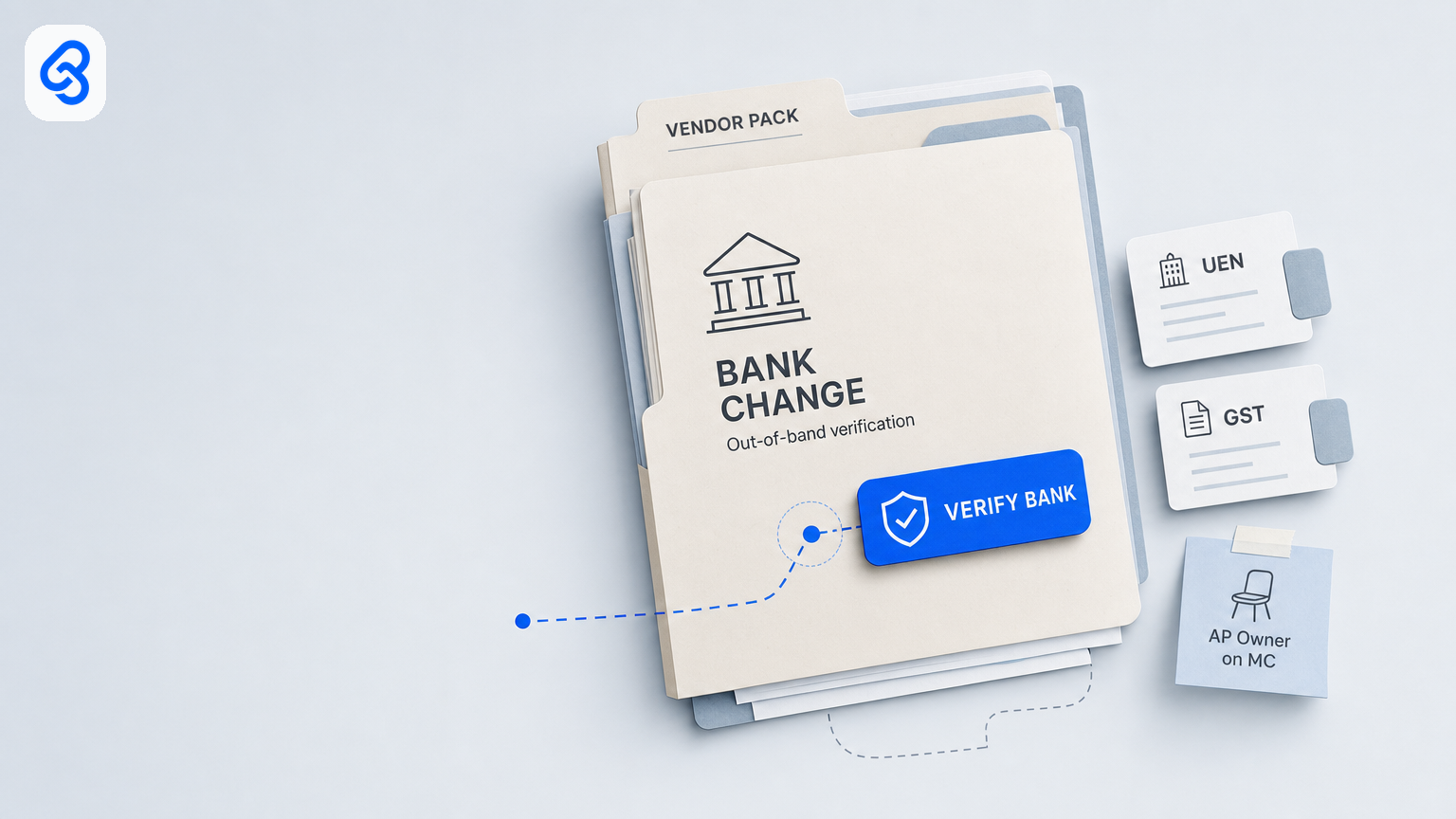
Supplier onboarding paperwork for Singapore SMEs: who owns bank-change when AP is on MC
A new vendor WhatsApps Tuesday afternoon — ACRA extract photo, GST registration PDF, and a bank-slip screenshot under fluorescent warehouse light. “Pls onboard so we can invoice.” Three thumbs-up in the AP Telegram. Nobody owns the row. The finance coordinator who usually verifies bank out-of-band and signs the vendor pack complete is on MC. By Friday the first tax invoice is already in Xero against a half-built vendor master — and the pay-run hits an account nobody ever called to confirm. Cash left. The paperwork lived in one person’s phone.
That is the supplier / vendor onboarding paperwork problem for a Singapore SME. Not a missing AP-suite “vendor portal” feature. Not a missing AI that “auto-approves every new supplier.” A lived queue — collect vendor docs, UEN, GST status, bank details → file in company tenancy → route bank-change and incomplete packs → named AP or ops owner signs vendor pack complete and verifies bank before first pay — that fails the week one named owner is away, and that still lives in chat because chat is where the firm actually works.
This guide is the operator version of supplier onboarding paperwork automation for Singapore SMEs. Named runbook: trigger, extract, route, human gate, tracker. Automation files, flags, and chases. A named AP or ops owner still signs the vendor pack. A named human still verifies bank-change — out-of-band, not “reply to the invoice email.” It sits on the money trail beside invoice workflow and lightly beside expense claims. Optionally upstream of quote-to-PO, delivery order, and GRN exception when they ship before you pay. Not a twin of the employee hire-pack pillar — people sibling, different queue. Not a “touchless vendor” tip that silently pushes bank details into Xero.
Wider frame: workflow automation services. Leave overlay only: leave cover. Timesheet / OT stays parked. This piece stays on who owns bank-change when AP is on MC.
What this guide covers
- What “supplier / vendor onboarding paperwork automation” means for a 10–80 person firm here — AP/ops tenancy, not the hire pack
- Why Singapore SME UEN / GST / bank-fraud reality matter without a news roundup or funding theatre
- A named vendor-docs → bank verify → pack signed → pay-ready runbook you can print and mark up
- Who signs vendor pack complete vs who verifies bank-change (segregation)
- PDPA for vendor contact and personal data on forms — lighter than NRIC chapters, still real
- When Sheets, Gmail/Drive, and Telegram are enough — and when they are not
- Steal-this-build DIY that stops before judgement (no silent bank push to Xero / pay-run, no auto-approve new vendor for first pay)
- Failure modes, consult → build → train, and checklists for this week
What supplier / vendor onboarding paperwork automation means here
Search “supplier onboarding automation Singapore” or “vendor bank change workflow SME” and you will mostly get global AP / P2P demos, vendor-portal screenshots, or thin local posts that jump to a tool list and a funding footnote. Useful as a sketch. Thin as an operating manual for a trading, logistics, construction, wholesale, or professional-services firm that already lives in Gmail, Drive, Sheets, Xero (or QuickBooks / MYOB), and WhatsApp or Telegram — with one AP or ops person still holding the week’s new-vendor packs and bank-slip photos.
For an SME operator, supplier onboarding paperwork automation is simpler to name:
Automation files vendor docs, flags missing UEN / GST / bank, and chases incomplete packs. A named AP or ops owner still signs the vendor pack complete. A named human still verifies bank-change out-of-band. Nobody auto-approves a new vendor for first pay because a Sheet said “ok,” and nobody silent-pushes a bank slip into the payee master.
Anything that marks a vendor “active” because three PDFs arrived and a bot saw “ok” in Telegram, or updates the payee from whatever is printed on this week’s invoice, is not a productivity win. It is a control failure with a notification sound — and the first payment already on the wire.
Three purchases get confused under the same phrase:
- Software — an AP vendor module, a procurement portal, a Power Automate template. Fine when your checklist is already written.
- A service — someone maps *your* new-vendor → docs → bank verify → pack signed → first-pay-ready path, builds in tools you already use, trains AP/ops and backup, and stays reachable on leave week.
- A browser tab / chat habit — someone pastes bank-slip screenshots into ChatGPT, copies fields into a personal Sheet, forwards “pls onboard” into a group, and calls it adoption. It dies on MC week — and contact data may already sit in public chat history.
Buy software if the process is clean. Leave it with a careful human if volume is tiny. Hire a service when the same fields wait every month and a wrong “active” moves cash to the wrong account.
People sibling, different queue — once. The employee onboarding paperwork runbook is the hire-pack chapter for *people*. Open it when HR owns the stall. This chapter is AP/ops tenancy for *suppliers*: UEN, GST, vendor bank, first pay. Same runbook shape. Different documents, signer, and fraud surface. Do not twin the hire pack — and do not rehash NRIC / Day-One here.
Why Singapore SME supplier onboarding context matters (without a news roundup)
You do not automate vendor packs because a press release landed. You automate because bank slips stall in Telegram, leave gaps turn “verify before first pay” into “we already paid,” and the person who “just knows” which WhatsApp number is the real accounts contact is the same person who goes on MC.
Vendor pack is a queue that touches cash. An unverified bank slip is a first payment to hope. A UEN only in a personal Drive is an IRAS / GST argument later. A sole-prop mobile in a twelve-person chat is a PDPA problem before it is an ops problem. One loop — docs in → pack signed → bank verified → pay-ready on the invoice leg — most SMEs only notice when the wire already left.
Bank-change fraud is not theatre — keep it light. AP still sees new bank details on the PDF, lookalike-domain slips, and “boss said pay this account” in the same week. Hard stop: new vendor and bank-detail change never go quiet into Xero or the pay-run. Out-of-band verify (call a number you already trust). Named human taps Bank verified. That is the spine — beside the invoice pillar’s new-bank hard stop, not instead of it.
UEN and GST are context, not a compliance essay. Collect what your books need. Flag missing / inconsistent. Do not DIY “AI decides GST is valid enough to auto-activate.” InvoiceNow lives on the invoice chapter; this chapter needs vendor fields clean enough that first pay is not a shrug.
WhatsApp and Telegram are the real vendor desk. Packs are lost in a group thread with no owner, no SLA, and no backup who can open Bank verify on a laptop. Another “gentle reminder” without a named owner is louder stalling — worse when AP is offline.
Leave is not an edge case. In a 15–40 person firm, AP and ops on AL the same week is normal. If the pack and “the real bank check” live in their heads, you have people, not a process. The leave-cover runbook is the overlay, not an FAQ here.
Labour and AI adoption (named surveys only). SBF National Business Survey 2024: manpower cost top challenge for 66% (n=519). MOM firm-level AI report (30 April 2026; 2,560 firms): 71.5% yet to adopt; only 3.8% integrating AI into core processes. IMDA Digital Economy Report 2025: SME AI 14.5% in 2024 (from 4.2%). Permission to stay practical: one trusted vendor-pack + bank-verify runbook beats an AP-suite migration sold as readiness.
The named supplier onboarding paperwork workflow runbook
Print this. Write real names in the blanks. If a step has no owner, you do not have a process yet.
Trigger
- New supplier / vendor request (buyer note, director intro, “we need them on the PO,” or first invoice from an unknown payee) into one intake — `vendors@…`, Drive drop, or form that writes a tracker row.
- Also: bank-detail change request; AP flags incomplete UEN / GST / bank before first pay; purchasing asks “is this vendor active?” before quote-to-PO.
- Rule: one intake path. “Sometimes Telegram photo, sometimes the director’s personal email, sometimes AP invents the vendor from the invoice” births wrong accounts and double masters.
Extract
- Fields: legal / trading name, UEN, GST registered? (Y/N / unknown), pay contacts, bank name / account name / account number (masked in chat), payee name match flag, exception tier, attachment links (ACRA / biz file, GST cert if collected, bank slip, vendor form if used).
- File to company Drive/SharePoint: `YYYY-MM-DD_vendorname_vendorpack`.
- Flag: missing UEN, blank / unreadable bank, payee ≠ legal name, bank-change with no prior master, duplicate suspect, GST claimed with no evidence when policy requires it.
- Do not DIY “AI validates the bank account” or auto-risk-score approve. Flag missing / changed. A named human judges pack complete and bank verified.
Route
- Clean pack (docs present, no bank change vs known master) → Ready for human sign-off with one-line summary + folder link.
- Incomplete → named AP/ops owner with reason codes: MISSING_UEN, MISSING_BANK, UNREADABLE_SLIP, GST_UNCLEAR, DUPLICATE_SUSPECT, NEEDS_INFO.
- Bank-change or first-time bank → hard Bank verify queue — never the same mute path as “docs arrived.”
- Missing info → back to vendor (or buyer) with a fixed reason code — not “pls resend.”
Human gate
- Named AP or ops owner signs Vendor pack complete (or returns / holds). The Zap does not. The model does not.
- Named human verifies bank-change / first bank out-of-band (phone a known number, callback from your master contact, director confirm for high value — write the method). Telegram thumbs-up is not Bank verified.
- Clean packs still need that tap for year one — write what “complete” means beside the Sheet.
- First pay stays on the invoice runbook — do not collapse pack OK, bank verified, and tap pay into one mute group. Pay: invoice workflow. Goods first: DO → GRN.
- Automation may remind, escalate to backup. It does not invent a complete pack, silent-push bank details into Xero, or auto-approve a new vendor for first pay.
Tracker
- Sheet, mailbox labels, or review screen the backup can open without the primary’s phone.
- Columns: status, vendor name, UEN, Owner, Backup, SLADue, Exception, FolderLink, PackSigned?, BankVerified?, FirstPayReady?, Notes.
- Statuses: New / Docs requested / Needs info / Pack in review / Bank verify / Exception / Pack signed / Bank verified / First-pay ready / On hold / Rejected / Duplicate.
Worked example (one vendor, one Tuesday)
Buyer confirms Harbour Supplies for next week into `vendors@`. Workflow creates `2026-09-14_harboursupplies_vendorpack`, writes a row, sends the checklist. ACRA + GST return; bank slip is dark → Needs info / “unreadable slip.” Mei (AP/ops) is on MC. Backup Wei opens the same Exception queue, same SLA, sends the fixed reason code. Clear slip Thursday → Bank verify. Wei calls the accounts number on Harbour’s letterhead — not the WhatsApp that sent the slip — confirms account name and number, taps Bank verified by 16:00 under written limit (routine local yes; related-party / overseas / high first-pay still need primary or director). Friday: Pack signed + Bank verified → First-pay ready. Nobody auto-activated Harbour in Xero because three files existed. Nobody pasted the full account number into a public model.
That shape — trigger, extract, route, human gate, tracker — is what you buy as a service. If a partner cannot walk your process in those five words, they are selling a stack.
Who signs vendor pack vs who verifies bank-change (segregation)
Write the names before anyone mentions models or Zaps.
- AP / ops owner (pack signer): opens Needs info / Pack in review / Exception, confirms the written “complete” list, taps Pack signed or return within SLA.
- Bank verifier (same human or second pair — write which): owns Bank verify; out-of-band check; taps Bank verified. Above a written first-pay threshold, many SMEs want a second name even on quiet dual-role weeks.
- Buyer / purchasing (optional): commercial need / related-party disclosure — not bank authority.
- Finance owner on pay: First-pay ready handoff on the invoice leg — not bank truth from Telegram.
- Automation: labels, files, flags, pings, escalates. Does not sign, verify bank, or push payee accounts.
- “AP group”: not a signer. Five people who “usually look” is how a wrong account becomes a paid invoice.
Segregation matters: the person who chased the bank slip should not also be the only person who marks Bank verified and taps first pay with no log. Tiny firms can dual-role on quiet weeks — write the dual role, the backup, and the threshold for a second pair of eyes.
Leave cover stays light: name primary/backup for Pack signed and Bank verify; leave cover for full design. Backup limits: routine missing-doc chase and Pack signed yes; bank-change and first pay above S$X still need primary or director on leave weeks.
PDPA for vendor contact / personal data (lighter than NRIC — still real)
Vendor packs are mostly business documents. They still carry personal data more often than operators admit: contact names, mobile numbers, personal emails for sole props, home addresses on older letterheads, sometimes NRIC fragments on outdated forms, and bank account names that are individuals.
Treat it carefully — lighter than the hire-pack NRIC chapter, not optional:
- Company tenancy. Workspace / Microsoft 365 Drive or SharePoint — not personal Drive, public ChatGPT, or a Telegram export.
- Need-to-have fields only. Legal name, UEN, GST status, pay contacts, bank fields — not a marketing list.
- Limit the queue. Named AP/ops, backup, bank verifier, finance for First-pay ready — not a twelve-person chat.
- Mask in chat. Pings carry vendor name + folder link + exception code — not full account numbers.
- Light log; retain with a reason. Who opened Bank verify is enough. Do not park every blurry slip in a personal folder forever.
- Processors. If a tool reads bank slips, know where files go and whether they train a public model. A shrug means do not paste live bank docs there.
PDPA in plain English: the vendor pack stays yours; only people who need it see mobiles and bank slips. Leave week does not widen the audience. Staff-side adjacency: expense claims — different queue, same tenancy instinct.
Sheets, Gmail/Drive, and Telegram vs dumping a new AP suite
Most Singapore SMEs already have an inbox, a Sheet, a chat app, Drive, and accounting software. The failure mode is not “we lack software.” It is “nobody can see which vendor pack is waiting, whether bank was verified out-of-band, who must sign complete, and whether first pay is allowed.”
Stay on Sheets + Gmail/Drive + Telegram + Xero (or current books) when: volume is low tens of new vendors a year plus occasional bank changes; one AP/ops owner and backup can clear Pack signed / Bank verify in a sitting; exceptions are the hard part; you can name primary and backup today; first pay stays on the invoice runbook.
Consider a dedicated AP / vendor module when a consult shows Sheets cannot carry it — multi-entity masters, auditors needing a productised trail, or bank APIs your Sheet cannot feed safely. Prefer a queue that feeds books you already trust.
Partner vs dump. A partner maps your live path, builds the smallest true runbook, trains owners, and stays reachable. A dump sells seats and leaves Telegram as the bank-slip desk. Same discipline as invoice for leave-cover across vendor packs and pay.
Steal-this-build DIY (stops before judgement)
Same shape in Zapier, Make, or n8n. Gmail + Sheets + Drive + Telegram is enough to start. These builds sort, file, flag, ping, and escalate. They do not auto-sign a vendor pack, push bank details to Xero / pay-run, auto-approve a new vendor for first pay, or paste bank slips into ChatGPT to “decide” if the account is safe.
Do not DIY bank-OCR or “AI KYC” here. Flag missing attachments. Leave bank judgement and first-pay authority for named humans.
Build 1. Vendor intake labels (Gmail filters, S$0)
What it does / does not: Labels `vendor-new`, `vendor-needs-info`, `vendor-bank-verify`, `vendor-pack-signed`. Does not mark Pack signed, Bank verified, or push Xero.
1. Create the four labels.
2. Filters on `to:vendors@` / subject keywords for new supplier, needs info, bank change, pack signed / bank verified.
3. Test one fake pack, one “missing UEN,” one bank-change note.
Where it breaks: Telegram-only bank-slip photos with no `vendors@` or form. Chat links to the row; it is not intake.
Build 2. Vendor docs land in company Drive
What it does / does not: Copy attachments into `Inbox-vendorpacks-2026` shared with backup. Does not OCR bank slips into Xero.
1. Folder: `Inbox-vendorpacks-2026` (or per-vendor `YYYY-MM-DD_vendorname`).
2. Zap: Gmail New Attachment on `vendor-new` / `vendor-bank-verify` → Drive Upload File.
3. Test one redacted pack; backup opens without the primary’s account. Share with owner + backup + bank verifier only.
Where it breaks: personal Drive; full account numbers in Telegram captions.
Build 3. Sheet queue + reminder pings
What it does / does not: Every live onboard has a row. Owner/backup get a ping near SLA. Does not tap Pack signed / Bank verified or push payee.
Columns, row 1:
`VendorID | VendorName | UEN | Owner | Backup | SLADue | Status | Exception | FolderLink | PackSigned | BankVerified | Notes`
Locked Status list. Real date cells.
Zap shape: morning schedule (Asia/Singapore) → Status in `Needs info` / `Pack in review` / `Bank verify` / `Exception` with SLADue today or earlier → Telegram/Gmail to Owner with VendorID, name, UEN, Status, SLA, Exception, FolderLink.
Do not mark `Pack signed`, `Bank verified`, or `First-pay ready` because time passed. Lock Status — free-text (“chasing”) breaks it.
Build 4. Backup escalate once (then stop)
What it does / does not: Owner misses SLA → ping Backup once; optional Director once; then silence. Does not auto-verify bank or push Xero.
Zap shape: Delay Until SLADue + 4 business hours (or next 09:00 SGT) → still waiting → Backup once → optional Director → stop. No hourly nag loops.
Where these four stop
They change a shared inbox and a Sheet. They do not replace judgement. Stop when the next sentence is: decide if a bank slip is “real enough,” silent-push into Xero, auto-approve first pay, or invent related-party / overseas rules. That is the service. The sorter and the ping are not.
Failure modes worth designing against
Speed is not the same as control. Vendor onboarding that only notifies can accelerate a wire to the wrong account.
Silent bank change. Updating payee from whatever is on this invoice PDF is how fraud and typos both win. Hard stop: out-of-band verify, named Bank verified tap, then invoice pay.
Group chat as vendor master. Five people saw the slip. Nobody owned the row. A thumbs-up is not Pack signed or Bank verified. Audit answer is a name and timestamp — not “it was in the AP group.”
No backup. Primary on MC, queue in their phone, SLA “when they’re back.” Hope is not a process — and first pay still leaves from a half-built master.
Auto-approve new vendor for first pay. Pack signed + Bank verified are assists. First pay stays human on the invoice runbook for year one.
PDPA-in-Telegram / ChatGPT hobby. Forwarding bank slips into a twelve-person group — or pasting them into a public model — widens access without a reason. File in company Drive; ping a named owner with a link.
Duplicate masters / policy-in-someone’s-head. Same supplier under three spellings; “complete” only in one person’s memory. Flag duplicates; write the checklist and bank-verify method beside the tracker.
Scope creep. Vendor paperwork and bank-change only. Hire packs stay on the people sibling. Timesheet / OT stays parked. DO / GRN / quote-to-PO are optional money-trail links — not a rehash.
Hard stops: no silent bank push, no auto-approve first pay, one escalation then stop, human gate stays human, backup limits written, bank slips in company tenancy.
Consult → build → train (lightly)
You do not need a 40-slide methodology. You need three honest phases.
Consult. Map one live new-vendor → docs → Pack signed → Bank verified → first-pay-ready handoff. Count volume, bank-change frequency, who signs, who verifies, leave cover. Leave with a yes/no and a scoped runbook.
Build. One workflow in tools you already use. Parallel-run beside Telegram. Pack signed and Bank verified stay behind named taps; first pay stays an explicit invoice handoff.
Train. Owners and backups explain every exception without the builder on the call. Smoke-test: primary offline; backup clears three rows alone under written limits. Expand after trust — invoice, quote-to-PO / DO / GRN, leave cover as overlay. Hire packs stay on the people sibling.
That is partner work. It is not “we build AI agents” as a homepage line. The product is a runbook that still works when AP is on MC — and bank-change still has a named verifier.
Practical checklists
This week (no new software)
- Draw trigger → extract → route → human gate → tracker for Pack signed and Bank verified.
- Write primary/backup, SLA, “complete” checklist, and out-of-band bank-verify method.
- One shared intake (`vendors@` or form); company Drive + one-tab Sheet shared with backup.
- Rule: no silent bank push / no auto first-pay.
- Mark three recent painful onboards or bank-changes with exception reasons.
Before you buy anything
- Can they walk *your* vendor-pack + bank-verify runbook without a product slide?
- Where do bank slips live, and who opens Bank verify on leave week?
- What is never auto-marked Pack signed / Bank verified and never auto-pushed to Xero?
- Who trains the backup? Gmail/Sheets/Drive first — or a new AP suite?
- First conversation: your queue — not a funding tour.
Red flags in a demo
- “Touchless vendor onboarding” / auto-activate with no bank-verify step.
- No named signer; leave cover as a later toggle; group chat as bank-slip system of record.
- Silent bank-detail push to the books in week one; “AI KYC approve” without out-of-band human.
- DIY that pastes bank docs into a public model; confuses this chapter with the hire pack.
Soft next step
If vendor packs stall in Telegram when AP is on MC, or first pay hits an account nobody verified — bring one real week of that queue to a free consult. We will map the runbook, name who signs and who verifies bank-change, design PDPA-safe filing, and say whether Sheets and Drive can carry it. No platform tour first. No invented case-study numbers.
Sources
- SBF National Business Survey 2024 — manpower 66% (n=519)
- MOM AI adoption among firms (30 Apr 2026; n=2,560) — 71.5% yet to adopt; core-process 3.8%
- IMDA Digital Economy Report 2025 — SME AI 4.2% → 14.5% (2023→2024)
- Context: workflow automation services, invoice workflow, expense claims, leave cover
- People sibling (different queue — once): employee onboarding paperwork
- Optional money trail: quote-to-PO, delivery order, GRN exception