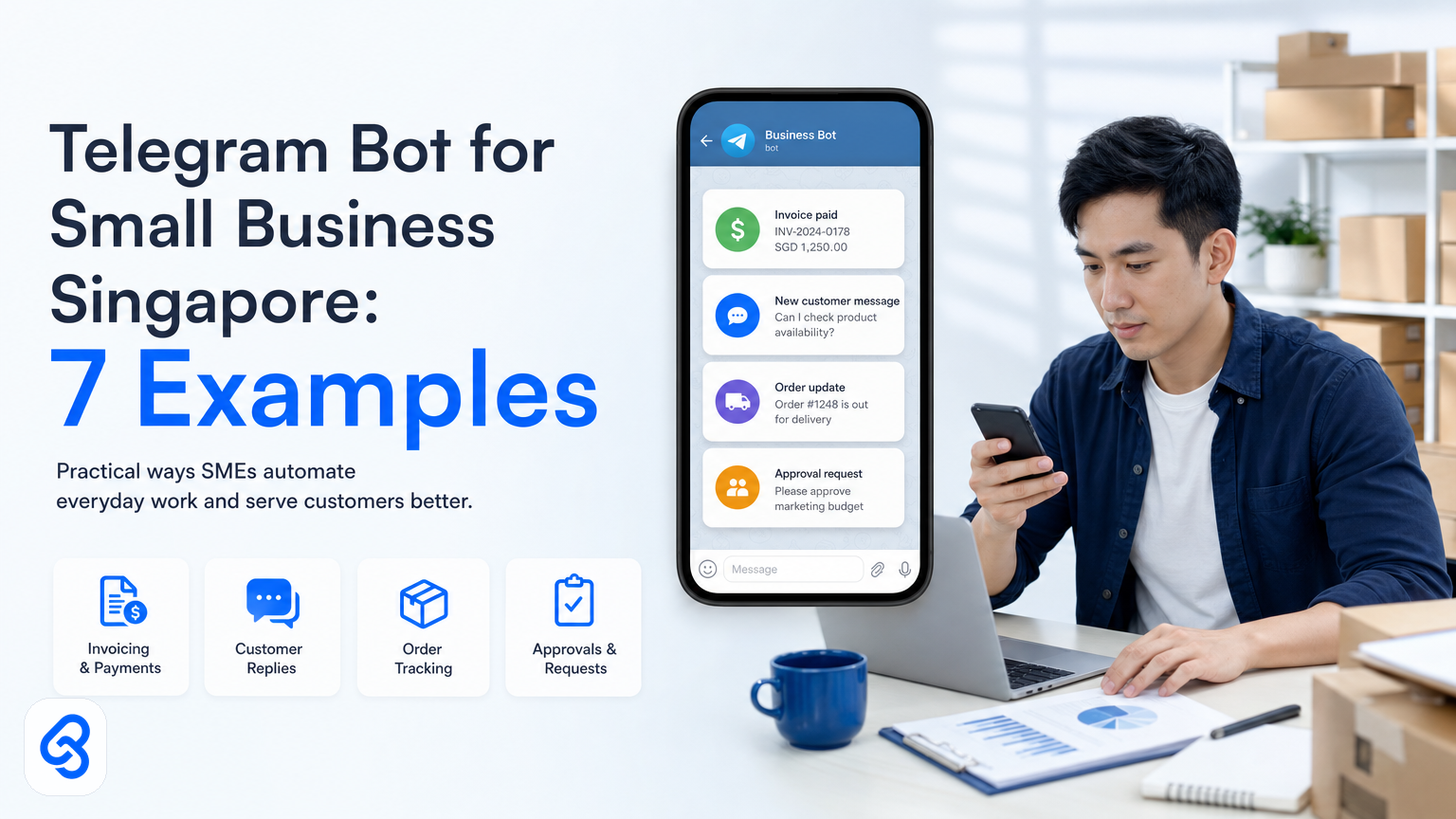
If you run a small business in Singapore, you've probably felt the weight of repetitive tasks. Someone asks for an invoice on WhatsApp. You manually create it, send it, chase payment. A customer needs order status. You check your spreadsheet, type a message back. A supplier quote lands in your inbox. You paste it into a form, wait for approval, paste the answer back.
Telegram bots can handle these workflows without hiring another person or buying expensive software. The catch is they only work well if you pick the right task and set them up right. Most Lynqra clients in Singapore find they save 5-15 hours per week once a bot is running, but only if they target the real bottleneck, not the most impressive-sounding automation.
This article walks you through seven real examples, shows you how they actually work, and tells you what to check before you spend time building one.
What is a Telegram bot and why does it matter for Singapore SMEs?
A Telegram bot is a program that runs inside Telegram and responds to messages automatically. It receives a message, follows a set of rules, and sends back a response or takes an action in another system (your invoice software, your spreadsheet, your hiring form). Telegram offers this for free, so the cost sits in building the bot and connecting it to your business tools.
Why Telegram instead of WhatsApp, email, or a website form? According to research on messaging platforms, Telegram bots work offline, don't rely on phone numbers, don't need app installation, and integrate cleanly with other software. Most importantly, they sit inside a messaging app your team and customers already use. The bot responds instantly, 24/7, and leaves a permanent record you can search.
For a Singapore SME, that means faster answers to customers, less manual data entry, and lower risk of forgotten follow-ups. The automation consultant at Lynqra studies your actual workflow before building anything, because a bot that saves one hour a week is a waste, but a bot that handles 20 customer questions daily is transformative.
Real Telegram bot example 1: Instant invoice generation and payment reminders
Your customer messages "Can I get an invoice for that order?" You're in a meeting. Without a bot, the message sits for hours. Your customer chases you. You create the invoice manually, send it, follow up three times before payment arrives.
A Telegram bot handles this in seconds. The customer sends a message with their order number. The bot looks up the order in your system, generates a PDF invoice, sends it immediately, and schedules reminders after 7 and 14 days. If the invoice goes unpaid after 21 days, the bot alerts you.
How it works in practice: You set up a form inside Telegram where customers type their company name and invoice date. The bot passes that data to your accounting software (using something called an API, which is just a secure connection between apps). Your accounting software creates the invoice and sends it back to the bot. The bot displays the PDF and a payment link. Customer clicks, pays, and the bot confirms receipt to you both.
Common pitfall: Trying to pull data from tools that don't have APIs. If your supplier list lives only in an Excel file on your laptop, the bot can't reach it. You'd need to move it to a cloud-based system first.
Cost drivers: The bot itself costs nothing. You pay for hosting (often 5-15 SGD per month) and the accounting software you already use. Some accounting tools charge extra for API access.
Real Telegram bot example 2: Customer order status tracking
You run a print shop or a catering business. Customers message "Where's my order?" ten times a day. Your staff repeats the same answer over and over.
A bot cuts that in half. Customer types their order number, the bot pulls the status from your order system and replies instantly. No staff member involved. The bot can also send automatic updates: "Your order is being printed" at 10 AM, "Ready for pickup" at 3 PM, "Collected" at 4:30 PM.
How it works: Your order management tool (or even a Google Sheet with order IDs and statuses) connects to the bot. When a customer sends an order number, the bot searches for it, retrieves the current stage, and sends back a plain-English update. If the order is late, the bot flags it to your operations team.
Real Singapore example: A Clementi bakery set up a bot that lets customers check whether their cake order is in the oven, cooled, or ready. Reduced customer calls by 60%. The bot also asked if they wanted to extend pickup time, which the bakery staff logged for forecasting.
Common pitfall: Customers sending unclear order numbers or nicknames. Set up the bot to ask for the exact order ID, not a description like "the chocolate one my sister ordered".
Real Telegram bot example 3: Document approval workflows
You manage a team. Purchase requests, leave approvals, quote authorizations all funnel through you manually. You read an email, decide, reply, the requester waits for confirmation.
A Telegram bot puts all approvals in front of you in Telegram, where you already check messages. Staff member uploads a purchase request through the bot. You get a notification with a summary. You tap approve or reject. The system logs the decision with a timestamp and tells the requester immediately.
How it works: An employee fills out a form in Telegram (or submits a document). The bot collects the data, stores it temporarily, and sends you a formatted message asking for approval or rejection. You tap the decision. The bot records who approved it, when, and sends a confirmation message back to the requester with a reference number.
Why this matters in Singapore: Many SMEs use WhatsApp for approvals, which means no audit trail. A Telegram bot creates a searchable record, useful for ACRA compliance and internal audits. You can prove who approved what and when, which supports your obligations under the Accounting and Corporate Regulatory Authority's filing requirements.
Common pitfall: Setting up too many approval levels. If every small request needs three sign-offs, the bot slows things down, not speeds them up. Use a bot only for decisions that actually involve judgment (quote approval, hire decision) and automate simple tasks fully (receipt acknowledgment).
Real Telegram bot example 4: Customer enquiry routing and FAQ automation
You answer the same five questions repeatedly: "What are your hours?" "Do you deliver to my area?" "How long is shipping?" "Can I return it?" "Do you offer bulk discounts?"
A bot answers these 24/7 and sends complex enquiries to your team. Customer asks a question. The bot searches its knowledge base. If it finds a match, it answers directly. If not, it assigns the enquiry to a staff member and notifies them in Telegram.
How it works: You build a FAQ database (even a simple spreadsheet works). The bot uses basic pattern matching or keyword search to find relevant answers. Questions like "shipping" or "delivery" trigger pre-written responses. Questions the bot doesn't recognize go into a queue for your team to handle, usually within minutes.
Singapore context: A Bukit Merah beauty salon set up a bot to answer "Do you have availability on Saturday?" and "What's the price for a manicure?" Reduced incoming calls by 40%. Complex requests like custom bridal packages still went to staff, but the team spent less time on basic information.
Common pitfall: Writing FAQ answers that are too vague or long. Customers are in Telegram, not reading a website. Keep answers to 2-3 sentences.
Real Telegram bot example 5: Lead capture and initial qualification
You advertise your service. Enquiries come in through your website form, email, or direct messages. You lose track. Serious prospects drown in the noise.
A Telegram bot qualifies enquiries before they reach you. Someone clicks "Contact Us" and opens Telegram. The bot asks three quick questions: "What's your company name?" "How many staff do you have?" "What's your main challenge?" The bot stores the answers and notifies you only if the prospect meets your criteria.
How it works: You create a Telegram link or QR code that opens a chat with your bot. The bot asks qualifying questions based on your business rules. If the prospect is a fit (e.g., 10+ staff, in your service area, has a clear problem), the bot alerts your sales team immediately. If not, the bot thanks them and offers a resource or asks to stay in touch.
Why this works in Singapore: SMEs often receive 20 enquiries a week and close 2. A bot filters out time-wasters and speeds up response to real prospects. You contact them within minutes, not days.
Common pitfall: Asking too many questions. Three questions maximum. If you need more information, schedule a call first.
Real Telegram bot example 6: Supplier and vendor communication
You have ten suppliers. Each sends invoices, delivery dates, and updates through different channels (email, WhatsApp, SMS, their website portal). You lose track of who's sending what.
A bot centralizes it. Suppliers send updates to a Telegram bot. The bot logs the information (PO number, delivery date, status, contact name) and sends you a daily summary or a real-time alert if something's urgent.
How it works: You share a Telegram bot link with suppliers. They send a message like "PO 2401-156 ready for pickup tomorrow". The bot extracts the key information and logs it to a spreadsheet or database. You see all supplier updates in one Telegram channel, with timestamps and searchable records.
Singapore SME example: A Geylang distributor had three suppliers. One sent emails, one used WhatsApp, one sent SMS. The owner checked three channels, missed dates, and held excess stock. A bot centralizing all updates cut inventory holding time by two weeks and eliminated missed deliveries.
Common pitfall: Suppliers won't use it. Start with your largest or most communicative supplier. Show results. Others follow. Make it optional, not mandatory, at first.
Real Telegram bot example 7: Hiring and onboarding
You post a job. Fifty applications arrive. You forward them to a shared folder, lose three, can't remember who you already interviewed.
A bot collects applications in a structured form. Applicants answer screening questions (salary expectation, availability, relevant experience). The bot scores responses based on your rules and sends shortlisted candidates to your hiring folder with summaries. You interview the filtered list, not the full 50.
How it works: You share a Telegram bot link on your job post. Candidates click it and answer a form: "5-10 years in warehousing?" "Available to start within two weeks?" "Expected salary?" The bot evaluates each response against your minimum criteria, stores the full application, and notifies you only of high-scoring matches.
Why this works: You spend three hours reviewing 12 qualified candidates instead of two days scrolling through 50 mismatched applications. Your team sees clearly who you've screened and who you've interviewed.
Common pitfall: Asking questions that feel discriminatory. Stick to skills, experience, availability, and salary expectations. Avoid questions about age, family status, religion, or appearance.
How do you actually build and connect a Telegram bot?
The technical path has three steps: create the bot, write the logic, connect it to your business tools.
Step 1: Create a bot. Open Telegram, message @BotFather, and request a new bot. You'll get a token (a unique password). Save it somewhere safe.
Step 2: Write the logic. This is where it gets technical. You choose a platform to build on: no-code tools like Zapier or Make (formerly Integromat) let you draw workflows with boxes and arrows. Code-based platforms like Node.js or Python let you write custom rules. For most SME use cases, a no-code tool is faster.
Step 3: Connect to your business tools. Your bot needs to talk to your accounting software, your spreadsheet, your hiring form, or your order system. If the tool has an API (most modern software does), the connection is straightforward. If it doesn't, you might need workarounds like copying data to Google Sheets, which the bot can then read.
This is where Lynqra comes in. We analyze your actual workflow, identify which tasks are worth automating, choose the right tools, and build the bot so it integrates smoothly with your existing systems. We test it, we monitor it, and we fix it when something breaks. You don't have to learn Zapier or hire a developer. You get a working automation that saves time and cuts errors. Read our full guide to Telegram bot workflows for step-by-step technical walkthroughs.
What could go wrong, and how do you protect yourself?
Telegram bots don't fail often, but when they do, it's usually for three reasons:
Data security. If your bot collects customer information (names, emails, order details), you must store it securely and comply with Singapore's Personal Data Protection Act. Use encrypted databases, not text files or screenshots. For guidance on protecting your systems and customer data, consult the Cyber Security Agency of Singapore's resources, which provide infographics, tools, and best practices for digital safety in Singapore's business environment.
API downtime. Your bot depends on other systems (your accounting software, your spreadsheet, your order database). If those systems go offline, your bot can't function. Build a fallback: log incoming messages so you don't lose enquiries while the API is down.
Outdated rules. A bot approves invoices under 500 SGD. Your cost of goods goes up. Now 500 is too high, but the bot doesn't know. Review and update your bot's rules every quarter.
Poor design. A bot that asks ten questions before completing a simple task frustrates users more than it helps. Test your bot with a real customer before going live. Watch them use it. If they get confused or abandon the conversation, redesign it.
When should you actually build a Telegram bot?
A bot makes sense if:
- You answer the same question five or more times a week.
- The task has clear, repeatable rules (not judgment calls).
- Your customers or team already use Telegram.
- The time saved per week is at least two hours.
- The data doesn't include highly sensitive information.
A bot doesn't make sense if:
- The task happens once a month.
- Every request is unique and needs human judgment.
- Your team hates Telegram and won't check it.
- The information is encrypted financial data or passwords.
- The bot would require rebuilding your whole system.
Before building anything, map your workflow: write down each step, how long it takes, and who does it. Identify the bottleneck. That's where automation earns its keep. If you can't pinpoint a real time cost, the bot won't save you money.
This is exactly what Lynqra does in a free discovery call. We ask questions. We listen. We find the real problem. Then we design a bot (or other automation) that solves it. Explore our guide to business process automation in Singapore SMEs if you want to understand how automation fits into your broader operations strategy.
Understanding digital transformation support in Singapore
If you're serious about automation, Singapore offers structured support. IMDA's Industry Digital Plans provide step-by-step guidance to help SMEs go digital, with sector-specific roadmaps that can support your automation strategy. These plans align with Singapore's broader digital economy framework and can help you understand which investments make sense for your business size and sector. Check with Enterprise Singapore about grants for capability upgrading as well. Many costs associated with building and hosting a bot may qualify for support, but eligibility varies by company size, sector, and prior grant history. Always confirm details with official sources before committing budget.
FAQ
How much does a Telegram bot cost to run?
The bot itself is free. You pay for hosting (usually 5-50 SGD per month depending on traffic), API connections to your business tools (some charge a small fee, many don't), and the time or consultant fees to build it. Total first-year cost is typically 500-3000 SGD including setup. Compare that to hiring one part-time staff member at 1500-2000 SGD per month.
Can I build a Telegram bot myself without coding?
Yes. No-code platforms like Zapier, Make, or Telegram's native workflow builder let you create bots by dragging boxes and connecting logic. The trade-off is flexibility. Custom requirements or complex integrations usually need a developer.
What happens if Telegram changes its API or shuts down the feature?
Unlikely. Telegram is profitable, independent, and prioritizes bot features. But if you depend entirely on one platform, risk exists. Combine your bot with other tools (email, SMS, your website) so no single channel carries all your automation.
Will customers use Telegram if they normally contact me on WhatsApp?
Some will, some won't. Test with a small group first. Include a link in your signature and on your website. Telegram has 2 billion users worldwide, so most will have it. Make using it easy: a QR code beats a typed URL.
Can a Telegram bot handle payment processing directly?
Telegram bots can't take payments directly through the app. Instead, the bot sends a payment link to an external service (Stripe, Wise, PayPal, your bank). Customer clicks, pays there, payment confirms back to the bot. It's secure and compliant.
---
If you've read this far and recognize a bottleneck in your own workflow, the next step is a conversation. Lynqra specializes in identifying which tasks actually deserve automation and building solutions that integrate with your existing tools without disrupting your team. Book a free discovery call or email us to discuss your specific needs. We'll ask questions, listen, and tell you honestly whether a Telegram bot is the right move for you, or whether something else would work better.