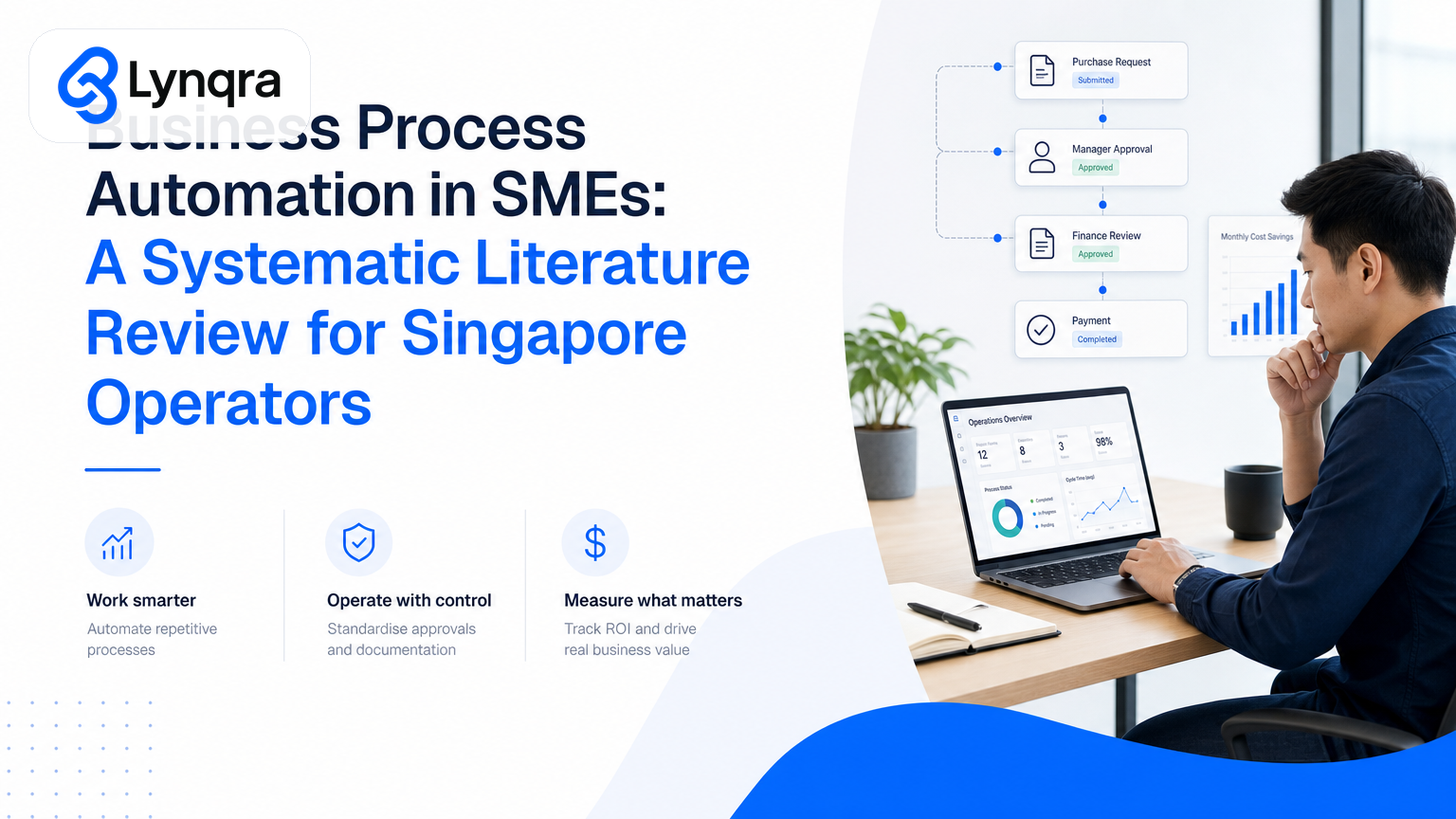
If you run a small or medium business in Singapore, you've probably heard the word "automation" thrown around at conferences and LinkedIn posts. Most of the time it sounds like either a distant future technology or a trap that forces you onto expensive enterprise software.
This guide explains business process automation in smes a systematic literature review for Singapore SMEs in practical terms, with a focus on reducing manual work without changing the core operation.
The truth is messier and more useful than that.
Business process automation in SMEs is not about replacing your team with robots or migrating everything to a new platform. It means identifying the repetitive, manual tasks that eat your team's hours, and building small, focused automations that do that work instead. Automations that plug into the tools you already use. Automations that save money and time without disrupting how your team works.
This article walks you through what business process automation actually is, why it matters for lean Singapore teams, what workflows you should automate first, how to navigate funding, and how to avoid the mistakes that sink most automation projects.
What Business Process Automation Really Means
A business process is any repeating workflow that produces a result. Invoicing. Screening job candidates. Approving purchase orders. Extracting data from PDFs. Sending follow-up emails. Routing documents to the right person.
Automation means building a system that does that workflow without human hands pressing buttons.
The catch: not all automation is the same. Some automation is cheap and lives inside the tools you already have. Some requires new software licenses, staff training, and months of setup. Some promises a lot and delivers a dashboard that no one uses.
The automation that works for SMEs does three things. First, it solves a real problem your team faces every week. Second, it uses tools and AI that exist today, not vaporware. Third, you can measure the result: hours saved, errors eliminated, or time to close cut in half.
Most SMEs struggle with one of these tasks: invoice entry and payment tracking, candidate screening and shortlisting, approval routing and sign-off delays, quote generation and response time, stock or inventory updates, or data entry from emails, PDFs, and forms.
You likely do at least one of these manually or with messy spreadsheets. That's your starting point.
Why SMEs in Singapore Need Automation Now
Singapore's economy runs on lean, fast-moving businesses. Your margins are tight. Your team is small and stretched. You compete against larger players with bigger budgets and better tech.
Manual work kills your competitiveness in three ways. Your team spends time on tasks that a system could handle. Mistakes happen: a missed invoice, a missed email, a candidate screened by gut feel instead of criteria. And your response time to customers or suppliers stays slow.
A trading company in Singapore was processing invoices by hand. Each one took 15 minutes: opening the email, reading the PDF, entering the details into the accounting system, flagging it for payment, checking it didn't duplicate anything. With 20-30 invoices a week, that was 5-6 hours of someone's time. And still, invoices got missed or paid twice.
They built an automation that reads the email, extracts the invoice details, enters them into their system, and flags it for approval. Substantial weekly time. clearer payment visibility.
That's what automation looks like.
The Singapore government also recognizes this. Enterprise Singapore and IMDA offer grants to help SMEs invest in digital tools and automation. We'll cover those later, but the point stands: moving your business forward means removing bottlenecks, and automation removes bottlenecks that software licenses can't touch.
Which Processes Should You Automate First: A Decision Framework
Not every process deserves automation. Some are too rare, too complex, or too dependent on human judgment.
The processes worth automating share these traits:
High volume and low variation. You do it at least twice a week, and it follows the same steps each time. Invoicing, candidate screening, approval routing, data entry, and quotation generation all fit. A one-off project analysis or customer relationship rebuild does not.
Time-consuming and low-skill. Your team does it, but it doesn't need your team's strategic thinking. It's busy work. Extracting numbers from a PDF, sending a templated email, checking a spreadsheet against a database, updating inventory after a delivery.
Error-prone or creates bottlenecks. Humans forget things, miss deadlines, or get overwhelmed. Manual approvals get stuck in someone's email. Invoices get entered twice. Candidates fall through the cracks.
Clear measure of success. You can count the hours saved, the errors eliminated, or the days cut from your cycle time. Vague goals like "improve efficiency" don't work. "Cut the time to screen candidates from 8 hours to 1.5 hours" does.
Here's a practical checklist. Score each process from 1-10 on each dimension:
- How often does it happen per week?
- How long does one instance take?
- How many people does it involve?
- How often do mistakes happen?
- How much time would automation free up for higher-value work?
- Can you describe the exact steps in writing?
High scores on all counts? That's your first automation project.
Most SMEs start with one of these: accounts payable and invoice processing, candidate screening and shortlisting, approval workflows and sign-off routing, quotation generation and response time, or inventory and stock tracking.
For more detail on prioritization, see our guide on workflow automation for Singapore SMEs: what to automate first.
How to Build Automation Without Breaking Your Workflow
Here's where many automation projects stumble. A vendor sells you a platform, you get trained, you migrate your data, and six months later the system is collecting dust because your team never actually switched over.
Good automation works differently. It integrates into the tools you already use.
If your team uses Google Sheets to track anything, automation can write to those sheets. If approvals live in email, automation can send requests and track responses. If your team communicates on Telegram or WhatsApp, automation can trigger workflows from messages. If you store documents in Gmail or Google Drive, automation can extract data from them.
The goal is zero friction. Your team does their job. The automation happens in the background.
An example: a recruitment agency screened candidates by hand. Each one took 20-30 minutes to read a CV, match it against the job spec, and decide yes or no. With dozens of applications a week, that was 10-15 hours of screening.
They built an AI agent that reads each CV, rates it against the job requirements, and puts the top candidates into a Google Sheet with notes. The recruiter opens the sheet, looks at the top 5-10, and makes the final call in minutes. manual screening time fell. The shortlists became easier to review.
The agency didn't switch platforms. They didn't retrain anyone. The automation plugged into their existing email and Google Workspace, and the screening process got faster.
For more on building this kind of agent-based automation, see AI agent for business Singapore: what it is and how to build it right.
The same principle applies to invoice automation, approval workflows, and data extraction. Build inside what you have. Keep your team's habits intact. Add speed and accuracy on top.
Real Examples: What Automation Delivers
Numbers matter less than specifics, so here's what automation has delivered for real Singapore SMEs:
Invoice and accounts payable. One trading company reduced weekly data entry and chasing and eliminated missed payments. No more manual entry. No more duplicates. Complete audit trail.
Candidate screening. One recruitment firm reduced manual screening. The shortlist went from a two-day process to a few hours.
Approval routing. One company using Telegram and Google Sheets shortened approval turnaround. Requests no longer disappear into inboxes. Full visibility on who's signed off and when.
Quotation generation. A food production company reduced response time from about 2 hours to 6 minutes. Sales team didn't have to wait for someone to calculate and format a quote.
Inventory and stock optimization. One logistics business reduced overstock by 30% through automated stock level tracking and reorder prompts.
These aren't transformations that required new platforms or massive upfront cost. They happened because someone identified a concrete problem, built an automation that solved it using existing tools, and measured the result.
Start with your most painful process. Measure the current state: time taken, error rate, cycle time, cost. Build the automation. Measure again. That's your proof of concept.
For a deeper walk-through of business process automation in Singapore, including detailed workflow examples, see our foundational guide.
How to Fund Automation Without Breaking Your Cash Flow
Many SME owners think automation requires capital they don't have. Singapore's government funding landscape says otherwise.
Enterprise Singapore offers grants to help SMEs adopt digital solutions and automation tools. Visit the Enterprise Singapore grants page to explore what's available for your industry and company profile.
IMDA (Infocomm Media Development Authority) runs the SMEs Go Digital program, which includes tools, funding, and guidance to help small businesses build automation and digital capability. Check the IMDA SMEs Go Digital page for current offerings.
Some industries also have specific digital transformation plans. IMDA's Industry Digital Plans cover sectors like food service, logistics, retail, and professional services.
Here's what matters: before you apply for a grant, know exactly what problem you're solving and how much it will cost to solve. Vague applications fail. Clear ones listing the specific workflow, the tools you'll use, and the expected time or cost savings succeed.
You should also know that grant eligibility depends on your company size, industry, and the type of automation you're building. Check the official channels for current rules, because they change.
For a practical guide to navigating automation funding in Singapore, including how to position your automation project for a grant application, see AI automation grants in Singapore: EDGE and SME ROI guide.
Common Mistakes: What Kills Automation Projects in SMEs
Automation fails when one of these happens:
Choosing the wrong process. You automate something rare or complex, hoping to save a little time. Nothing happens. The system sits unused. Pick something that happens every week and eats real hours.
Forcing your team onto new software. Your team uses Gmail and Google Sheets. You buy a fancy ERP system. They never switch over. Your data lives in two places. Chaos ensues. Build automation inside the tools people already use.
Not measuring before and after. You implement automation and assume it worked. But did it? By how much? If you can't measure it, you can't improve it, and you can't justify the investment to your boss or investor.
Expecting automation to fix broken processes. If your approval process is broken because no one knows the rules, automation won't fix that. First, clarify the process. Then automate it.
Setting it and forgetting it. Automation needs maintenance. Rules change. Your team finds better ways to work. Check in every month. Iterate. Improve.
Underestimating the integration work. Automation isn't just building the logic. It's connecting systems, testing edge cases, documenting what happens when something goes wrong, and training your team. Budget time for all of it.
The winners we work with do the opposite. They pick one painful process. They measure it carefully. They build something small and focused. They use their existing tools. They check the results. Then they iterate.
What to Look For in an Automation Partner
If you decide to bring in help (which most SMEs do, because building this stuff requires both technical skill and business judgment), look for a partner who:
Starts with your problem, not a product. A good partner asks about your workflow before talking about their platform. They want to understand what slows you down and why. Bad partners pitch solutions that don't fit your business.
Works inside your existing tools. They shouldn't force you onto new software. They should plug automation into Gmail, Google Sheets, Telegram, WhatsApp, email, and whatever else you already use.
Measures ROI in time and money. They talk about hours saved per week, error rate drop, and cycle time cut. They don't talk about "digital transformation" or "workflow optimization." Concrete numbers.
Stays after launch. Automation breaks. Rules change. Your team learns a better way. A good partner iterates with you. A bad partner takes your money and disappears.
Understands SME constraints. You don't have IT staff. You can't afford months of downtime. You need results fast. A good partner knows this and works within it.
Helps with grants. If you need funding, a good partner either has grant advisory relationships or knows how to help you structure your automation project to qualify.
The partner's title doesn't matter. Could be a consultant, a fractional automation lead, a systems integrator, or an in-house hire. What matters is whether they solve your problem and stick around to make sure it works.
A Practical Next Step
Business process automation for SMEs isn't mystical or expensive. It's identifying a workflow that takes your team too long, building a focused system that does it faster and more reliably, and measuring the result.
Start here:
1. Pick one process that happens at least twice a week and eats 3+ hours.
2. Time it carefully. Count the steps. Identify where mistakes happen.
3. Write down exactly what you'd want to automate. Be specific.
4. Explore who might build it for you. Check if funding is available.
5. Measure the result after launch. Check hours saved, errors eliminated, cycle time cut.
If you'd like help identifying your best automation opportunity and building something that actually sticks, book a free 30-minute discovery call. We'll walk through your workflows, find the biggest bottleneck, and sketch out what automation could look like for your team.
Book a discovery call with Lynqra to get started.