Human Oversight for AI Agents Singapore Cost
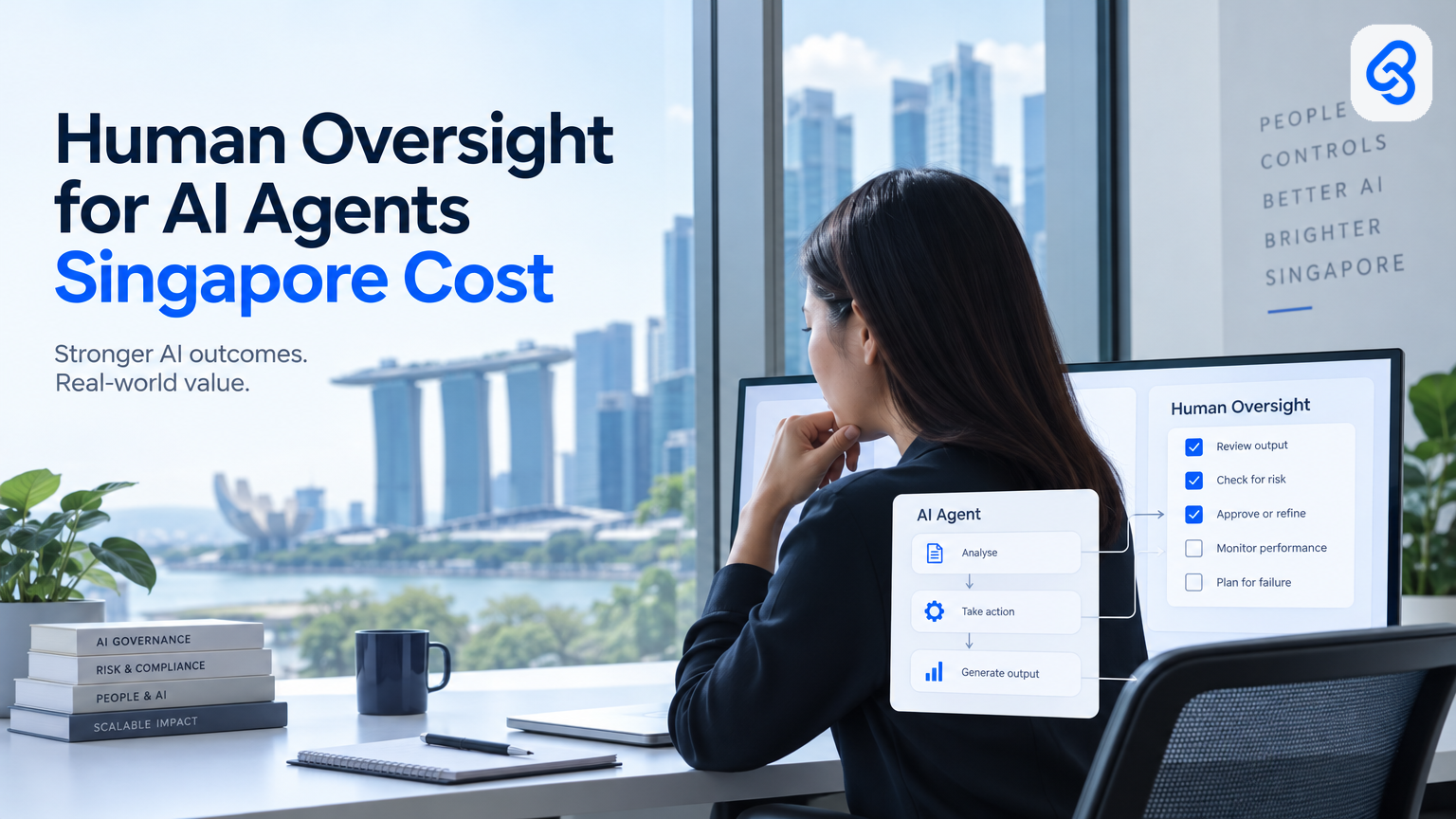
An AI agent can draft a reply, prepare a payment or update a customer record. The cost of human oversight for AI agents Singapore businesses face depends on what the agent can do, what a person must check and how the workflow connects to existing systems. The right question is not simply "How much does approval cost?" It is "What level of review keeps this task safe without slowing the team down?"
For a Singapore SME, oversight should be part of the workflow design from the start. That means deciding which actions need approval, what evidence a reviewer sees and what happens when the agent is unsure. These choices affect build effort, daily workload and the cost of operating the system.
What does human oversight for AI agents cost in Singapore?
There is no single standard price for human oversight. The cost depends on the process, the systems involved, the level of risk and the amount of review work people must do. A useful estimate separates one-off design and setup from ongoing human review, maintenance and exception handling.
A practical budget usually has four parts:
- Workflow assessment and design: Map the current steps, decision points, data and failure cases. Decide which actions an agent may take and which need a person.
- Build and integration: Connect the workflow to the tools the team uses, such as a spreadsheet, finance system or customer service platform. Add approval screens, alerts and records of decisions.
- Human review time: Estimate how often the agent will request approval and how long each review takes. This is an operating cost, even if staff handle it within their existing roles.
- Ongoing operation: Allow for changes to the process, access permissions, error handling and checks that the workflow still behaves as intended.
A simple prototype may need little more than a clear approval step and a record of what the agent proposed. A workflow that can send money, change customer records or make commitments needs tighter controls and more careful testing. Those differences matter more than the label "AI agent".
Ask suppliers to separate setup and recurring costs, and to state what their estimate assumes about transaction volume, integrations and human review. Without those assumptions, two prices may describe very different systems.
What makes oversight more expensive?
Oversight costs rise when reviewers lack context, when the workflow has many exceptions or when the agent can take actions that are hard to reverse. They fall when the system presents clear evidence, routes only uncertain cases to a person and keeps routine, low-risk steps within agreed limits.
Review effort often grows when:
- A person must search across several systems to verify each decision.
- The agent gives a recommendation without showing the source documents or key facts.
- Staff cannot tell what the agent has already changed.
- Every case goes to the same senior approver, including routine ones.
- The process has unclear rules for incomplete, conflicting or unusual information.
Build the review around the decision, not around a generic "approve" button. For example, a finance reviewer may need to see the invoice, purchase order, delivery record and the reason for any mismatch. A customer service lead may need the customer's request, relevant order details and the proposed reply.
Singapore SMEs can also review digital options through IMDA's SMEs Go Digital programme. The programme provides information on digital solutions and support for SMEs. Check the official details to see what applies to your business and current needs.
How much human review does your workflow need?
Set oversight according to the consequence of an error, how easy it is to reverse and how confident the agent can be using reliable information. This gives managers a practical way to choose between automatic processing, sampled checks, approval before action and human handling throughout.
Use this four-level decision framework:
1. Automatic for bounded, reversible steps. The agent can sort an incoming request or prepare a draft, provided it cannot make an external commitment or overwrite important records.
2. Sampled review for stable, low-impact work. A person checks a defined sample and looks for patterns that suggest the workflow needs adjustment. Set a clear route for unusual cases.
3. Approval before consequential action. A person checks the evidence and approves actions such as sending a quotation, changing a customer record or preparing a payment for release.
4. Human-led for high-impact or unclear decisions. The agent can gather and organise information, but a person makes the decision when the facts are disputed, incomplete or sensitive.
Treat this as a starting point, not a permanent setting. If the process changes or the agent starts handling new data or actions, review the control level. For personal data, consider the organisation's responsibilities under Singapore's PDPA and consult the PDPC's PDPA overview.
How do you estimate the cost before you build?
Estimate oversight cost by counting review events and the work required for each one, then add the cost of designing, integrating and maintaining the controls. You do not need a market benchmark to start. A small process sample can show where people spend time and what information they need to approve safely.
Start with a real workflow and answer these questions:
- How many cases does the team handle in a normal week?
- What share of cases need a decision, rather than simple data entry?
- Which decisions could the agent prepare, and which must a person make?
- What evidence should appear in front of the reviewer?
- How long does a typical review take, including looking up information?
- What should happen when information is missing or systems disagree?
- Who owns the workflow when it fails or needs a rule change?
Then estimate the human workload: expected approval requests multiplied by average review time, plus time spent resolving exceptions. Keep the assumptions visible. If you do not yet know the approval rate, run a limited pilot and measure it rather than guessing.
A supplier should be able to explain how the proposed design changes reviewer effort. Lynqra's approach starts by mapping how the team already works, then assesses the opportunity, governs the risks, enables people and builds around the workflow. The aim is a governed system that fits the process, rather than an extra platform for staff to manage.
For examples of bounded business workflows, see Lynqra's guides to three-way match exceptions and purchase requisition approvals. Both illustrate why exceptions and approval rules belong in the process design.
How this actually runs: invoice exception review
Consider an illustrative Singapore SME that receives supplier invoices by email and tracks approvals in Google Sheets. The goal is not to let an agent approve invoices. It is to organise the evidence and send a reviewer a clear exception to decide.
1. Trigger: A staff member records a new invoice row in Google Sheets, including the supplier, amount and invoice reference. The new or changed row starts the workflow.
2. Prepare the check: Google Apps Script can respond to spreadsheet events and work with Google services, as described in the Apps Script overview. In this illustrative setup, it checks that required fields exist and passes the invoice details to the next step.
3. Route the case: An n8n workflow receives those details and checks the available records against the business's matching rules. n8n documents workflows for connecting triggers and actions in its workflow automation documentation. The workflow hands the reviewer a case summary with the invoice reference, amount, missing fields or mismatch, and links to the relevant records.
4. Human decision: The reviewer checks the source documents and chooses to approve the next step, request a correction or send the case back for more information. The workflow records the decision and the reviewer's identity in the case log.
5. Controlled handoff: Only after approval does the workflow pass the authorised outcome to the next business step. If the invoice details change, the case returns for review instead of carrying forward the earlier approval.
In practice, the spreadsheet may contain an incomplete row, a supplier may reuse an invoice number or records may not match. The workflow should stop when required evidence is missing, flag a duplicate for review and route mismatches to a named owner. It should not guess a missing value or treat a blank field as approval.
This example is illustrative, not a Lynqra deployment or a claim about what either product does out of the box. The actual design depends on the tools, records and approval rules the business uses. For a broader view of possible projects, see Lynqra's AI agents and workflow automation for Singapore SMEs.
How should Singapore businesses approach grants and funding?
Treat grants as a possible way to support a suitable project, not as the reason to build an AI workflow. First define the business problem, control requirements and expected operating effort. Then check current grant details and eligibility through official channels before including funding in a budget.
Enterprise Singapore's capabilities and support overview describes support areas for businesses. The available schemes, terms and eligibility can change, so confirm details directly with the relevant official channel. IMDA's Industry Digital Plans can also help businesses explore digital needs by industry.
A funding decision does not replace governance. The business still needs an owner for the process, clear limits on what the agent can do, and a way for staff to report errors or unsafe behaviour.
What should leaders put in place before launch?
Before launch, name the person accountable for the workflow, set the agent's permissions and agree how staff will handle uncertain cases. Test with realistic examples, including incomplete and conflicting information. Start with a limited scope, review what happens and adjust the controls before expanding access or actions.
Use this short readiness check:
- Can staff see what the agent proposed and why?
- Can they verify the information against its source?
- Does the agent stop when it lacks required evidence?
- Can a reviewer reject or correct a proposal without fighting the system?
- Does the business record who approved a consequential action?
- Is there a clear owner for incidents, rule changes and access?
- Have staff practised the exception route, not only the happy path?
Lynqra's operating journey is Assess, Govern, Enable, Build and Operate. That sequence helps teams decide what to automate, set the controls, prepare the people involved and keep the workflow useful after launch.
Frequently asked questions
Human oversight costs depend on the work people must do and the controls the process needs. A small, low-risk workflow may only need a reviewer for exceptions, while a consequential process may need approval before every action. These answers help Singapore business leaders scope the first conversation.
Is human approval required for every AI agent action?
No. Approval should match the action's risk and reversibility. An agent might sort or prepare information within clear limits, while a person approves a payment, external commitment or significant record change. Define the boundary in the workflow, and make sure staff can see when the agent has stopped for review.
Can a Singapore SME use AI agents without a large platform project?
Yes. A business can start with one contained process and the tools it already uses, provided the workflow has clear permissions, an owner and a safe exception route. Keep the first scope small enough to test with real cases. Expand only after staff can verify the agent's work and handle failures.
How do we know whether human review is worth the cost?
Compare the time people spend on review with the time the current process takes, including corrections and exception handling. Also consider the cost of an incorrect action and whether a reviewer can catch it in time. A limited pilot can reveal actual approval rates and review effort before you scale.
Do grants cover AI oversight work?
Grant support depends on the current scheme, project and business eligibility. Do not assume that a particular control, integration or AI project qualifies. Check the terms through official channels, including Enterprise Singapore or IMDA, before relying on funding in your budget.
If you are deciding where human oversight belongs, start with the workflow that creates the most avoidable admin or the greatest concern about an unchecked decision. Start an AI readiness conversation with Lynqra, or email mark@lynqra.com.