When you send a rate quotation to a potential client, you have one chance to be clear, professional, and fast. A badly formatted quote confuses buyers, delays decisions, and costs you deals. A well-structured one answers their questions before they ask them, builds confidence, and shortens your sales cycle.
For Singapore SMEs, the format of a rate quotation matters more than you might think. You are competing against larger firms with slicker systems while juggling multiple formats because each client, industry, and product has slightly different expectations. A manufacturing SME quotes differently from a trading house. A service provider quotes differently from a logistics operator. Yet all need the same thing: a format that is clear, professional, legally sound, and quick to produce.
For external context, Enterprise Singapore administers various grants for SMEs and IMDA's SMEs Go Digital programme supports capability building and software adoption. These resources assist Singapore SMEs in planning and improving quotation workflows.
This guide walks you through what should go into a quotation, why the format matters, common mistakes made by Singapore SMEs, and how to automate the process to save time and reduce errors.
What a Rate Quotation Is and Why Its Format Matters
A rate quotation (or rate quote) is a formal offer to supply goods or services at a stated price with defined terms and conditions. It is not an invoice or a price list but a specific proposal tied to a customer inquiry.
The format of your rate quotation sets expectations. A sloppy format suggests sloppy service. A clear format builds trust, reduces back-and-forth communication, and speeds up the buyer's decision-making process.
For SMEs, the format also affects operational costs. If your quotation process takes two hours per quote and you send 20 quotes weekly, that amounts to 40 hours of manual work. A structured format, especially one you can automate, can reduce this to 20 minutes per quote or less.
Core Elements of a Professional Rate Quotation
A complete rate quotation includes:
Header and Identification
Your company name, logo, address, phone, email, GST registration number (if applicable), and a unique quotation number. The quotation number is important for tracking, filing, and dispute resolution.
Date and Validity Period
When the quote was issued and how long the price remains valid (e.g., "Valid for 30 days from issue date"). This protects you if the buyer delays decisions while costs rise.
Customer Details
Full legal name, registered address, contact person, phone, email, and purchase order contact (if different). Accurate customer information prevents payment delays.
Itemized Description of Goods or Services
Avoid vague terms like "delivery service." Use details such as "Courier delivery, 5kg parcel, Singapore island, next-business-day, insured to SGD 500." Specificity reduces disputes.
Quantity, Unit Price, and Line Total
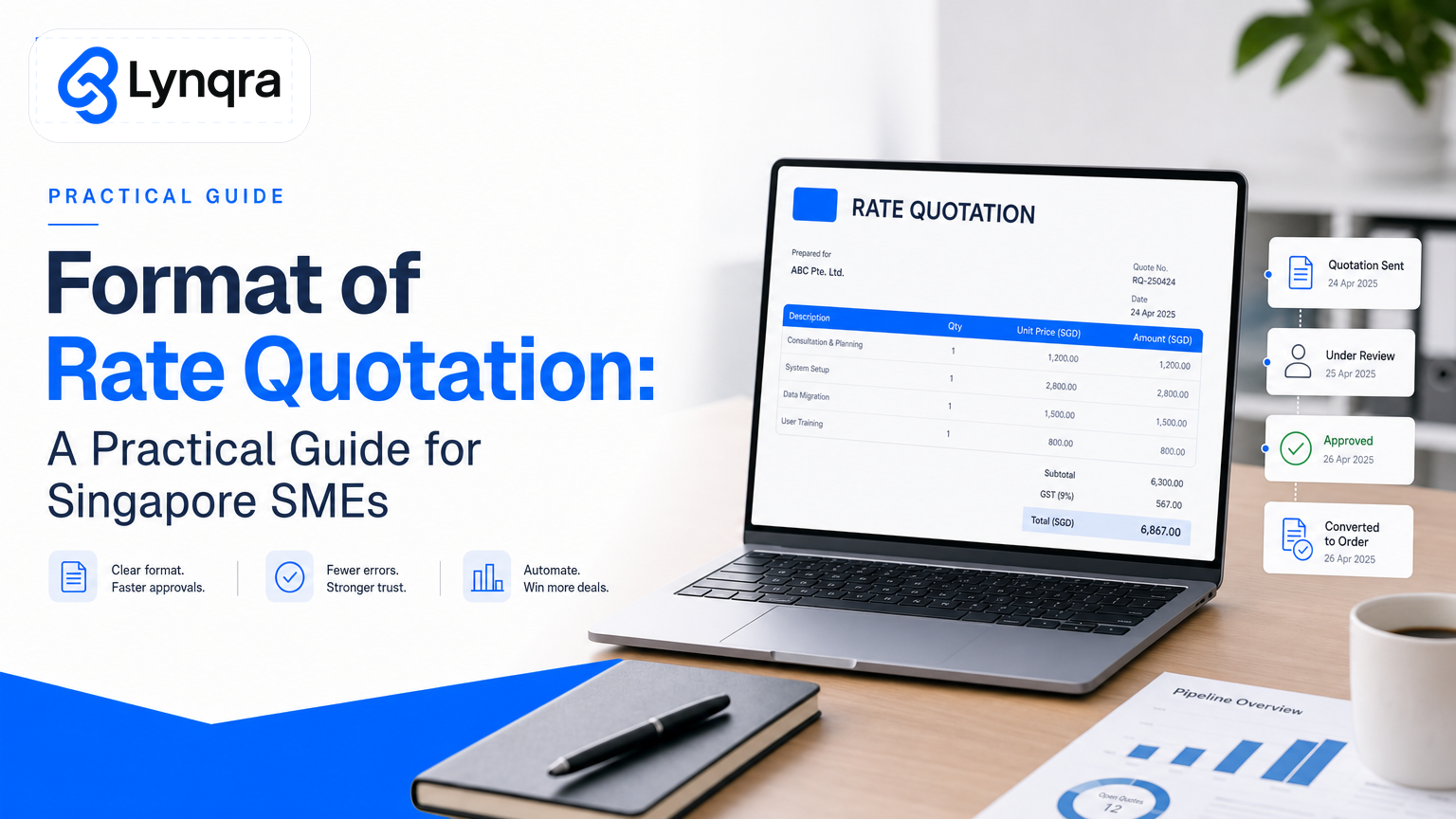
Presented in a clear table with one row per item. Show both unit price and total cost per line. Buyers typically scan for total cost first, so make it easy to find.
Subtotal, Taxes, and Total Cost
Itemize taxes such as GST if registered. Show delivery fees, installation fees, or discounts separately before the final total.
Terms and Conditions
Include payment terms (net 30, 50% upfront, full on delivery, etc.), delivery timeline, cancellation policy, warranty or guarantee period, and liability limits. Terms should be explicit, either in the quotation or referenced in a separate document.
Signature or Approval Line
Include your name, title, date, and signature (digital or printed). Some quotes feature an "accepted by" line for the buyer to sign, making it a binding agreement.
Notes or Special Conditions
Any additional details like material availability, pricing exclusions, installation fees, or bulk discounts.
Common Format Mistakes Singapore SMEs Make
1. Vague Quantities
Phrases like "Approx 10-15 units" or "depending on job scope" create confusion and hinder acceptance. Specify exact quantities or clarify if the quote is variable with supporting scope documentation.
2. Hiding the Total Price
If buyers must search or calculate to find the total, the chance of losing sales increases. Display the total prominently and in Singapore dollars (SGD).
3. Omission of Terms
Terms such as payment conditions should never be "available on request." State them clearly upfront. List all options if you have multiple payment terms.
4. Inconsistent Quote Formats
Sending quotes in different formats (Word, spreadsheet, email) shows disorganization, undermining buyer confidence.
5. Missing GST or Company Details
GST-registered businesses must include their GST number. Omitting it may invalidate the quote for buyer tax purposes.
6. No Validity Period
Without an expiry date, buyers may request obsolete prices months later. Always include a clear validity window.
7. Slow Quote Turnaround
A well-formatted quote that takes too long to produce can cost you deals to faster competitors.
How to Structure a Rate Quotation in Practice: Three Examples
Example 1: Trading SME (Electronics Distribution)
- Header: Company name, logo, GST number, contact, quotation number QT-2025-08241, date 16 June 2025.
- Customer: ABC Manufacturing Pte Ltd, 50 Joo Koon Circle, Singapore 629107, attn: Purchasing Manager Lee Wei.
- Items: Industrial Power Supply, Model PS-500W, 50 units at SGD 120 each; Surge Protection Module, Model SPM-2L, 50 units at SGD 35 each; Installation and testing (half day) at SGD 400.
- Totals: Subtotal SGD 8,150; GST 8% SGD 652; Total SGD 8,802.
- Terms: Net 30, 5 working days delivery, stock availability, 1-year warranty, cancellation policies.
Example 2: Service Provider (HR Recruitment)
- Header: Company details and quote number QT-2025-08242.
- Customer: Growth Startup Pte Ltd, 30 Eu Tong Sen Street, attn: Head of People.
- Services: Executive Search with 60-day replacement guarantee at SGD 4,500; Job postings on 5 boards at SGD 800.
- Totals: Subtotal SGD 5,300; GST SGD 424; Total SGD 5,724.
- Terms: 50% upfront, 50% on placement, 3-4 week timeline.
Example 3: Logistics (Warehousing and Fulfillment)
- Header: Company details and quote number QT-2025-08243.
- Customer: E-Commerce Retailer Pte Ltd, 10 Bukit Timah Road, attn: Operations.
- Services: Warehouse storage (100 pallets), order picking and packing (500 orders), last-mile delivery (Singapore island).
- Totals: Subtotal SGD 5,250; GST SGD 420; Total SGD 5,670 monthly.
- Terms: Net 15, 3-month minimum, volume discounts, notice for inbound goods.
Each example highlights what matters to the buyer and ensures clear, professional communication.
How Can Singapore SMEs Automate Their Rate Quotation Format?
Automation transforms quotation processes, reducing errors and turnarounds from hours to minutes.
Common methods include:
- Google Sheets with custom workflows to maintain updated pricing, tax rates, and terms in separate tabs. When inquiries arrive, the system auto-populates a formatted quotation PDF.
- Email or Telegram triggers that extract order details automatically and generate quotes, minimizing manual input.
- Approval routing workflows streamlined through Google Forms or messenger apps to fast-track manager sign-off.
- Quotation-to-invoice automation that converts accepted quotes into invoices automatically, reducing billing delays.
Exploring automation can drastically improve efficiency. For example, a food production SME cut quotation response time from two hours to six minutes by applying these tools. Learn more on quotation automation for Singapore SMEs.
How to Choose the Right Quotation Format for Your SME
Consider the following to select the best format:
- What triggers a quotation (e.g., incoming inquiries, contracts, tender responses)?
- What varies per quote (customer, products, quantities, terms)?
- Approval requirements and hierarchy.
- Frequency of price or term changes.
- Need for audit trails for compliance or client demands.
- Existing tools and platforms used in your business.
Most Singapore SMEs start with a consistent Word or Sheets template plus a basic approval workflow, moving to automation as quote volume increases.
Grant Support for Digital Transformation in Singapore SMEs
Automating quotation formats can be supported by government grants:
- Enterprise Singapore's SME grants for productivity and digital investments.
- IMDA's SMEs Go Digital programme for capability and software adoption.
- Industry-focused resources like IMDA Industry Digital Plans.
Confirm current terms and eligibility through official channels. Many SMEs also benefit from grant advisory services to align projects with available support.
Frequently Asked Questions
What is the difference between a rate quotation and an invoice?
A rate quotation is a formal offer specifying price and terms before a sale, while an invoice requests payment after goods or services are delivered.
Can I automate quotations without new software?
Yes. Many SMEs automate using tools like Google Sheets, email, and messaging apps that they already use, reducing manual effort without costly new systems.
How long should a quotation be valid?
Typically, validity ranges from 14 to 30 days, depending on pricing volatility and industry norms. Always state the validity explicitly.
Related Lynqra Resources for Singapore SMEs
- Explore our Document Processor AI for Singapore SMEs to reduce manual data entry around quotations.
- Understand Inventory Automation for Restaurants in Singapore to manage inventory linked to quotations and orders.
---
For more guidance on streamlining your quotation workflow and solving operational challenges, contact us to discuss your specific situation. Efficient quotation processes save time, reduce errors, and help your SME win more deals.