AI Adoption Plan for Advanced Manufacturing SMEs
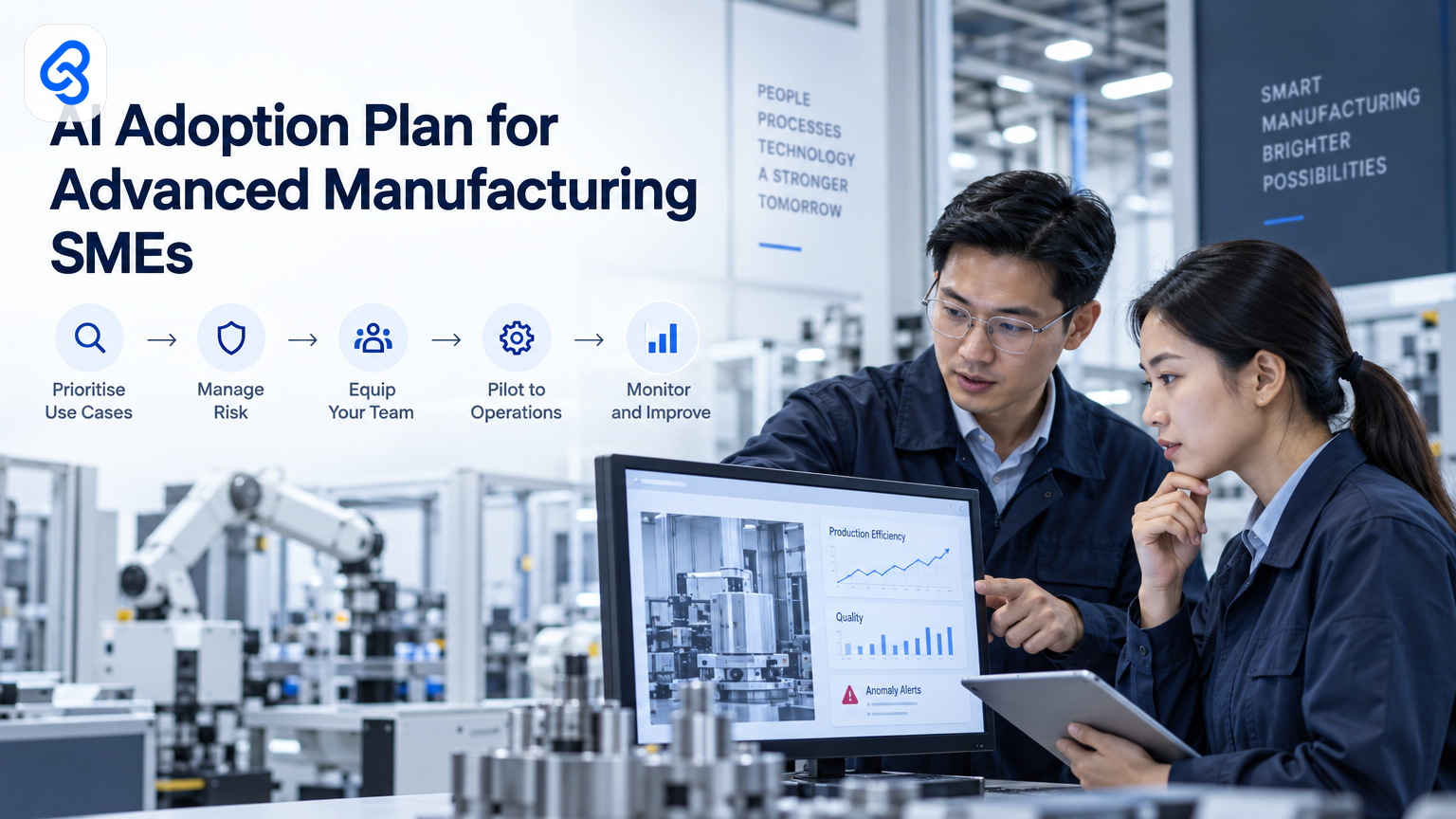
An ai adoption plan advanced manufacturing leaders can use should start with a production or business problem, not a shopping list of AI tools. For a Singapore SME, the first job is to choose a workflow that matters, check whether the people and data are ready, and decide who will turn a pilot into something the team can use every day.
That can feel like a lot when you have a small team and a full production schedule. The answer is not to plan every possible use of AI at once. Build a short, practical roadmap that connects one operational need to an owner, a working system and a clear decision about what comes next.
What should an AI adoption plan for advanced manufacturing include?
An AI adoption plan for an advanced manufacturing SME should connect a defined business problem to a workflow, the data and systems it relies on, a named owner, and a test for whether it works. It should also cover human review, data handling and the steps required to move from a pilot into daily use.
A roadmap is useful when it helps someone make a decision. If it names technologies but cannot say who will change a process, what data the workflow needs or what happens when it makes a mistake, it is not ready to guide implementation.
For a first version, include:
- A problem worth fixing: for example, slow responses to quality exceptions or time-consuming preparation of production reports.
- A defined workflow: where the work starts, who handles it now, and what output they need.
- A suitable first use case: one with a clear owner and a manageable risk if the system gets something wrong.
- A data and systems check: what information exists, who can access it and whether the necessary systems can exchange it.
- A human control: the point where someone checks, approves or corrects an AI-generated result.
- A measure of value: such as time saved per report, faster exception triage or fewer manual handoffs. Set the baseline before the pilot.
- A route to production: the support, permissions, training and handover the workflow will need after testing.
For a Singapore SME, the plan should fit the company's size and current digital setup. IMDA's Industry Digital Plans provide sector-specific digital guidance. They can help a business check relevant digital priorities, but they do not replace a plan based on the company's own processes.
Where should an advanced manufacturing SME start with AI?
Start where a recurring workflow creates a measurable burden and a staff member can check the output. Manufacturing teams might examine quality records, maintenance information, job instructions or reporting. Pick one narrow process that already has a clear owner, then check its data, exceptions and cost of error before choosing a tool.
A useful starting question is: Which task repeatedly makes a capable employee search, copy, compare, summarise or route information? That question often leads to a better first project than asking where the business can use AI.
Consider a quality coordinator who receives non-conformance reports from several sources and spends time sorting them, finding related records and preparing a summary for review. An AI-assisted workflow might classify each report and draft a summary for the coordinator to check. It should not make a final quality decision unless the company has assessed the consequences and put suitable controls in place.
Other candidates could include:
- Preparing a shift handover summary from approved production notes.
- Finding relevant passages in current work instructions for a supervisor's review.
- Sorting maintenance requests by equipment and urgency for a technician to confirm.
- Drafting a recurring production report from approved records.
These are examples to assess, not proof that AI will suit every factory. A use case that involves unclear data, no process owner or a costly error may need process cleanup before AI work begins.
For a wider look at whether your company has the right people, processes and data to begin, use Lynqra's AI readiness assessment for Singapore SMEs.
How do you choose a first manufacturing AI use case?
Choose a first use case by checking business value, data access, human review and implementation effort together. A promising workflow has a clear owner, a repeatable input and an output that someone can verify. Avoid starting with an important but poorly defined process where a mistake could affect safety, product quality or customer commitments.
A quick decision screen can make discussions more concrete. Score each item as low, medium or high, then discuss any disagreement with the person who owns the workflow:
1. Business value: Does the task consume meaningful staff time or delay a decision?
2. Repeatability: Do people follow a broadly consistent process?
3. Data access: Can the team find the necessary records and use them for this purpose?
4. Checkability: Can a staff member verify the result without redoing the entire task?
5. Failure impact: What happens if the output is wrong or late?
6. Implementation effort: Can the company connect the required systems and support the workflow?
This is a conversation aid, not a formula that produces the right answer automatically. For example, report summarisation may have lower risk than automated acceptance of a product defect. But a summary still needs reliable source records and a reviewer who knows what a correct result looks like.
Write down the reason for choosing the use case and the reason for rejecting the closest alternative. That short record helps leaders avoid restarting the same debate after a pilot.
How should the plan handle data, security and human review?
An AI plan should identify what information a workflow uses, who can access it and where a person must check the result. Start with the minimum data the task needs. Set out what the system may do, what it must not do and who investigates an incorrect output before anyone connects AI to operational records.
Manufacturing data can include personal information as well as production information. A workflow may contain employee names, contact details or customer records even if the original project concerns maintenance or quality. The company should check its data protection responsibilities and its controls before using personal data in an AI workflow. The PDPC's overview of Singapore's Personal Data Protection Act is an official starting point for understanding personal data obligations.
For each proposed workflow, record:
- Which systems provide the input and who owns those records.
- Whether the information includes personal, confidential or customer data.
- Which staff roles can view, change or approve outputs.
- Whether the AI can draft, classify, recommend or take an action.
- How staff report errors and how the owner reviews them.
- What happens when the system cannot confidently handle an input.
Keep the first version's authority narrow. For example, an AI system can prepare a maintenance request for a technician to review, while the technician decides whether to stop a machine or change a maintenance schedule. That division makes accountability clearer and gives the team a way to learn from incorrect suggestions.
How does an AI plan become an operating workflow?
A plan becomes an operating workflow when the team connects a real trigger to a sequence of actions, defines what each step hands to the next, and assigns someone to handle exceptions. A pilot should run on actual work under controlled conditions, with a human checking outputs and a clear way to pause or correct the process.
How this actually runs
Illustrative scenario: a small manufacturing firm wants to help its quality coordinator sort incoming non-conformance reports. The team already records each report in Google Sheets. The goal is to create a draft category and summary for the coordinator, not to decide whether a product passes inspection.
1. Trigger: A staff member adds a new report row to Google Sheets. The row includes the report description and a reference to the relevant record.
2. Read the record: An n8n workflow starts when it detects the new row. It passes the report text and approved reference fields to the next step. Google Sheets and n8n both document workflow-related capabilities in their official documentation: Google Apps Script overview and n8n workflow automation documentation.
3. Prepare a draft: The workflow sends the approved fields to an AI model through a configured connection. The model returns a suggested category and a short summary. It does not approve the report or change a production decision.
4. Record the handoff: n8n writes the draft and a review status back to Google Sheets. The coordinator sees the original report beside the suggested category and summary.
5. Human review: The coordinator checks the source record, corrects or accepts the draft and records the final category. That reviewed entry becomes the handoff for any existing follow-up process.
What breaks in practice? A report may lack a clear description, repeat an earlier case or use a term the model has not handled well. The workflow should flag missing fields, detect possible duplicates where the available data allows, and leave uncertain cases for manual review. If the AI connection fails, the original report should remain available for the usual manual process. The coordinator should be able to stop the workflow without losing the source record.
This example shows the kind of detail a plan needs. It does not show that any particular company uses this system, or that these tools suit every factory. Before implementation, check the available integrations, permissions and data rules against your actual setup.
How can a Singapore SME move from pilot to daily use?
Move a pilot into daily use only after the workflow's owner can show how it handles ordinary cases, exceptions and failures. Then document access, review responsibilities, staff training and support. A successful demonstration alone does not prove the system can run reliably in a production environment or fit the company's ongoing responsibilities.
During the pilot, compare results with the baseline you set earlier. Check whether the workflow saves time after staff review, whether it creates extra corrections and whether the team can explain what happens when the system fails. Ask the workflow owner to review a mix of routine and awkward cases, not just examples that make the tool look good.
Before rollout, confirm that:
- Someone owns the workflow and can approve changes.
- Staff know which output they must check and how to report a problem.
- The process still works if an integration or AI service becomes unavailable.
- Access matches each person's role.
- The company knows how it will review performance and update the workflow.
- The system's handover includes enough information for someone else to operate it.
If the company has a plan or a pilot but lacks the people to implement it, the next step may be a build. If leaders cannot agree on the first use case, start with consultation and planning. If staff need confidence using AI in their work, training may come first. Lynqra's AI services for Singapore SMEs cover plan, build and training, with the right sequence depending on the company's starting point.
Companies exploring grants or other support should check current requirements with official channels. Enterprise Singapore's capabilities and support overview is a place to review available support. Do not assume that a particular project qualifies. Check the relevant scheme's current details and eligibility before making plans around funding.
What should leaders do next?
Leaders should choose the next step based on what remains uncertain. If the team cannot identify a suitable workflow, begin with consultation. If employees lack practical AI skills, consider training. If the business already has a defined plan or pilot, scope the implementation, including its data, controls and route into daily operations.
A short internal review can clarify the choice:
- No agreed problem: map the workflow and identify a suitable first use case.
- A problem, but no capable team: build practical understanding through training.
- A plan or pilot with no implementer: define the system, controls, handover and support needed for implementation.
- A working pilot: check performance and exceptions before deciding whether to expand it.
The plan should make the next action easy to name. "Explore AI" does not. "Test whether the quality coordinator can use an AI-drafted report summary after checking the source record" does.
Frequently asked questions
These answers cover common planning decisions for Singapore manufacturing SMEs. The right sequence depends on the workflow, the data and the consequences of a mistake. Use the questions to identify what your team needs to settle before it spends time on a pilot or chooses an implementation partner.
Does an advanced manufacturing SME need an AI strategy before a pilot?
Not necessarily. A company can test one well-defined workflow before it creates a company-wide AI strategy. It should still name an owner, check the data and decide how staff will review outputs. Use the pilot to answer a business question, then use what the team learns to shape the broader roadmap.
Should we build an AI system or buy software?
Start by defining the workflow and checking the tools your company already uses. Existing software may handle a straightforward task, while a custom system may suit a process that needs specific integrations, access controls or review steps. Compare the options against the actual process and support needs, not a feature list alone.
Can AI make production or quality decisions without a person?
Do not assume it should. First identify the consequences of a wrong decision and the controls the company needs. For early workflows, AI can draft, sort or recommend while a qualified staff member checks the result. Any move towards automated decisions needs an explicit risk review, suitable testing and clear accountability.
What if we already have an AI plan or pilot?
Check whether the plan names an owner, data sources, human review, failure handling and the steps needed to support the system after launch. If these pieces exist but no one can implement them, scope the build and handover. If they do not, revisit the plan before adding more technology.
If you are unsure whether training, an AI plan or implementation should come first, book a free consult with Lynqra or email mark@lynqra.com. Bring one workflow your team wants to improve, and use the conversation to decide what should happen next.