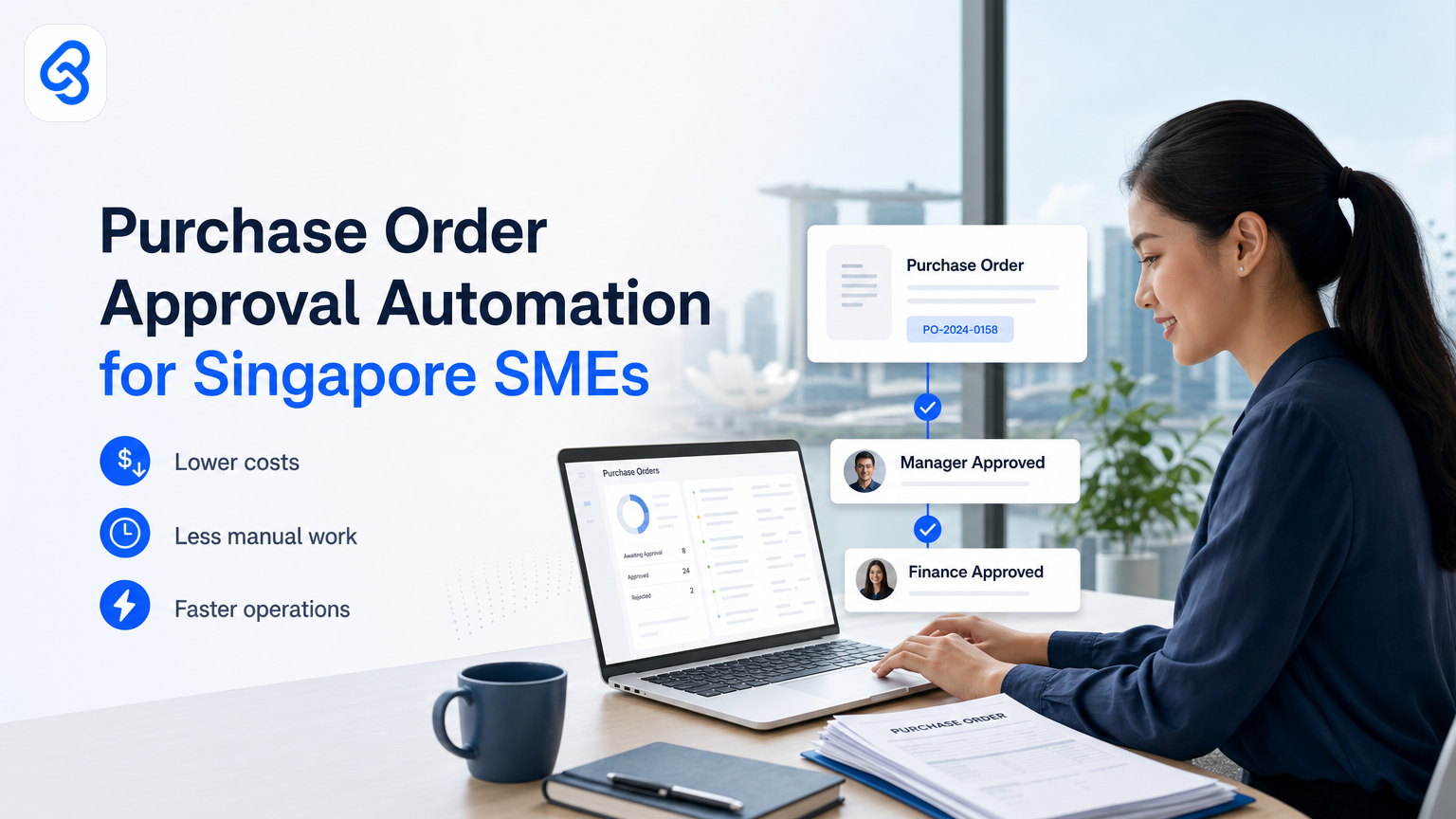
For Singapore SMEs managing purchase orders, approval delays often reduce efficiency and stall cash flow. Purchase order approval automation can eliminate manual bottlenecks, shorten processing times, and free teams to focus on higher-value tasks. This article guides Singapore SME owners through the meaning, benefits, practical steps, and government support for purchase order approval automation suitable for local businesses.
What is purchase order approval automation and why does it matter for Singapore SMEs?
Purchase order approval automation uses technology to streamline and manage the approval of purchase orders without manual input. Traditionally, purchase orders are approved via paper forms or email exchanges, leading to errors, delays, and duplicated effort. Automating the approval workflow helps Singapore SMEs by reducing turnaround times, minimizing human mistakes, and cutting administrative costs.
Singapore SMEs operate with tight margins and fast-paced demands. Automation that speeds routine activities directly improves cash flow and enhances supplier relationships. According to IMDA SMEs Go Digital, automation adoption enables businesses to scale sustainably by freeing staff from repetitive tasks, with approval workflows among the top automation candidates.
Purchase order approval automation also complements other relevant SME priorities such as accounts payable automation and delivery order automation. Learn more about these interconnected processes in Lynqra's detailed guide on Accounts Payable Automation Singapore, How to Build It Right.
How can Singapore SMEs start automating purchase order approvals?
Begin by mapping your current purchase order approval process: identify who creates POs, who approves them, approval methods, and pain points such as errors or delays. Then seek automation tools that fit your existing IT setup with minimal disruption to your team.
Common automation triggers include the submission of purchase order forms or entry of PO data into an accounting system. Workflow automation platforms like Microsoft Power Automate or n8n can route the PO to the correct approvers following your specific business rules. These platforms also send notifications and reminders to keep approvals moving and automatically update ERP or accounting systems to reflect the PO status.
Singapore SMEs can integrate these tools by connecting accounting software such as Xero, messaging platforms like Microsoft Teams or Slack for approvals, and cloud storage or Google Sheets for PO record-keeping. The IMDA Industry Digital Plans provide tailored guidance for different industries on digital transformation, including automation adoption.
Before implementing, review if your approval processes require multiple sign-offs or compliance checks and design your automated workflows accordingly to meet these needs.
What grants or government support exist for purchase order approval automation in Singapore?
Multiple schemes in Singapore encourage SMEs to adopt digital solutions and automation. For instance, Enterprise Singapore's capability upgrading grants help finance investments into process automation technologies,though eligibility and coverage details must be checked on official websites.
IMDA's SMEs Go Digital program offers advisory services and implementation support to help SMEs adopt automation aligned with industry best practices. Since grant conditions and amounts vary, verifying the latest requirements from official portals is essential before applying.
SMEs should prepare automation projects that demonstrate tangible ROI such as reducing approval delays, lowering manual errors, or improving visibility over purchase-to-pay cycles. This practical approach often attracts better funding support than abstract technology projects.
How does purchase order approval automation actually run? A practical workflow example
Here is a concrete example for a mid-sized Singapore SME using Microsoft Power Automate, Google Sheets, and Microsoft Teams to automate purchase order approval:
1. Trigger: A team member submits a purchase order request through a Google Form connected to Google Sheets. This submission triggers a Microsoft Power Automate workflow.
2. Step 1: Power Automate detects the new PO entry in Google Sheets and checks the purchase order amount.
3. Step 2: If the PO amount is below S$5,000, Power Automate sends an approval request via Microsoft Teams chat to the department head containing the PO details.
4. Step 3: The department head approves or rejects the PO directly in Microsoft Teams. Power Automate captures the response instantly.
5. Step 4: When approved, Power Automate updates the PO status in Google Sheets and emails the supplier using a predefined email template with PO details. If rejected, the requester receives an email with remarks.
6. Step 5: Every step is timestamped and logged in Google Sheets, creating a clear audit trail for accounting and compliance purposes.
Handling exceptions:
- Power Automate sends reminders if no approver response is received within 2 business days and escalates the request to a higher manager if necessary.
- If the email to the supplier bounces, the workflow flags the PO record and alerts the finance team for follow-up.
This workflow leverages common cloud tools familiar to many SMEs in Singapore, reducing paperwork, shortening approval times from days to hours, and increasing transparency.
What are the risks and challenges when implementing purchase order approval automation in Singapore SMEs?
Common risks arise from automating poorly understood or inefficient processes. Without careful workflow mapping and user training, automation can lock in errors or cause new bottlenecks. Some SMEs may face technical challenges integrating legacy accounting or procurement systems without open APIs.
Compliance and audit requirements are another concern. Automated workflows must securely log approval actions to meet tax and regulatory obligations enforced by authorities such as IRAS. Failure to maintain proper audit trails could lead to compliance issues.
Additionally, staff resistance to new digital workflows can delay adoption. Effective change management, involving users early and rolling out automation in phases, reduces such risks.
What practical checklist helps Singapore SMEs decide if they are ready for purchase order approval automation?
- Have you documented your current PO approval process and identified pain points?
- Do you clearly understand your approval hierarchies and decision rules?
- Are your existing tools cloud-based or offer APIs enabling integration?
- Can you define measurable benefits like speed improvements or error reductions to assess ROI?
- Have you reviewed relevant compliance and audit requirements?
- Is there leadership support and team willingness to adapt workflows?
Answering yes to most suggests your SME is ready to implement automation confidently.
How does purchase order approval automation connect with other SME processes?
Purchase order approval automation is a key part of the broader procure-to-pay cycle. It integrates closely with accounts payable automation to match invoices against approved POs, preventing payment errors and fraud. It also connects with inventory management and logistics processes to streamline the supply chain.
For deeper insights, read Lynqra's post on Delivery Order Automation Singapore Logistics for SME. Combining these automation layers improves cash flow forecasting, supplier negotiation, and contract compliance by providing a unified view of procurement and payment activities.
What next steps should Singapore SME owners take?
Consider scheduling a free consultation with Lynqra to review your existing workflows and identify where automated purchase order approvals can deliver tangible benefits without burdening your teams. Lynqra specializes in ROI-focused automation using the latest AI and workflow tools customized to your needs. Contact Lynqra via the contact page or email mark@lynqra.com for a no-obligation discussion.
Meanwhile, explore Singapore government-supported digital capability initiatives such as those from Enterprise Singapore and IMDA to potentially fund or assist your automation journey.
---
FAQ
What manual tasks does purchase order approval automation eliminate?
It removes manual email chasing, repeated data entry into accounting systems, and supplier notification by automating approvals, reducing errors and saving employee hours.
Is automation suitable for all Singapore SMEs?
Most SMEs with multiple purchase orders benefit; the key is customizing automation complexity to your business size and needs without rigidifying workflows.
How does automation improve approval compliance?
Automation enforces preset approval rules, logs each step, and sends alerts or escalations if approvals stall, ensuring processes remain transparent and auditable.
Which tools are ideal for purchase order approval automation?
Microsoft Power Automate and n8n are popular choices due to integration capabilities. Affordable tools like Google Sheets and Microsoft Teams offer accessible starting points for SMEs.
Are there government grants supporting purchase order automation?
Yes. Grants from Enterprise Singapore and advisory support via IMDA SMEs Go Digital exist but always verify eligibility and conditions from official sources before applying.
---
For related operational automation insights, see: