Model AI Governance Framework Singapore: A Practical Guide
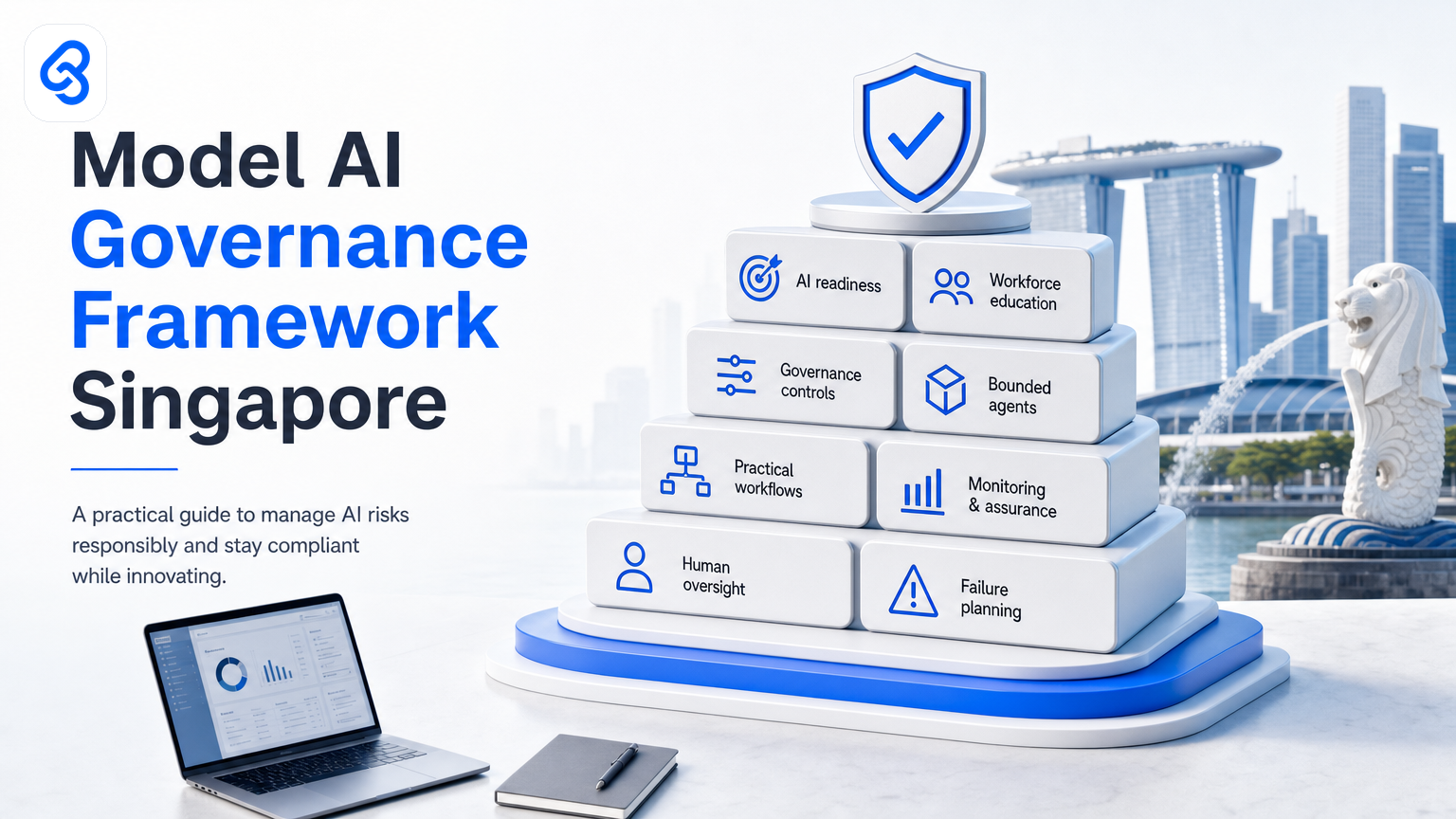
If you run a Singapore business and have started adopting AI tools, you might feel the tension between speed and safety. You want faster operations and cost savings, but you also need clarity on managing risks when things go wrong. Your team requires guardrails, your board demands oversight, and your customers expect confidence in your use of AI.
This tension lies at the heart of building a model AI governance framework for your business. You cannot pause AI adoption to write endless policies, nor can you allow unchecked AI use. The solution is a governance model aligned with how your business operates, enabling responsible innovation while effectively managing risks.
This article walks you through what a model AI governance framework for Singapore SMEs looks like in practice, how it aligns with regulatory expectations, and how you can build one tailored to your needs.
What does a model AI governance framework actually do?
A governance framework for AI is a structured system of roles, rules, and reviews that ensures AI use aligns with your company's values, operational goals, and legal requirements. It clarifies when AI is used, for what purposes, how data is handled, and who is responsible for assessing risk and compliance.
Many Singapore SMEs adopt AI tools rapidly but skip formal governance. That causes uncertainty around output quality, data protection compliance such as the Personal Data Protection Act (PDPA), and how to handle risks like AI bias or errors. A model framework anticipates these challenges and channels innovation without causing delays.
It bridges your board's risk appetite with front-line teams' day-to-day AI use, designing decision rights, documenting AI adoption decisions, and enabling compliance with regulators including the Monetary Authority of Singapore (MAS), the Personal Data Protection Commission (PDPC), and the Accounting and Corporate Regulatory Authority (ACRA).
How does Singapore's regulatory context shape your AI governance framework?
Singapore currently does not have AI-specific legislation. However, existing laws and guidance govern critical AI aspects:
- The Personal Data Protection Act (PDPA) covers any AI processing of personal data. If your AI tools analyze customer or employee information, you must comply with PDPA principles such as consent, purpose limitation, and data protection.
- The Monetary Authority of Singapore (MAS) expects financial institutions to maintain rigorous AI model validation and audit trails. SMEs handling payments or credit data should align their governance accordingly.
- Employment laws apply when AI influences hiring and employee evaluation decisions.
- The Accounting and Corporate Regulatory Authority (ACRA) and Inland Revenue Authority of Singapore (IRAS) require transparency when AI-generated content affects financial reporting or tax submissions.
Understanding these rules enables your governance framework to demonstrate responsible AI use and legal compliance, turning "we use AI" into "we use AI responsibly."
What are the core components of a working AI governance framework?
A practical framework for Singapore SMEs generally consists of four pillars: intake, guardrails, oversight, and learning.
Intake is a formal review process for approving new AI tools or uses before they enter production. Team members submit details,such as AI purpose, data involved, and decision ownership,through a simple form. This promotes thoughtful adoption and creates a central registry for your AI tools.
Guardrails are operational rules reflecting your risk tolerance. Examples include prohibiting unencrypted customer data in prompts, requiring human review before publishing AI-generated outputs, or limiting AI to advisory roles rather than autonomous decisions. Guardrails differ by sector: a logistics firm might allow autonomous route planning whereas financial services firms may forbid it.
Oversight is a regular review cycle auditing AI outputs and compliance with guardrails. This could mean quarterly spot-checks of AI-assisted decisions to detect mistakes, bias, or data misuse. Ongoing oversight builds a compliance record for regulators and strengthens internal controls.
Learning closes the loop by logging issues found during oversight, revisiting intake approvals, and refining guardrails accordingly. This continuous improvement deepens governance maturity alongside evolving AI use.
How does a compliance intake and audit workflow actually run?
Consider an illustrative example: a 40-person insurance broker where several agents use the AI tool Claude for drafting email replies. This workflow uses real tools familiar to many Singapore SMEs:
Trigger: An agent completes a Google Form requesting approval to use Claude. They provide details such as use case, data involved, review procedures, and expected volume. The form feeds data into Google Sheets, where Google Apps Script automations centralize tracking.
Step 1: An n8n workflow routes the intake request to the data protection officer for PDPA compliance review and to the IT team to validate Claude's data security policies.
Step 2: The data protection officer approves usage with guardrails in place (for example, banning policy numbers in prompts). Claude is added to the approved AI tools list.
Step 3: The compliance officer performs weekly audits on sampled Claude email outputs, checking for human review, accuracy, and guardrail compliance.
Step 4: If issues arise,such as agents including phone numbers in prompts,the team updates guardrails (using pseudonyms instead), retrains agents, and implements a checklist ensuring human review quality.
This workflow exemplifies safe, scalable AI adoption with ongoing governance, leveraging accessible digital tools like Google Workspace and n8n automation.
How does this connect to Singapore's AI readiness and grants ecosystem?
Singapore's IMDA SMEs Go Digital initiative and Industry Digital Plans promote digital transformation and AI adoption across sectors like retail, logistics, and food and beverage. Responsible AI use is a key expectation of these programmes.
When applying for funding through schemes such as Enterprise Singapore's Boost Capabilities Programmes, demonstrating a governance framework can strengthen your application by showing risk management readiness and the ability to capture value from AI investments.
Your framework also supports workforce development by clarifying AI decision rights and safety protocols, enabling focused upskilling beyond general digital literacy. Learn more in Lynqra's Singapore AI Workforce Training resource.
What happens after you build the framework?
An AI governance framework is a living system. Quarterly or event-driven reviews keep it aligned with evolving AI uses and emerging risks.
As your automation landscape grows complex,linking tools like Claude, n8n, Slack, and others,your governance must scale to manage handoffs, fallback plans, and user training. Ongoing workforce education ensures everyone understands the governance rules, not just the tools.
Partnering with external consultants experienced in Singapore's AI ecosystem can help tailor your framework and uncover blind spots, such as unmanaged employee data uses or unclarified risk appetite.
Building your AI governance framework: a practical checklist
- Define key risk categories relevant to your business (e.g. data privacy, accuracy, bias, decision impact)
- Establish a simple intake process specifying submitters, reviewers, and approvers for AI tool use
- Create 3 to 5 guardrails reflecting your risk stance and making compliance actionable
- Set regular oversight cadence (monthly or quarterly) with clear accountability
- Document at least one concrete AI workflow illustrating governance in action
- Review effectiveness and adjust governance within three months of rollout
This approach creates a manageable and evolving system suitable for your SME's scale and pace.
FAQ
What is the difference between an AI governance framework and an AI policy?
A policy is a high-level statement or rule. A governance framework is the operational setup that implements those policies through defined roles, processes, and oversight.
Do I need to publish my AI governance framework?
No, it is primarily an internal guide for managing AI risks and compliance but should be clear and auditable for regulators if requested.
How often should I review my AI governance framework?
At least quarterly or whenever new AI tools or processes are introduced. More frequent reviews suit fast-innovating companies.
Can very small businesses implement such a framework?
Yes, governance scales with business size and AI use. Even simple intake and oversight processes add value.
What should I do if oversight identifies an issue?
Document the problem, investigate root causes, fix promptly, update guardrails, and communicate changes clearly. Continuous improvement is essential.
Additional Resources
Lynqra's blogs offer further assistance:
- Singapore AI Workforce Training
- Govern the AI you already use. Then keep it current.
- How Much Does Business Automation Cost for Singapore SMEs?
Official government support to explore:
- IMDA SMEs Go Digital
- IMDA Industry Digital Plans
- Enterprise Singapore grants overview
- PDPC data protection officer guidance
With a model AI governance framework, your Singapore SME can innovate confidently,balancing speed with safety and positioning for sustained success in the digital economy.
If you want help assessing your AI readiness or building a tailored governance framework, contact us through our AI Governance and Safety Singapore page or explore our AI Transformation Services Singapore.