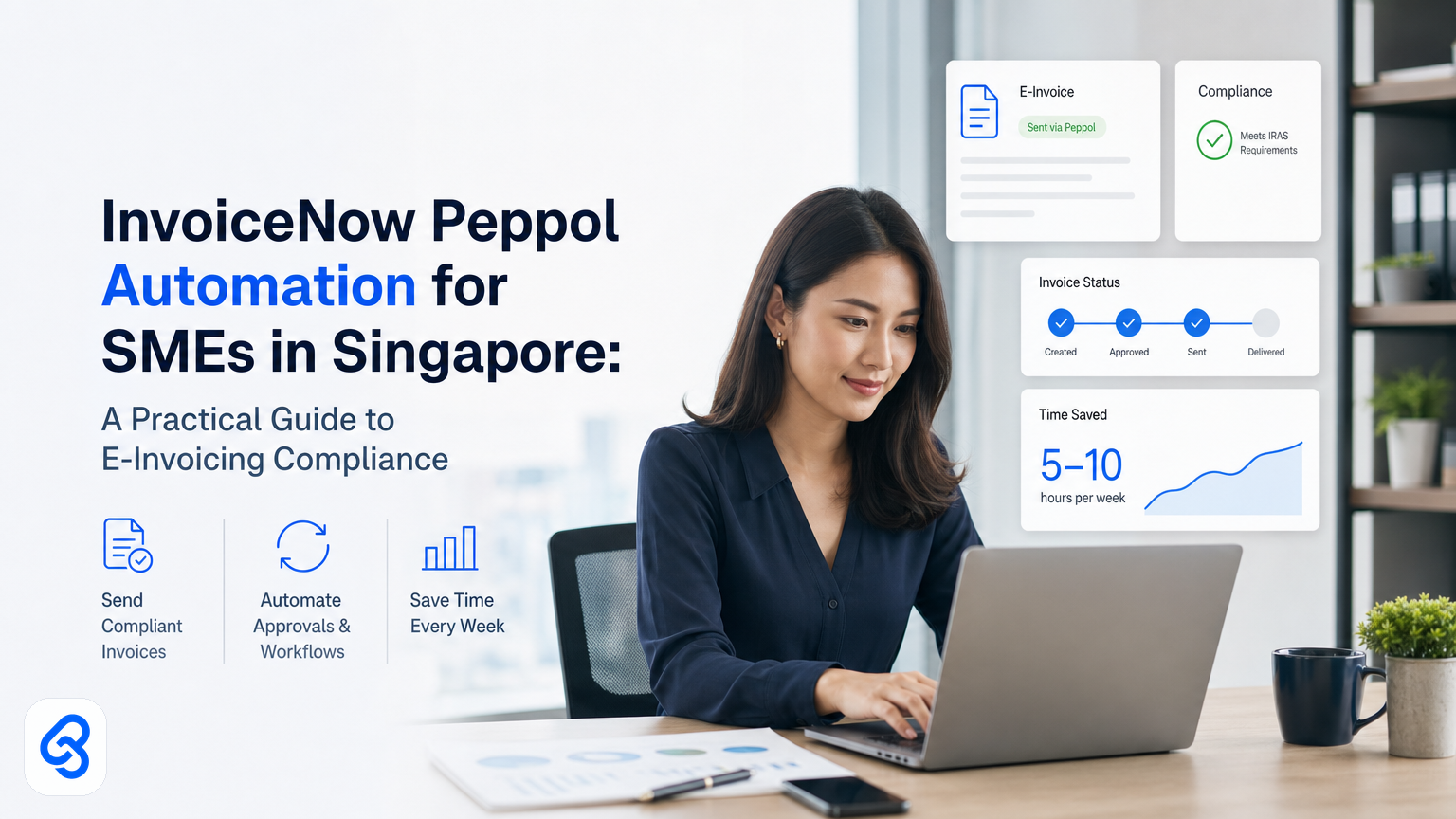
If you run a GST-registered business in Singapore, you've probably heard that InvoiceNow is coming. From April 2028, you'll need to transmit invoice data directly to the Inland Revenue Authority of Singapore (IRAS) via Singapore's nationwide e-invoicing network. But InvoiceNow Peppol automation is not just a compliance checkbox. Implemented well, it can cut invoice processing time, reduce manual errors, accelerate payment cycles, and free up your team to focus on things that actually grow your business.
The catch: most SMEs don't know where to start, and many worry that adopting e-invoicing means ripping out their existing systems and learning new software. It doesn't have to be that way. In this guide, we walk you through what InvoiceNow is, who needs to comply, when, what your automation options are, and how to avoid the common pitfalls that slow down SME implementations.
What is InvoiceNow and why does it matter for your business?
InvoiceNow is Singapore's nationwide e-invoicing network based on the Peppol standard. Introduced by the Infocomm Media Development Authority (IMDA) in 2019, it allows businesses to send and receive invoices in a structured digital format over a secure network. Instead of printing, scanning, or emailing PDF invoices, you submit invoice data electronically, which reduces manual entry, cuts processing delays, and gives IRAS real-time visibility into your transactions for tax purposes.
The Peppol framework ensures that invoices move securely between certified access points across the country. IRAS uses InvoiceNow data to streamline tax administration and help businesses comply with GST rules more easily. But beyond compliance, SMEs see real operational wins: faster invoice reconciliation, fewer payment disputes, cleaner audit trails, and less time spent chasing receipts or re-entering invoice details into spreadsheets.
For a typical distribution or trading SME, invoice processing can eat 5 to 10 hours per week just in manual data entry, filing, chasing approvals, and reconciliation. Automation of that workflow, integrated with InvoiceNow, is where the ROI kicks in.
Who must comply with InvoiceNow, and when?
InvoiceNow compliance is phased in based on business revenue and GST registration status. In broad terms:
- Businesses with an annual GST turnover of more than SGD 10 million must comply from April 2025.
- Businesses with GST turnover between SGD 5 million and SGD 10 million must comply from January 2026.
- Businesses with GST turnover below SGD 5 million must comply from April 2028.
- Certain businesses, such as those in prescribed industries or with specific exemptions, may be excluded or given extensions.
Even if your deadline is 2028, early adoption is worth considering. Businesses that move early often receive support, access to IMDA SMEs Go Digital resources, and more breathing room to debug their workflows before the hard deadline. Early adopters also signal to customers that you take digital efficiency seriously, which can improve payment cycles and reduce friction with larger trading partners.
How does InvoiceNow automation actually work?
Most SMEs think e-invoicing means buying specialized software. In reality, InvoiceNow automation can happen in layers, and the best approach depends on what systems you already use and how complex your invoicing workflow is.
Layer 1: Direct submission via an InvoiceNow-ready provider. You choose a certified e-invoicing solution provider (such as accounting software, an ERP system, or a standalone Peppol access point) and configure your invoicing to flow directly to IRAS. This is straightforward for simple, high-volume invoicing.
Layer 2: Integration between your existing tools and an InvoiceNow provider. You keep your invoicing in Google Sheets, your accounting software, or your email workflow, and automation bridges that system to an InvoiceNow-ready solution. Data flows from your source system into the Peppol network without manual re-entry.
Layer 3: Workflow automation around invoice creation, approval, and submission. Before you even hit the InvoiceNow network, you automate the steps that create the invoice data in the first place: pulling order details from forms, auto-populating customer records, routing invoices for approval, flagging missing tax IDs, and only then submitting to InvoiceNow.
Most SMEs benefit from a combination of Layers 2 and 3. You don't need a big ERP platform or a heavy new accounting tool. You can work inside tools you already use, add automation to remove the manual steps, and then push the clean invoice data into an InvoiceNow-ready solution for compliance transmission.
How to automate invoice workflow before InvoiceNow submission
Here's a concrete walkthrough of how invoice automation works in practice, using a typical SME scenario: you generate invoices for customers after they place orders, an approver reviews them, they get sent to customers, and their data must eventually flow into InvoiceNow.
Trigger: A new order is confirmed (this could come from an email, a form submission, your sales system, or even a message from a salesperson).
Step 1: Extract and validate order data. Automation reads the order details (customer name, items, quantities, dates, tax ID) and checks that all required fields are present. If a customer record is missing a tax ID or a business registration number, the automation flags it and notifies the finance team before the invoice is drafted. This is where AI data extraction helps: systems can read unstructured emails or documents and pull the right fields without human intervention.
Step 2: Generate invoice data. Using the validated order data, automation populates an invoice template, calculates line items and taxes correctly, and formats the invoice as a structured record (not just a PDF).
Step 3: Route for approval. The draft invoice is sent to the designated approver (often a manager or finance lead) via email or your existing approval system. The approver sees a summary, flags any issues, and clicks to approve or reject. Rejected invoices return to the originator with feedback. Approved invoices move forward.
Step 4: Deliver to the customer. Once approved, the invoice is sent to the customer via email (as a PDF or link, depending on your preference). A copy is logged in your records.
Step 5: Prepare for InvoiceNow submission. The invoice data is then formatted to InvoiceNow standards and queued for submission. If you're using an InvoiceNow-ready solution provider, this step may be automated too. The key is that no data is re-entered; it flows from system to system.
Step 6: Monitor and reconcile. As invoices are submitted, automation tracks which ones went through, which ones had errors, and when payments arrive. Mismatches between submission records and payment records trigger alerts so you can follow up on unpaid invoices.
Common pitfalls to avoid:
- Dirty data in your customer database. If half your customers are missing tax IDs or have duplicate records, automation will either fail or produce invalid invoices. Audit your customer list before you automate.
- Assuming one tool does everything. Most SMEs need a mix: email or forms to capture orders, a data store (Sheets, a CRM, or your accounting system) to hold records, automation to connect them, and an InvoiceNow provider to handle the final submission. Don't try to force everything into one platform.
- Starting too ambitious. Automate your highest-volume, most repetitive invoicing first. Prove the ROI with one workflow, then expand. If you try to automate everything at once, you'll hit roadblocks and lose momentum.
- Forgetting about audit trail and compliance. InvoiceNow requires you to keep records of who did what and when. Make sure your automation platform logs all actions (who approved, who submitted, when) so you can answer IRAS questions later.
Does InvoiceNow automation need new software?
No. If you currently work in Google Sheets, email, and basic accounting software, you don't need to replace those tools to comply with InvoiceNow. Instead, you add a layer of automation that connects your existing workflow to an InvoiceNow-ready provider. This approach has three advantages:
1. Lower switching cost. Your team doesn't need to learn new software. They keep working in tools they know.
2. Faster implementation. You're not migrating years of data or retraining staff. You're automating what's already working.
3. Easier iteration. As your business changes, you tweak the automation, not the underlying system. Your core tools remain stable.
The IMDA programme encourages SMEs to build on existing infrastructure and use automation to improve efficiency, rather than rip-and-replace their entire tech stack. The focus is on solving real bottlenecks, not just buying new software. Our guide to invoice and accounts payable automation for Singapore SMEs explores how to build this hybrid approach in more detail.
What does InvoiceNow automation cost, and where can you find funding?
InvoiceNow automation cost depends on your current setup and how much complexity you want to handle.
If you're using a simple certified e-invoicing provider (basically a Peppol access point), the subscription cost is usually modest, anywhere from SGD 30 to SGD 200+ per month depending on the provider and transaction volume. That's the compliance cost.
If you also want to automate the steps before submission (data extraction, approval routing, validation), you're adding another layer. Some of this can be built in-house using tools like Zapier or Make, but for most SMEs, working with an automation consultant is faster and more reliable. A custom invoice automation project typically costs between SGD 2,000 and SGD 10,000 depending on complexity, but the payback is fast: most SMEs save 5 to 10 hours per week, which translates to SGD 1,000 to SGD 3,000 per month in freed-up time.
Singapore offers grant support for automation projects. Enterprise Singapore's financial assistance programmes include grants that help SMEs fund digital transformation and process automation. Additionally, IMDA's Industry Digital Plans offer sector-specific support and co-funding for eligible businesses. Both programmes have different eligibility criteria and timelines, so you should check the official sites and speak with a grant advisor to understand what applies to your business. We work with grant advisory partners who help clients explore suitable funding pathways based on their profile and scope. More detail is available in our guide to AI automation grants in Singapore and SME ROI.
The key point: don't let cost be a blocker. Grants can cover 30 to 70% of the project cost, and the efficiency gain from automation usually pays for the whole thing in the first few months.
What risks should you watch for?
Data security. InvoiceNow uses Peppol, which is a secure standard, but your invoice data will move over networks. Work with providers who comply with Singapore's cybersecurity standards and have clear data handling policies. Check that they hold no more data than they need and that they encrypt in transit and at rest.
Data privacy. Invoices contain customer details, which fall under Singapore's Personal Data Protection Act (PDPA). Make sure your automation and InvoiceNow provider are PDPA-compliant and have signed data processing agreements. The PDPC's guide to data protection responsibilities outlines your obligations as a business handling customer data and provides step-by-step guidance on compliance.
Integration gaps. If your automation connects three or four different systems, one API change or provider update can break the flow. Choose stable, well-documented integrations, and test thoroughly before going live. Leave some manual fallback steps in place for the first few weeks.
Process lock-in. If you automate a workflow that's broken, you'll scale the broken process. Before you automate invoice approval, for example, make sure your approval rules and customer data are clean. Automate a solid process, not a workaround.
Incomplete compliance. Just because you submit via InvoiceNow doesn't mean you're tax-compliant. You still need to keep proper records, handle GST correctly, and respond to IRAS queries. InvoiceNow is a transmission mechanism, not a tax filing system.
Decision framework for InvoiceNow automation
Use this checklist to decide whether InvoiceNow automation is right for your business and where to start:
- Are you GST-registered? If no, InvoiceNow is not mandatory (though you may still benefit from general invoice automation).
- When is your compliance deadline? If you have until 2028, you have time to plan and test. If your deadline is 2025 or 2026, start now.
- How many invoices do you generate per month? If it's more than 100, automation ROI is strong. If it's fewer than 20, you might handle it manually and only focus on the InvoiceNow transmission step.
- How much time does invoicing take your team currently? If it's more than 5 hours per week, automation will pay for itself quickly.
- What tools are you already using? If you're on Google Sheets and email, you can automate incrementally without a large system change. If you're on a legacy ERP, integration is more work but still doable.
- Do you have support budget? If yes, a managed implementation from an automation consultant reduces risk and speeds up deployment. If no, you can build it yourself or in steps.
- Are there grant funds available? Check with Enterprise Singapore and IMDA. Grant funding can reduce your out-of-pocket cost by 30 to 70%.
If you answered yes to most of these questions, especially the time-saving and tool-use ones, it's worth exploring automation. Start with a small pilot (one invoice type, one approval chain) and prove the ROI before you scale. Learn more about how to plan a phased rollout in our guide to accounts payable automation in Singapore.
Frequently asked questions about InvoiceNow automation
Do I need to buy new accounting software to use InvoiceNow?
No. You can work with your current accounting system, spreadsheets, or email, and add automation to connect to an InvoiceNow-ready provider. Many SMEs use this hybrid approach and save money on software licensing while still complying with the InvoiceNow requirement.
What happens if I don't comply with InvoiceNow by my deadline?
IRAS has phased penalties for non-compliance. Missing the deadline can result in fines and increased audit scrutiny. Early adoption avoids this risk and often qualifies you for support and grants.
Can I automate invoice approval and still maintain an audit trail?
Yes. Good automation platforms log every action (who approved, when, what changed) and produce audit reports. This is standard for compliance-grade systems.
Will InvoiceNow automation work if I have customers overseas?
InvoiceNow is for invoices issued in Singapore and transmitted to IRAS. Overseas invoices follow different rules. Your automation can handle both, but you need to route them correctly.
How long does a typical InvoiceNow automation project take?
Simple projects (connecting one invoice workflow to an InvoiceNow provider) take 2 to 4 weeks. More complex ones (multi-step approval, data extraction, integration with multiple systems) take 6 to 12 weeks. Most of that is discovery, testing, and iteration, not technical build time.
What's the difference between building automation in-house versus hiring a consultant?
Building in-house gives you control and lower upfront cost, but it takes longer and requires staff with automation experience. A consultant brings best practices, faster delivery, and ongoing support. Most SMEs find the consultant route faster and lower-risk, especially for compliance-critical workflows like invoicing.
Can I start small and expand my automation later?
Yes. Start with one invoice type or one approval chain, prove the ROI, and then expand to other workflows. This staged approach reduces risk and lets you learn what works for your business before you scale.
Next steps
InvoiceNow compliance is not optional, but the way you implement it is. You can choose a tool-heavy approach or a lean, automation-driven one. The lean approach tends to fit SMEs better: less disruption, lower cost, faster ROI, and easier to tweak as your business grows.
If you're an SME in Singapore facing an InvoiceNow deadline, or if invoice processing is eating up your team's time, we can help. We work through your current workflow, identify the bottlenecks, and build automation that fits into the tools you already use. No heavy software, no template solutions, no unnecessary platform migration. Just cleaner processes, compliance on track, and time back for your team.
Book a free discovery call to talk through your invoice workflow and see if automation makes sense for your business. Visit our contact page or email us to get started.