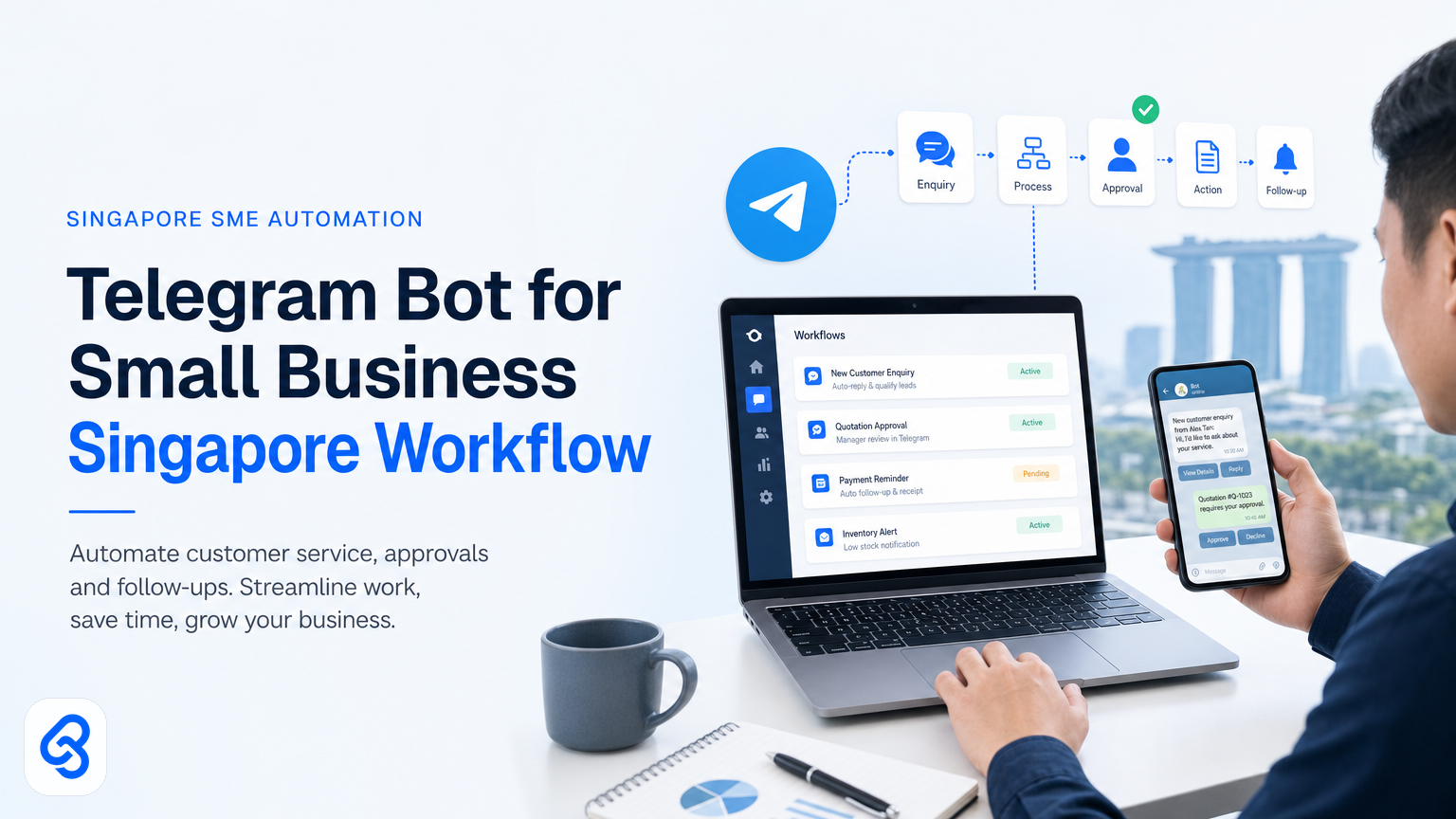
When your team spends two hours a day answering the same customer questions, chasing invoices, or manually updating spreadsheets, you lose money. A Telegram bot can stop that. This guide shows Singapore SME owners how Telegram bots fit into real workflows, what they actually automate, and how to decide if one works for your business.
Why Telegram for small business automation in Singapore?
Telegram has over one billion monthly active users globally, and it's now the fourth most downloaded messaging app in Singapore. Your customers likely already use it. Unlike WhatsApp, Telegram has built-in automation tools, webhooks, and a public API that work without jumping through hoops. You don't need to host your own server or negotiate enterprise licenses upfront. That matters for a bootstrap SME.
More importantly, Telegram bots handle triggers (a customer sends a message, someone uploads a file, a time passes) and run workflows in response. They fetch data, send confirmations, tag requests, escalate urgent items, or store information without a human touching the keyboard. For a small team, that cuts repetitive work by 30 to 60 percent depending on the workflow.
What workflows can a Telegram bot actually automate?
A Telegram bot works best on tasks where the input is a message, a file upload, or a scheduled time, and the output is a quick response or a record in another system.
Customer inquiry triage and first response. A customer messages your business account with a question. A bot checks a FAQ, detects the topic (invoice status, product availability, shipping date), and sends an instant answer. If the question needs a human, the bot flags it and sends your team a notification. This cuts response time from hours to seconds for routine questions.
Invoice and quotation requests. A client messages "Invoice for Project X" or uploads a purchase order. The bot parses the message, pulls the relevant project details from your system (if integrated), generates a draft invoice or quotation, and sends it back. Your accountant reviews it once before sending. The bot logs every request so nothing gets lost in chat history.
Approval workflows. A team member needs approval to spend money, adjust a client contract, or hire a freelancer. They message the bot with the request. The bot captures the details, sends the approval request to the decision maker on Telegram, logs the decision, and notifies the requester. No email chain, no delays, all timestamped.
Lead capture and follow-up scheduling. A prospect messages your sales channel. The bot collects their name, phone, and interest area, stores it, and schedules a follow-up reminder for your sales team three days later. The bot can also send weekly reminders until the lead converts or opts out.
Stock or booking status checks. A customer asks if a product is in stock or if a service slot is available. The bot checks your inventory or booking system in real time and replies instantly with availability and price.
Document collection and task assignment. You need signatures, receipts, or completed forms from your team or a client. The bot sends a request via Telegram, collects responses, stores files, and marks tasks complete when all items arrive.
These workflows share one thing: they replace manual back-and-forth, waiting, or repetitive data entry. They don't replace relationship building or complex negotiation.
How does a Telegram bot workflow actually work? A practical example.
Let's say you run a logistics or fulfillment company in Singapore, and clients constantly ask "Has my shipment left the warehouse?" Your team answers the same question fifty times a week.
The trigger: A customer sends a message with a shipment reference number.
Step 1 (bot): The bot receives the message and extracts the reference number using pattern matching or natural language understanding.
Step 2 (integration): The bot queries your warehouse management system or tracking database via an API and retrieves the shipment status (packed, in transit, delivered).
Step 3 (bot): The bot composes a reply: "Reference XYZ123 left the warehouse on 15 Jan at 2:30 PM and is with courier ABC. Expected delivery: 17 Jan. Track here: [link]."
Step 4 (bot): The bot sends the reply immediately and logs the inquiry in your CRM so your sales team knows the customer was active today.
Step 5 (escalation): If the bot detects a problem (shipment delayed, returned, or lost), it tags a supervisor and flags the chat as urgent instead of resolving it alone.
Common pitfalls:
- The bot doesn't have access to your live data. It sends cached information that's hours old, frustrating customers.
- The bot misunderstands slang or abbreviations. Customers write "tracking no" or "ref no" and the bot fails.
- The bot escalates every edge case and wastes your team's time. Train it to handle 80 percent of cases fully and escalate only the last 20 percent.
- Your team ignores escalated chats because they blend into the group noise. Set up separate notification channels.
Building a Telegram bot: in-house, no-code, or hire a partner?
In-house development. If you have a developer on staff, they can build a bot using the Telegram Bot API in Python, Node.js, or Go. This takes 2 to 4 weeks for a basic workflow. You own the code and have full control. The ongoing cost is server hosting (a few dollars per month) plus development time for updates and integrations. Best if the workflow is stable and your developer has capacity.
No-code platforms. Services like Zapier, Make (formerly Integromat), or Telegram-specific bot builders let you drag workflow steps without coding. Setup is faster (days), but you pay per workflow or per action. If you need to connect to obscure systems, these platforms may not support them. Good for simple, one-off automations.
Custom automation partner. You describe the workflow, someone builds it, integrates it with your actual systems, and hands it over. This costs more upfront (typically SGD 2,000 to 15,000 depending on complexity) but takes the technical burden off your team. If the workflow is critical to your business, the ROI usually justifies it.
The choice depends on your timeline, budget, and how tightly the bot must integrate with your existing tools (accounting software, CRM, inventory system).
What systems does a Telegram bot need to connect to?
A useful Telegram bot rarely works alone. It pulls data from and pushes data to other systems.
Common integrations for Singapore SMEs:
- Accounting software (Xero, QuickBooks, Wave, local GST compliance tools) to fetch invoice data or record transactions.
- CRM or sales tools (Pipedrive, Zoho) to log leads, tag conversations, and pull client details.
- Spreadsheets (Google Sheets) to store simple data or act as a poor person's database.
- Warehouse or inventory systems (WooCommerce, Shopify, custom databases) to check stock and reservations.
- Email (Gmail, Microsoft 365) to send copies of bot conversations to your inbox or notify your team.
- HR tools (Bamboo HR, Rippling) to check leave balances or process time-off requests.
- Payment gateways (Stripe, Wise) to send invoices or payment reminders.
If your systems lack public APIs (an interface for external tools to talk to them), the bot can't integrate cleanly. This is often the biggest hidden cost: you may need to upgrade your accounting software or hire a developer to build a custom data bridge.
What does a Telegram bot cost to run?
Telegram itself is free. The actual cost sits elsewhere.
Development (one-time or initial):
- In-house, full-time developer building it: salary cost, plus a few weeks of time (already paid, so incremental cost is low).
- No-code platform setup: USD 0 to 500 for simple workflows, recurring fees per action.
- Custom build from a partner: SGD 2,000 to 20,000 depending on integrations and complexity.
Running (monthly):
- Server hosting (if you self-host): SGD 20 to 100 per month.
- No-code platform subscriptions: USD 10 to 100+ per month depending on message volume.
- API calls to your other systems: often free within fair-use limits, sometimes SGD 50 to 500 per month if you have high volume.
- Maintenance and updates: a few hours per month if the bot is stable, or more if you keep adding features.
For a typical Singapore SME (200 to 500 customers, 20 to 100 staff), a well-built Telegram bot costs SGD 3,000 to 8,000 to build and SGD 100 to 500 per month to run. The payoff is usually 5 to 15 hours of labor per week saved, which for a team of three to five people is substantial.
How does a Telegram bot fit into broader workflow automation?
A Telegram bot is one tool in a larger automation toolkit. Other approaches handle different problems. Understanding where Telegram bots fit helps you avoid building something that looks like automation but doesn't solve your real bottleneck.
RPA (Robotic Process Automation) mimics human clicks and keyboard input. It's useful when you have legacy systems with no API and a workflow like "log into System A, copy data, paste into System B, click Submit." RPA is heavier and slower than a bot but works where integration is impossible. For more detail, read our guide on the difference between RPA and workflow automation.
Workflow automation platforms (Zapier, Make, n8n) connect apps without code and handle logic like "if this then that". They're general-purpose and excel when you need to move data between many systems. Telegram can be one node in a larger workflow.
AI agents understand context and make decisions. If you need a bot that reads an email, understands tone, decides whether it's angry, and routes it accordingly, an AI agent is stronger than a simple bot. That's overkill for "what's my invoice status?" but essential for "should we approve this discount?"
A Telegram bot shines when most of your requests come through Telegram, when responses are fast and rule-based, and when your customers expect instant replies. If your bottleneck is something else (like poorly documented processes, unclear roles, or bad data), a bot won't fix it.
Risks and limits of Telegram bots for SMEs.
Automation carries real risks. Know them before you build.
Data security. Telegram messages sit on Telegram's servers. If you're sending sensitive data (full payment card numbers, passwords, medical information), you need encryption beyond what Telegram provides. Singapore's Personal Data Protection Act (PDPA) requires you to protect customer data, so check with your legal advisor before automating sensitive workflows. The Cyber Security Agency publishes resources on securing your digital operations that may help frame the conversation: visit their resources page to access infographics, guides, and the Internet Hygiene Portal for self-assessment tools.
Integration failures. If your Telegram bot depends on your CRM API and the API goes down, customers get errors or no response. Build in fallbacks: if the bot can't reach your system, it should tell the customer and escalate to a human instead of hanging.
Customer confusion. Some customers resist talking to a bot and want to talk to a human. A good bot identifies itself, offers a quick response, and makes it easy to escalate. Don't hide the bot as if it's a person.
Compliance and auditing. Every interaction your bot handles should be logged with a timestamp and the outcome. If a customer disputes an invoice or a decision, you need proof of what happened. Set up logs before you go live.
Maintenance burden. If your bot breaks and your team doesn't understand how it works, you're stuck. Document it, or build it with a partner who can support it.
Singapore grants and support for SME automation.
Singapore has programs to help SMEs adopt digital tools. They don't cover Telegram bots directly, but they may help with the integration work or wider automation projects.
The SMEs Go Digital programme from IMDA offers guidance and subsidies for digital transformation. It introduces the Digital Enterprise Blueprint to help SMEs adopt impactful digital solutions and build their capabilities. Check the current Industry Digital Plans to see what's available for your sector. Automation, workflow tools, and integration work may qualify depending on the scheme.
Enterprise Singapore provides capability development grants for process improvement, training, and consulting. If you hire a partner to design and build your Telegram bot as part of a larger workflow review, some costs may be eligible. Check the latest details directly with them and confirm before committing to a project.
These programs change regularly and have specific eligibility rules. Verify current details directly with IMDA or Enterprise Singapore before budgeting.
Building a Telegram bot workflow: your decision framework.
Before you spend time and money on a Telegram bot, ask yourself these questions.
Does the workflow trigger on incoming Telegram messages? (Yes = good fit. No = maybe not.)
Is the response rule-based and fast? (Yes = good fit. No = you need a human or AI decision-maker, which is more complex.)
Is the task repeated 50+ times per week or month? (Yes = bot saves real time. No = manual handling may be fine.)
Do you have a system to integrate with? (Yes = bot adds value. No = the bot is just a message repeater.)
Is the data non-sensitive, or can it be encrypted? (Yes = lower risk. No = data security concerns may rule it out.)
Can your team document and maintain the bot? (Yes = good. No = you need ongoing support from your builder.)
If you answer yes to at least four of these, a Telegram bot is worth exploring. If you answer no to most, look at whether the real bottleneck is something else, like unclear processes, bad data, or staff training.
For a deeper dive into how to identify automation opportunities in your business, see our guide to business process management for small business.
A simple Telegram bot setup checklist.
If you've decided to build a bot, here's the order of work.
Phase 1: Define and test the workflow manually. Write down exactly what the bot should do, step by step, with concrete examples. Have a team member do it manually once while you watch. This clarifies the gaps and edge cases before you build anything.
Phase 2: Map integrations. List every system the bot needs to talk to (CRM, accounting, inventory). Check if they have APIs. If not, note the gap and budget for a workaround.
Phase 3: Choose your build method. In-house dev, no-code platform, or hire a partner. Get quotes if outsourcing.
Phase 4: Build and test in a sandbox. Create a test Telegram group and run the bot there first. Fix bugs before your customers see them.
Phase 5: Write documentation. How does the bot work? What happens if it breaks? Who maintains it? Document this so your team doesn't get stuck.
Phase 6: Deploy and monitor. Go live with a small subset of requests first. Watch for errors, slow responses, and customer feedback. Tweak before scaling.
Phase 7: Review and iterate. After one month, measure time saved and customer satisfaction. Does the bot need tweaking? Is it solving the original problem?
Most teams skip phases 1 and 2 and jump straight to building. That's why bots often fail. Spend the time upfront.
FAQ.
Can I build a Telegram bot myself if I have no coding experience? Yes, using no-code platforms like Make or Zapier. You'll be limited by what those platforms support, and you may hit integration walls. If your workflow is simple (collect info, send it to a spreadsheet), you'll be fine.
What happens if the bot makes a mistake? Depends on the mistake. If it sends a wrong invoice, your customer sees it immediately. If it escalates a chat to your team and no one sees it, the customer waits. Always have a human review critical outputs (invoices, approvals, decisions) before they reach the customer.
Is a Telegram bot PDPA-compliant? Telegram is, but you must handle data securely. Don't ask for or store data you don't need. Encrypt sensitive information. Let customers opt out. If unsure, ask your lawyer.
How long does a Telegram bot take to build? Simple bot, one integration: 1 to 2 weeks. Medium complexity, three integrations: 3 to 6 weeks. Complex workflows with AI and heavy integrations: 2 to 3 months.
Can a Telegram bot replace my customer service team? No. It handles routine questions and routes edge cases to humans. It frees your team to focus on relationship building and problem-solving instead of answering "what's my order status?" fifty times a week.
Next step.
A well-built Telegram bot cuts repetitive work and improves response time. But building one that actually connects to your systems and solves a real bottleneck takes more thought than most SMEs expect. If you're not sure where to start, or if you've built a bot that isn't working as planned, talk to us.
We help Singapore SMEs identify which workflows are worth automating, build them correctly, and integrate them with your actual systems. Book a free discovery call to talk through your biggest bottleneck. Or email mark@lynqra.com if you'd rather start with a conversation.
The goal isn't flashy technology. It's you getting back two hours a week to run your business instead of answering messages.