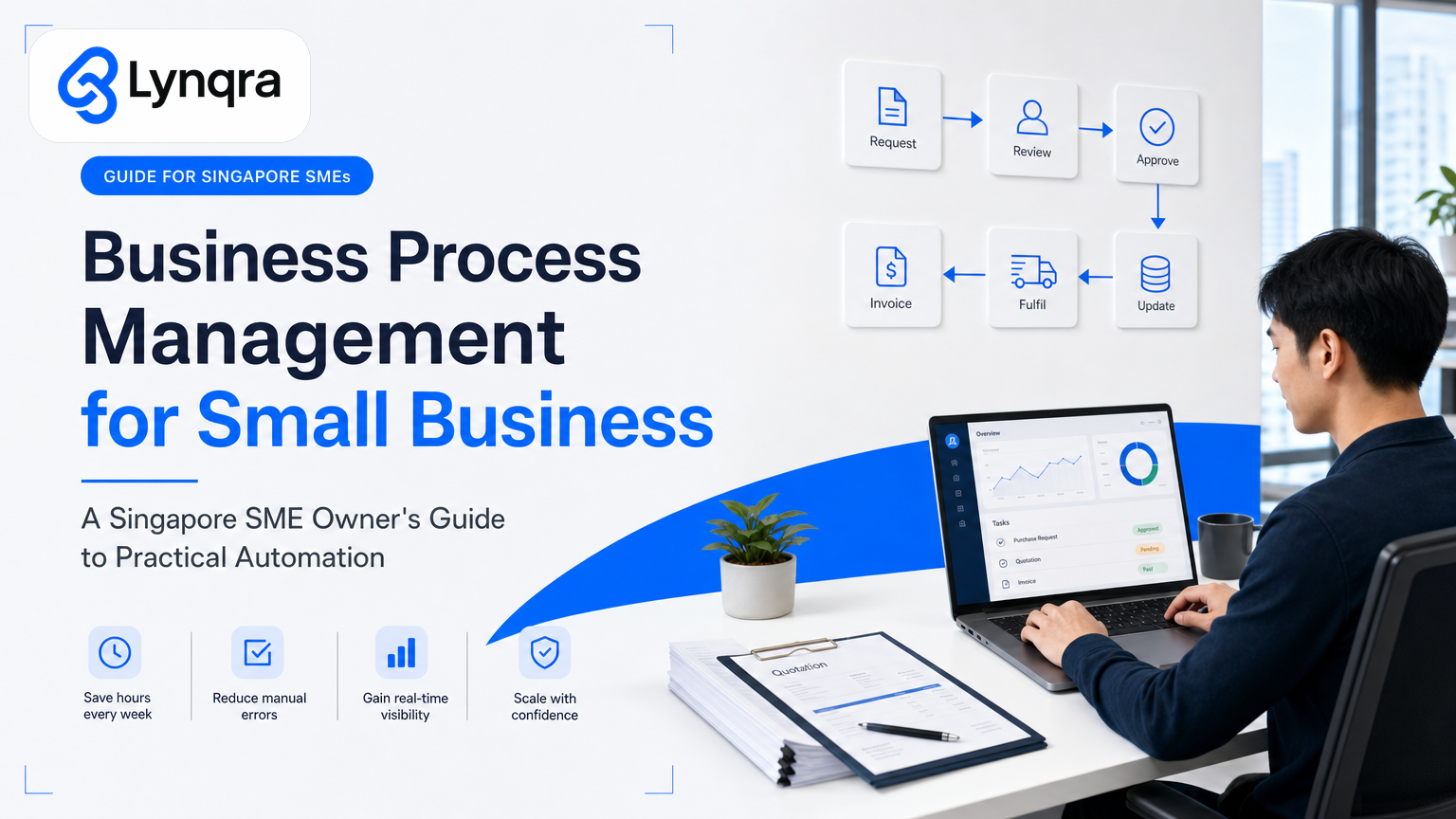
Your team spends two hours every morning chasing invoices. Your operations manager screens recruitment applications by hand. Your approval workflows get stuck in email chains for days. None of this moves your business forward.
This is business process management in practice. It's not a buzzword or a software purchase. It's the work of identifying where your team wastes time, removing that waste, and building systems that let people focus on what matters.
For Singapore SMEs, business process management (BPM) often means something simple: finding the bottlenecks in your day-to-day work and fixing them with automation that fits inside the tools you already use. You don't need an enterprise platform. You need a clear view of what's broken and a practical way to fix it.
What Business Process Management Actually Means for Small Business
Business process management is the act of mapping, understanding, and improving the workflows your team runs every day. In a small business, you're not managing complex global supply chains or compliance frameworks that span continents. You're solving real problems that slow your people down.
The best way to think about it: a process is a sequence of steps your team repeats. Invoicing. Screening job candidates. Approving purchase orders. Processing customer quotations. Managing stock levels. Tracking accounts payable. Each of these runs the same way, over and over, across your business.
When you improve a process, you typically do one or more of three things. You remove steps that don't add value. You automate the repetitive parts so people don't have to do them by hand. You add visibility so you know what's stuck and where.
For most Singapore SMEs, the real win isn't in theory. It's in concrete time and cost savings. A trading company automated invoice matching and payment tracking, reducing manual work from six hours per week to near zero with clearer payment visibility. A recruitment agency cut candidate screening time by 80 percent and reduced shortlist time from hours to minutes. A food production business reduced quotation turnaround from two hours to six minutes.
These weren't huge technology investments. They were small, focused automations built into Google Sheets, email, or approval workflows the teams already used daily.
Why Most Singapore SMEs Struggle Without a Clear Process Framework
If you're running a lean team, you probably don't have documented processes. Your processes live in people's heads. When someone leaves, you lose that knowledge. When volume increases, your team struggles because they're still doing everything manually.
Manual work creates three big problems. First, it's slow. Your team spends time on repetitive tasks instead of customer problems or growth. Second, it's error-prone. Invoice numbers get mixed up. Candidate names are misspelled. Approvals get lost in email. Third, you have no visibility. You can't easily tell your bank manager how many invoices are pending, or your CFO which approvals are bottlenecks.
In Singapore, where labor costs are high and hiring is competitive, manual work is especially expensive. A person earning SGD 4,000 to 5,000 a month who spends four hours a week on invoicing is costing you about SGD 320 to 400 monthly on that one task alone. Across your team, that adds up fast.
Most SMEs also underestimate how much time they lose to approval delays and follow-ups. A purchase order gets sent to a manager who's in a meeting. It sits for two days. Someone has to chase it. This happens dozens of times a month. It's not dramatic, but it erodes productivity.
Key Areas Where Singapore SMEs See the Biggest Wins
Not all processes are created equal. Some have much bigger impact on your bottom line. Here are the areas where automation tends to save the most time and money.
Invoice and accounts payable management. If you're a distribution, trading, or manufacturing business, invoicing and payments are core to cash flow. Manual invoice entry, matching, and approval routing can tie up your finance team for hours every week. Automation here means faster payment processing, fewer errors, and better visibility of what you owe and what you're owed. Learn more about this approach in our detailed guide on Accounts Payable Automation Singapore: How to Build It Right.
Candidate screening and hiring workflows. If you hire regularly, screening takes time. Human review of every application is thorough but slow. AI-powered screening can filter candidates and shortlist qualified applicants in minutes, freeing your hiring manager to focus on interviews and culture fit. This is especially valuable if you get high application volumes. See how this works in practice in our guide AI Candidate Screening Singapore: A Practical Recruiter Workflow Guide.
Quotation and order processing. For businesses that issue custom quotes (food production, logistics, consulting, manufacturing), quote generation can take hours. Automation that pulls data from your customer record, builds the quote, and sends it can cut turnaround from hours to minutes. Your sales team focuses on closing, not formatting spreadsheets.
Approval routing and document workflows. Most businesses have a mess of approval workflows scattered across email, WhatsApp, or Telegram. Critical documents get lost. Approvals take days. A structured approval workflow with an audit trail means faster sign-offs and compliance visibility. We've seen approval turnaround drop by 70 percent with proper routing.
Data entry and document processing. If your team manually pulls data from PDFs, forms, or images, that's prime automation territory. You might extract invoice line items, customer details from forms, or stock levels from warehouse photos. AI handles it in seconds, with accuracy that beats manual entry. For deeper detail, read AI Document Processing in Singapore: Automating PDFs, Forms, and Manual Data Entry.
Stock and inventory management. For logistics or retail SMEs, stock optimization through better data and automated reorder workflows can reduce overstock and stockouts. Overstock ties up cash; stockouts lose sales. Visibility and automatic triggers can cut both.
The common thread: all of these are repetitive, rules-based, and high-volume. They eat time but don't require judgment calls. They're the perfect candidates for automation.
How to Start: A Simple Decision Framework for SME Owners
You don't need a consultant to tell you where your biggest problems are. You know them. The question is how to prioritize and where to start.
Step 1: List your pain points. What takes your team the longest? What tasks are repetitive? What gets stuck in approvals? Write down three to five.
Step 2: Quantify the impact. For each, estimate how many hours per week your team spends on it, and who does it. If your operations manager spends five hours a week on invoicing, that's real money. If your sales team spends two hours daily generating quotes, that's also real money.
Step 3: Check what systems you already use. Do you use Google Sheets? Gmail? Forms? Telegram? WhatsApp for work? Most SMEs already have tools that can be connected and automated. You don't need new software; you need smart integration.
Step 4: Look for quick wins. Some processes are simple to automate because they're self-contained and repeatable. Others are tangled across multiple systems. Start with the simple ones. Build momentum and confidence.
Step 5: Consider your team's readiness. Can your team learn a new workflow? Are they open to automation, or do they fear job loss? The best automation aligns with what your team actually needs. If your approval process is broken because managers are traveling, fixing email won't help. You need mobile notifications or a proper routing system.
Once you've identified a priority, the next step is to work with someone who understands your specific workflow. A generic BPM tool won't solve your invoicing problem. A custom automation built inside your actual process will.
Implementation: What Actually Happens When You Build an Automation
When you decide to automate a process, the work starts with understanding exactly how your team does it today. This is where most generic vendors fail. They sell you a template. You have to conform your workflow to the template. That doesn't work for SMEs, because your workflow is tied to your specific suppliers, customers, and team structure.
The right approach is to map your actual workflow. Where does the invoice arrive? Email? PDF? Telegram? Who reviews it first? What checks do they do? Where does it get stuck? Only after you understand the real workflow do you build the automation.
A good implementation partner will ask questions like: "What's the worst error that could happen here?" and "How do you handle exceptions?" They're not building a perfect system; they're building a practical one that handles your real edge cases.
Implementation also means testing. When you automate invoice processing, you don't flip the switch and hope. You run parallel for a few weeks. Your team does it the old way and the new way. You compare results. You fix issues. Then you go live.
Finally, a good partner stays with you after launch. Automation isn't a one-time thing. Your business changes. Your suppliers change. Your team changes. You need someone who can iterate and adjust as things evolve. This is why choosing the right partner matters more than choosing the right tool.
Cost and ROI: What You Should Actually Expect
SME owners often hesitate on automation because they think it's expensive. The truth is more nuanced.
A custom automation solution typically costs less than the annual salary cost of a person doing that work part-time. If someone spends five hours a week on a manual task earning SGD 4,500, that's about SGD 23,400 a year in labor cost. A good automation solution can pay for itself in weeks.
The real cost drivers are: how complex is your workflow? How many systems need to connect? How much data entry is involved? How much manual exception-handling do you need?
A simple automation (like routing approvals and sending notifications) might take a week and cost modestly. A complex one (like invoice matching across three systems with exception handling) might take longer. But even complex automations typically show ROI within three to six months.
One thing to watch: avoid solutions that require you to migrate all your data to a new platform. That's expensive, disruptive, and unnecessary. The best automations work inside your existing tools.
Funding Your Automation: Singapore SME Grants and Support
Singapore has active support for SME digitalization and automation. Enterprise Singapore and IMDA (Info-communications Media Development Authority) both offer grants and support programs.
Enterprise Singapore offers grants for business development and productivity. Check current programs and eligibility on the Enterprise Singapore grants overview page.
IMDA's SMEs Go Digital program provides support for business process automation and digital transformation. Their Industry Digital Plans are tailored to specific sectors and may cover portions of your automation costs.
Eligibility varies based on company size, sector, and the scope of your automation project. We work with grant advisory partners who can help you explore suitable pathways based on your specific situation. Before assuming grant eligibility, confirm the current criteria with the official channels, as programs evolve.
A grant isn't guaranteed, and you shouldn't wait for one before starting. But if you qualify, it can cover 50 to 70 percent of your automation costs. That changes the ROI math significantly.
Common Objections and How to Think Through Them
"We're too small for automation." You're actually the perfect size. You don't have the overhead to hire someone just for invoice processing. Automation lets your lean team punch above their weight.
"We don't have IT staff." You don't need IT staff. You need a partner who understands your business and can build automations inside tools you already use. The best solutions require no coding knowledge from your team.
"We'll lose control if we automate." Good automation increases control. You get visibility into what's happening. You get audit trails. You know where things are stuck. Manual processes are actually less controlled.
"This will take months to implement." A focused automation project typically takes weeks to launch, not months. You map the workflow, build it, test it, and go live. You refine as you go.
"Our process is too unique." Every business thinks their process is unique. What you really mean is it's complex. That's fine. The automation is built for your specific workflow, not forced into a template.
What to Check Before You Buy or Start
If you're considering a BPM solution for your SME, here's what matters:
Does the solution work inside your existing tools or force you to migrate? (Existing is better.)
Can you see how long implementation will take and what the actual cost is? (Avoid vague timelines and pricing.)
Will someone stay with you after launch to iterate and fix issues? (One-time implementation is risky.)
Do they have examples of work they've done with similar businesses? (Ask for details, not just case study names.)
Can they explain the ROI clearly, or are they selling you technology for its own sake? (ROI comes first.)
Will they help you explore grant funding if you qualify? (This matters for your budget.)
Do they understand your workflow before suggesting solutions? (Beware of one-size-fits-all answers.)
Practical Next Steps
If you're ready to explore automation for your business, here's what we suggest:
Start small. Pick one process that's clearly broken and costing you time. Don't try to automate your entire business at once.
Map it honestly. Write down exactly how your team handles this process today, including edge cases and exceptions. This is your blueprint.
Measure it. How many hours per week does this take? Who does it? What errors happen? This becomes your baseline for measuring improvement.
Find the right partner. Look for someone who asks questions first and sells second. Someone who understands your business and builds for your workflow, not a template. Someone who'll stay with you after launch.
Plan for iteration. The automation won't be perfect on day one. Build time into the plan for refinement based on real use.
If you'd like to explore where automation could help your business most, we're here to help. We work inside your existing tools and focus on measurable ROI, not technology for its own sake.
You can also read more about how other Singapore businesses have approached automation in our guides: Business Process Automation in Singapore: A Practical SME Guide and AI Agent for Business Singapore: What It Is and How to Build It Right. Both cover real examples and practical implementation steps.