Your team spends half its day on repetitive messaging: approval requests ping back and forth, quotations get typed out manually, customer follow-ups slip through gaps. You've heard Telegram bots might help, but you're not sure what that even means, how it fits into your actual workflow, or whether it's worth the effort.
This guide walks you through what a Telegram bot actually does for a Singapore SME, when it makes sense, and how to know if it's the right move for your operation.
What Is a Telegram Bot for Small Business?
A Telegram bot is an automated account that lives inside Telegram and responds to messages or triggers without needing a human to type every reply. For small business owners, a bot typically handles three kinds of tasks: it collects information from your team or customers, it routes decisions or approvals to the right person, and it sends alerts or updates back to a group chat. No app download needed. No new software to train people on. Just messaging, but automated.
Unlike generic chatbots, a business-focused Telegram bot works inside a tool your team already uses every day. It speaks the same language as your WhatsApp-style workflows and fits into lean operations without forcing a platform migration.
Why Does a Telegram Bot Work Well for Singapore SMEs?
Telegram adoption in Singapore is steady among businesses and younger consumers. Telegram ranks as a widely used messaging platform in the country, and businesses increasingly use it to stay in touch with clients and teams.
Here's why that matters for your operation. First, adoption is low friction. Your team and customers already have Telegram. They don't need to learn a new app or remember a new login. Second, Telegram bots integrate naturally with approval workflows, daily check-ins, and customer notifications without replacing your existing email or document system. Third, the cost is predictable: Telegram itself is free, and the automation sits on top of it.
For Singapore SMEs working across invoicing, hiring, stock management, or quotations, a Telegram bot can compress the approval cycle, flag delays in real time, and keep decision-makers aligned without adding overhead.
What Can a Telegram Bot Actually Do for Your Business?
Telegram bots work best on workflows where speed and repeatability matter. Here are the operational areas where Singapore SMEs see the biggest gains:
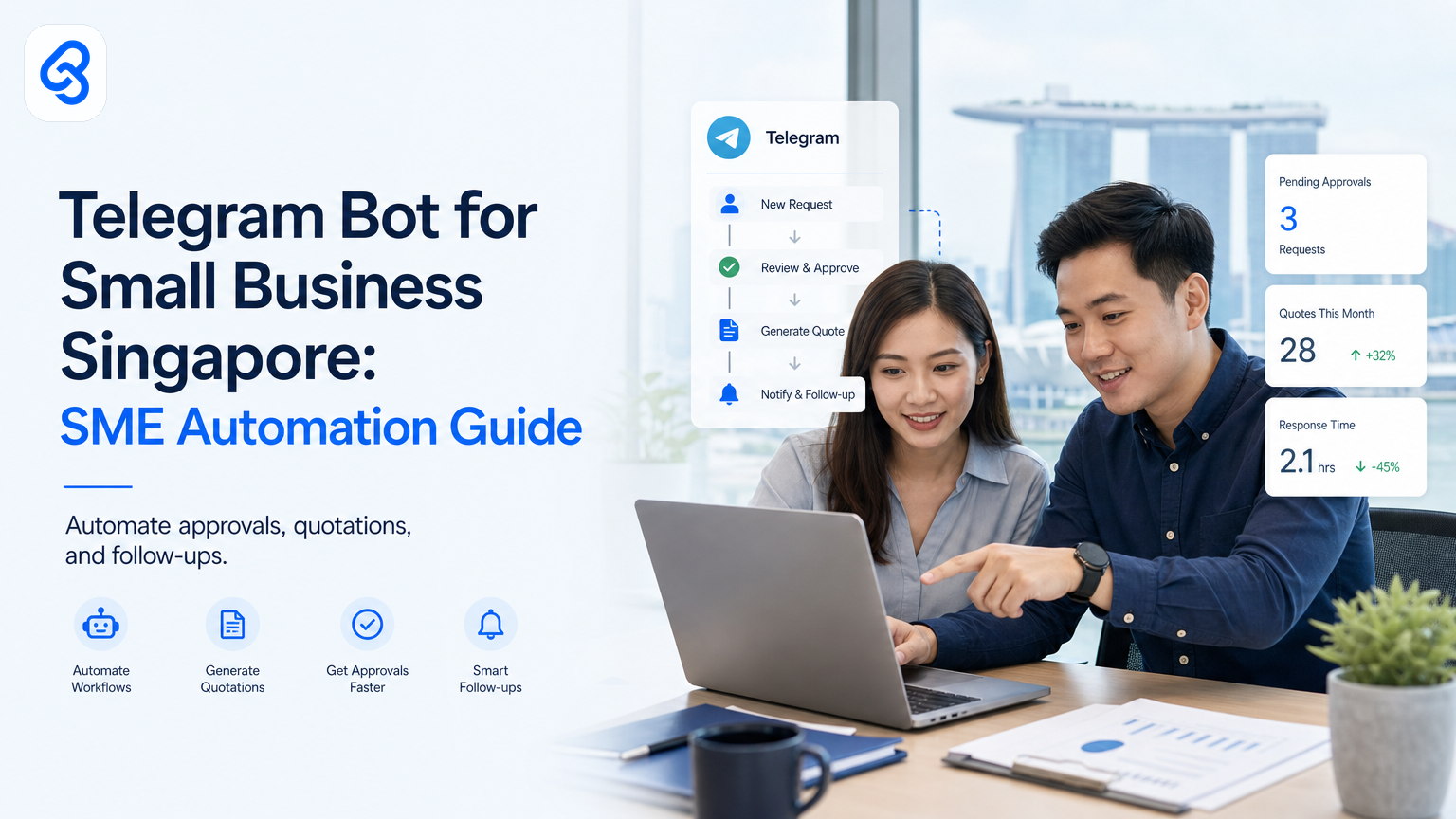
Approval routing and turnaround. A team member submits a leave request, an expense claim, or an approval via a simple form. The bot captures the data and pings the approver on Telegram with a summary and an action button. They approve or reject in the chat. The bot logs the decision with a timestamp and notifies the requestor. This cycle, which might take 48 hours via email, compresses to under an hour. Businesses using structured messaging systems with full audit trail coverage typically see approval turnarounds cut significantly when this workflow moves from email to automated routing.
Quotation follow-ups. A customer requests a quote. Instead of a salesperson typing it out in email, a bot collects the details (product, quantity, delivery date) from a Telegram form, passes it to your team, and notifies the customer of the status. Once approved, the bot sends the quote link or PDF directly into the chat. Response times improve dramatically when quotation data flows through a structured system rather than email threads.
Customer and team check-ins. A daily standup message arrives in a group chat. Team members tap emoji reactions or type a one-line update. The bot collates those into a summary and flags risks. No lengthy status meeting. No email thread.
Invoice and payment tracking. A bot can remind you when invoices are due, alert you to overdue payments, and track payment confirmations. Combined with Google Sheets, it keeps your accounts payable organised without forcing your team into accounting software they won't use.
Candidate screening notifications. For recruitment or contractor onboarding, a bot can notify you when new applications arrive, summarise key details, and route shortlisted candidates to the next interview stage. Automation of initial triage into structured workflows significantly reduces the time spent on screening tasks.
Stock and inventory alerts. When a product falls below a threshold, the bot notifies your warehouse or ordering team. When stock is updated, the bot confirms the change in a group chat. This visibility alone prevents both stockouts and overstock by making real-time changes visible to all stakeholders.
The common thread: the bot handles information capture, routing, and notification. Your team still makes the decisions.
How Do You Build a Telegram Bot Without Needing to Code?
You don't need a developer, but you do need the right tools and a clear workflow.
Step 1: Define the workflow. Before you touch code or tools, write down the flow. Who sends the request? What information do you need? Who decides? What happens next? A simple approval workflow looks like: Team member fills a form, bot collects the data, bot sends a summary to the approver, approver taps approve or reject, bot notifies the requestor and logs the decision.
Step 2: Choose the integration layer. Telegram bots connect to other tools via APIs. For a no-code approach, you use a middleware tool (like Zapier, Make, or a custom integration platform) that sits between Telegram and your existing software. The middleware watches for a trigger (new message, form submission, scheduled time), then executes actions (send a message, create a row in Google Sheets, update a record). If you're already using Google Sheets as your business database, a bot can read from Sheets, display options in Telegram, and write approvals back into Sheets as a log.
Step 3: Test the workflow with a small group. Start with one team or one process. Run it for two weeks. Collect feedback. What worked? What slowed down? Did people use it, or did they fall back to email? This matters because adoption friction is real. If your team prefers email, a Telegram bot won't save time; it'll add a step.
Step 4: Iterate and expand. Once one workflow runs smoothly, you can add the next. Most SMEs find that the first bot uncovers three more obvious candidates for automation: invoicing, ordering, or customer follow-ups often follow approval workflows.
Common pitfalls to avoid. Telegram bots fail when teams view them as a replacement for real communication or decision-making. They also fail when the workflow is too complex to fit into messaging (if your approval involves attaching five documents and three sign-offs, email might still be faster). The other stumbling block is poor setup: if the data captured by the bot doesn't match your existing system of record, you end up with two conflicting versions of the truth. Finally, don't assume everyone will adopt it at once. Roll out to the people who benefit first, then let word of mouth spread it.
Should You Build It Yourself or Use a Consultant?
Building a simple Telegram bot yourself is possible if you have technical capacity or time. Telegram's official documentation is thorough, and no-code platforms like Make or Zapier reduce friction.
But most Singapore SME owners find that the real cost isn't the bot itself; it's mapping your workflow correctly, testing it, and then fixing it when real work doesn't match your theory. A one-person build often takes weeks. A consultant who has done ten approval bots knows the common traps: they spot the places where your data model breaks, they catch the approvers who need to be notified differently, and they set up the audit trail from day one so you don't face compliance issues later.
For a straightforward three-step approval bot or a customer notification workflow, you might handle it in-house. For anything touching invoicing, compliance, or multi-team approval, a consultation pays for itself in weeks.
How Does a Telegram Bot Fit Into Your Bigger Automation Picture?
A Telegram bot is one piece of a larger operational system. It works best when it connects to a reliable backend: usually Google Sheets, email, or a lightweight CRM.
The most common setup we see in Singapore SMEs is a three-layer architecture. Layer one is Telegram: your team and approvers live here. Layer two is your database, usually Google Sheets or a lightweight tool like Airtable. Layer three is the logic: a bot or integration layer that watches for events and moves data between the two.
This approach works because it respects your existing tools. You don't need to migrate data or retraining. You also get an audit trail: every decision, approval, and timestamp lives in Sheets, which your accountant or compliance team can review.
If you're already working on a broader automation strategy, a Telegram bot often becomes your first quick win. It sits on top of your current operation without disrupting it. That success builds confidence for larger automation efforts, like invoice processing or candidate screening workflows. Read our guide on business process automation in SMEs to see how individual bots fit into a full operational overhaul.
What Are the Data Protection and Compliance Considerations?
Telegram is a cloud-based messaging platform, which means messages and data flow through Telegram's servers. For a Singapore business, you need to understand your obligations under the Personal Data Protection Act (PDPA).
If your Telegram bot collects personal data (names, phone numbers, employee ID numbers, payment details), you must comply with PDPA requirements. That means having a clear privacy notice, storing data securely, and limiting access to only people who need it. Telegram provides encryption for messages in transit, but data stored in Telegram or linked systems (like Google Sheets) remains your responsibility.
The PDPC publishes practical guidance on data protection for organisations in Singapore. Refer to their getting-started guide for data protection officers to understand your obligations before you deploy a bot that handles sensitive data. The guide outlines key steps to protect your customers' and employees' data while ensuring compliance with the Personal Data Protection Act.
For most SME approval workflows, the risk is low: you're sending internal approvals and timestamps, not customer payment details. But if your bot handles hiring data, salary information, or customer contact details, you need a data protection plan in place.
Can You Get Funding to Build a Telegram Bot?
Singapore offers several funding schemes for SMEs investing in digital tools. Enterprise Singapore and IMDA both run grant programs designed to help small businesses automate operations.
The IMDA SMEs Go Digital initiative provides funding for digital transformation projects, including automation. IMDA also manages industry digital plans that help SMEs adopt technologies like process automation and digital tools to drive growth in Singapore's digital economy. Enterprise Singapore publishes financial assistance and grants information with current schemes and eligibility criteria.
Telegram bot development typically qualifies for funding if it's part of a larger workflow automation project. A standalone Telegram bot might not meet the minimum investment threshold, but if you're automating your approval process, quotation workflow, and customer follow-ups as a unified project, the total investment often qualifies. Always check the latest eligibility criteria with the funding bodies directly; requirements and timelines change.
Lynqra works with grant advisory partners to help clients explore suitable funding pathways based on company profile, scope, and timing. If you're interested in automating your operations and want to understand your funding options, we can guide you through the process.
How to Decide If a Telegram Bot Is Right for Your Business Now
Ask yourself these questions to determine if a Telegram bot makes sense for your operation right now:
- Do you have a workflow where approval, notification, or data collection happens manually, repeatedly, and costs your team more than 5 hours per week?
- Is that workflow used by at least three people on your team?
- Do most of those people already use Telegram for work communication?
- Is the data involved relatively simple (approval decisions, quotation details, customer contact info) rather than complex or highly regulated?
- Are you willing to run a two-week trial with a small group before rolling it out company-wide?
If you answered yes to three or more of those questions, a Telegram bot is likely a good fit. If you answered no to most, you might be better served by a more general workflow automation or by fixing a bigger operational bottleneck first.
Read our guide on business process management for small business to understand how to prioritise which workflows to automate first.
How Telegram Bots Compare to Other Automation Approaches
You might also be considering WhatsApp bots, email automation, or a purpose-built approval tool. Here's how they compare:
Telegram vs. WhatsApp automation. WhatsApp is more widely used in Singapore consumer markets, but WhatsApp Business API is more tightly controlled and harder to automate without official approval. Telegram bots are easier to set up, and Telegram adoption among teams and younger consumers is growing steadily.
Telegram vs. email automation. Email automation (rules, filters, auto-replies) is familiar, but it doesn't create a structured approval record. A Telegram bot gives you speed plus a clean log. Email is better for external communication and formal records.
Telegram vs. a custom approval tool. A purpose-built approval tool (like a simple web portal or an off-the-shelf workflow engine) is more powerful but requires adoption friction: people need to log in, learn a new interface, and switch between systems. A Telegram bot sits inside a tool people already use every day, which is why adoption is faster.
For most Singapore SMEs, a Telegram bot wins on speed and simplicity. But if your workflow is complex or regulatory heavy, a more formal tool might be worth the friction.
Practical Implementation Checklist
Before you start building or talking to a consultant, run through this checklist:
- Workflow mapped: Write down exactly what happens now and what you want to happen.
- Team identified: Know who initiates requests, who approves, who gets notified.
- Tools listed: Identify what systems the bot needs to read from or write to (Google Sheets, email, CRM, etc.).
- Data sensitivity assessed: Know whether your workflow touches personal data, payment details, or compliance-sensitive information.
- Success metric defined: How will you measure whether this bot worked? (Approval time, error rate, time saved per week, adoption rate).
- Trial group picked: Choose 2-3 power users to run the bot for two weeks before rolling out.
- Feedback loop planned: How will you collect feedback and fix problems during the trial?
This doesn't take long, but it saves weeks of misalignment later.
Next Steps: Get Started With Your Automation
A Telegram bot is a practical way to compress approval cycles, speed up quotations, and keep your team aligned without heavy new software. But it's most useful when it's built on top of a clear understanding of your actual workflow.
If you're ready to explore whether a Telegram bot (or a broader automation strategy) fits your operation, let's talk. We'll map your current workflow, identify the biggest bottleneck, and show you exactly how much time and cost you could save.
Book a free discovery call or email mark@lynqra.com. We'll spend 30 minutes understanding your operation and recommend the right next step. No pitch, no obligation, just practical advice.
For a deeper look at how automation fits into your SME strategy, read our guides on AI agents for business in Singapore and business process automation in Singapore.
FAQ
Can I build a Telegram bot without coding?
Yes. Using no-code platforms like Zapier or Make, you can connect Telegram to Google Sheets or email and create simple bots for approvals, notifications, and data collection. For more complex workflows that require conditional logic or data validation, you'll need a developer or a consultant who has built these before. Most Singapore SMEs start no-code and add custom features only when they hit the limits of what the platform can do.
How long does a Telegram bot take to build?
A simple approval or notification bot takes 1-2 weeks if you're building it in-house (including testing and training your team). A consultant who has done this before can often deliver in 3-5 working days because they know the common mistakes and have templates for standard workflows. The bulk of the time is usually testing and refinement, not the initial build.
Will my team actually use a Telegram bot, or will they stick with email?
Adoption depends on friction and relevance. If the bot saves your team real time on a workflow they do every day, adoption is usually fast. If it adds a step or feels like a gimmick, people will ignore it. Start small with one workflow, measure the time saved, and let that success drive adoption of the next bot. Don't launch five bots at once and expect people to learn them all.
Do I need to worry about Telegram access if I use a Telegram bot?
Your team needs to have Telegram installed and be part of a group or chat where the bot operates. Telegram is free and available on Android, iOS, Windows, Mac, and Linux. For a Singapore business, adoption is usually straightforward because most team members already have Telegram for personal use. For older team members or very conservative operations, adoption might be slower.
What happens if my Telegram bot breaks or Telegram changes its policies?
Telegram has been stable for over a decade, and its bot API is well-documented and rarely changes in breaking ways. If your bot stops working, the cause is usually a problem with your integration layer (the tool connecting Telegram to your backend) rather than Telegram itself. That's why having a consultant or support plan matters: they can diagnose and fix problems quickly.