
The Misconception on Business Automation and What That's Actually Costing You
4/18/20263 min read
Let's skip the AI hype for a moment.
You've heard the pitches. You've sat through the LinkedIn posts about "10x productivity" and "the future of work." And if you're like most SME owners we talk to, your reaction is somewhere between curiosity and skepticism.
You're not against AI. You're just not convinced it's for your business, right now, at this stage.
We get it. And to be honest? That skepticism isn't irrational. This article is to walk you through why businesses like yours hesitate, what that hesitation is actually costing, and what happened when two SMEs decided to stop waiting.
Why SMEs Hesitate (And Why It Makes Sense)
When we meet with SMEs, the pushback against automation often arises from a lack of knowledge or misconception. A survey by the Institute of Directors found that over half of business leaders identified insufficient knowledge about AI. Most SME owners aren't resisting change — they're overwhelmed by options they don't fully understand.
"What if it breaks something that's already working?" This is a question that most SME bosses ask me. Introducing automation can often feel misinterpreted and the fear isn't irrational as their worry is how an implemented technology can disrupt workflows. The question is whether the risk of changing outweighs the cost of not changing.
"My team won't use it." This is the main concern that most employees shared. Staff who've spent years mastering a manual process don't always welcome a system that claims to do their work in minutes. And if the team doesn't adopt the tool, then the investment in automation may end up being wasted. This concern might be legitimate regarding the use of technology, but it also takes away the benefits of embracing business automation.
"I can't justify the cost without proof it'll work." SMEs don't have the budget or to invest in an unknown automation. Many owners would rather stick with what they know when they are unclear about the unclear ROI projections specific to their operations. These are not excuses. These are rational responses from people who've built businesses by being careful with their resources. The problem is that while the hesitation is rational, the cost of standing still is compounding.
The Price You Pay For Staying Manual
Here's what rarely gets discussed in business conversation: the cost of not automating isn't zero. It's just invisible.
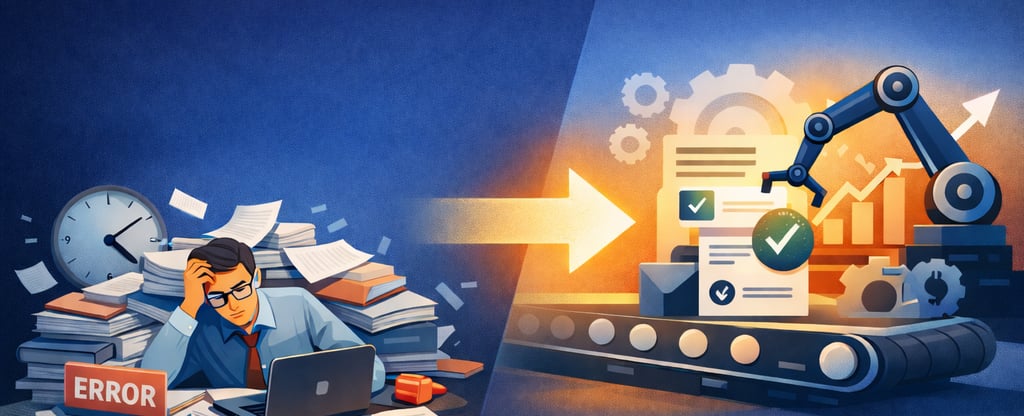
Your team is spending their days on the wrong work. Studies consistently indicate that employees in SMEs dedicate four to six hours each day to repetitive, manual activities like processing invoices and updating spreadsheets. This represents an unproductive time when your sales team is not selling and your staff are not addressing genuine issues.
Manual errors are silently bleeding money. Manual data entry carries an error rate of one to five percent. Every mistake leads to rework, corrections, and occasionally the loss of clients. Studies indicate that mid-sized companies waste between 20 to 30 percent of their operational budget each year due to rework, miscommunication, and complicated systems.
You can't scale what runs on memory and spreadsheets. If a 20 percent rise in orders would strain your current team, it indicates that your operations have a limit to scalability.
As manual processes grow linearly, the increased volume requires more staff which leads to more errors and greater coordination challenges. Automated processes are not limited by this restriction. The gap widens with each quarter of growth.
The harsh reality is that the longer you rely on manual processes, the more likely you are to face issues like slower speed, reduced accuracy, higher costs, and losing talent.
What Happens When SMEs Actually Make the Switch
Theory only goes so far. Here's what happened when two real businesses stopped deliberating and started automating. Lynqra AI has collaborated with several clients, including a food production company, which has cut down the time for quotes that used to take hours to just six minutes by using Google Sheets integration.
The Pattern Behind Both Stories
The automation that worked wasn't ambitious. It was specific. It didn't try to reinvent their operations. It took one painful, time-consuming process and made it fast and reliable.
It fit into the team’s existing workflow by using familiar tools like Google Sheets and email. And it was built fast and not months of planning and committee meetings. Two weeks from "let's try this" to "it's working."
That's the part most SME owners don't expect. They imagine automation as a massive, disruptive overhaul. In reality, the highest-impact projects are often small, targeted, and operational within weeks. If you've read this far, you're probably not someone who dismisses technology. You're someone who wants to be sure before committing. That's a strength.
You don't need to automate everything. You don't need a digital transformation roadmap or an AI strategy deck. You need to identify one process that's costing you time, money, or people — and fix it. That's where we start every conversation at Lynqra. Not with technology. With your bottleneck.
Ready to find out where automation actually makes sense for your business? Book a free 30 minute consultation for a complimentary audit and discussion on how we can improve your business operations.
Follow us on social media
E-mail: mark@lynqra.com
Whatsapp: +65 96658846
© 2026. All rights reserved.
Lynqra Pte. Ltd.
UEN 202540279R