If you run a Singapore SME, you've probably heard about ServiceNow. It sits in the enterprise software space, and the vendor talks a lot about records, tables, and automation engines. But what you actually want to know is simpler: can it help your team stop doing repetitive manual work, and will the cost and effort be worth it?
This article covers ServiceNow workflow automation with real examples, explains when it makes sense for SMEs, and shows you what to check before you commit. We'll also show you simpler paths that many Singapore business owners find work better for their lean teams.
What ServiceNow Actually Does (The Practical Version)
ServiceNow is a cloud platform for managing and automating business processes. At its foundation, it treats every piece of work (an invoice, an approval request, a ticket, a hire) as a "record" stored in a "table". You then build workflows that move those records through stages, apply rules, and trigger actions like sending emails or updating spreadsheets.
It's powerful for large organisations with complex, regulated processes. But here's the honest part: ServiceNow costs real money, requires technical setup, and often means your team learns a new tool instead of staying in the systems they already use.
For a small trading company or recruitment agency in Singapore, that trade-off isn't always the right call.
Common ServiceNow Workflow Automation Examples
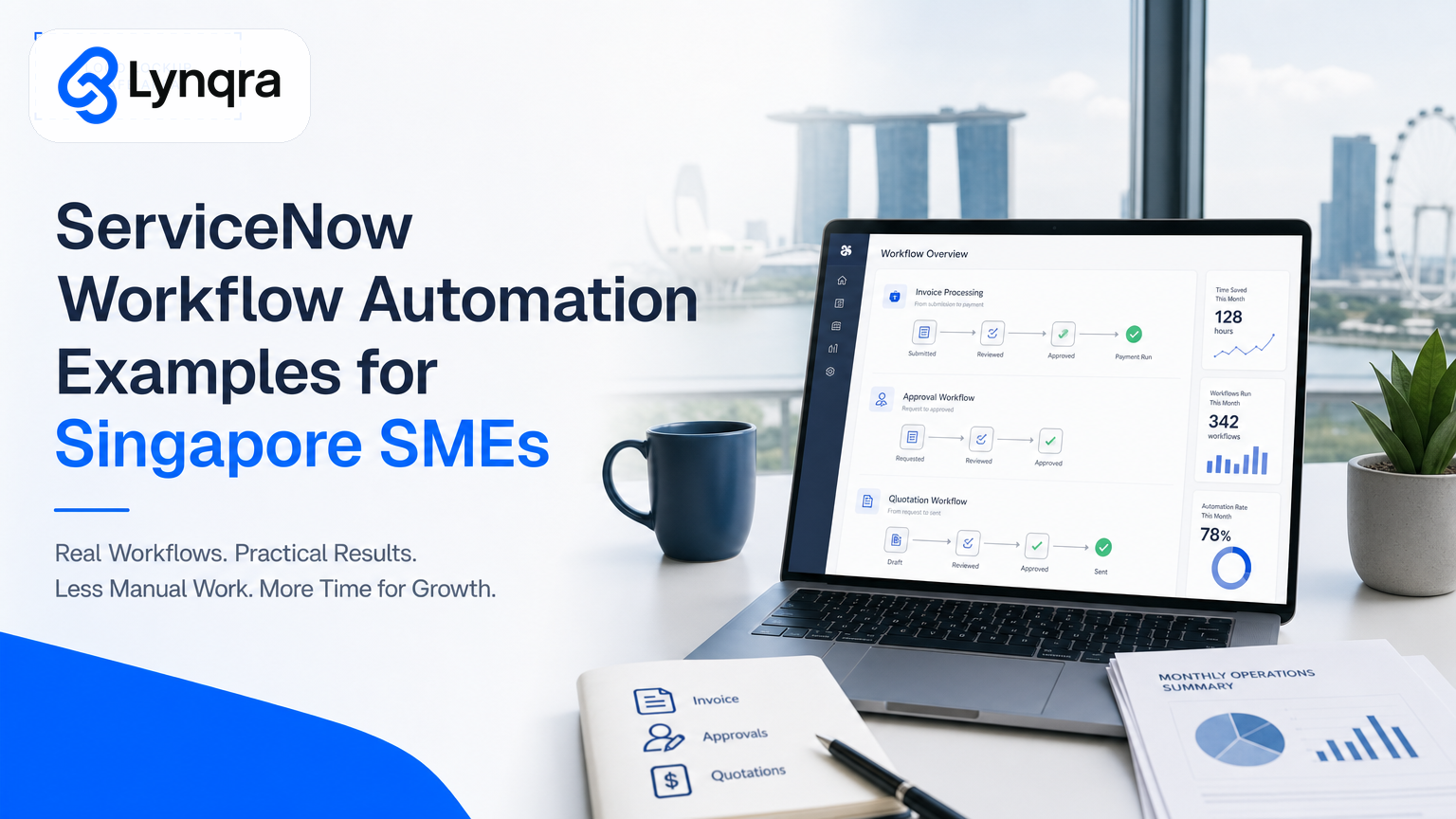
Example 1: Invoice and Expense Approval Workflows
ServiceNow lets you build a process where invoices arrive, get logged as records, move through approval stages (manager, director, finance), and trigger payment only when all approvals complete.
Each step creates an audit trail. If an approver is away, you can set escalation rules. Approvers get notifications in ServiceNow's interface or via email. Finance gets real-time visibility on what's pending.
The realistic cost: Implementation takes weeks. Your finance and IT teams spend time mapping the process, building the workflow, and testing it. Training the approvers takes time. If your invoice volume is under 50 per week and approvals are usually fast, the effort may not pay back quickly.
For SMEs in Singapore: This is where many operators find a simpler path works better. An approval workflow built inside Google Sheets with Telegram notifications can achieve the same result in days, not weeks, and costs a fraction of the price. See our guide on approval workflow automation for a practical comparison.
Example 2: Candidate Screening and Recruitment Workflows
A recruitment agency uses ServiceNow to log every applicant, score them against criteria, route qualified candidates to consultants, and track interview status. Rules automatically reject candidates who don't meet minimum requirements. Consultant notifications trigger when new qualified leads arrive.
The realistic benefit: You see a clear funnel. You know exactly how many candidates are at each stage. You never lose a lead in someone's inbox.
The realistic cost: Setup is complex. ServiceNow needs to integrate with your job boards, email, and calendar systems. Testing integration takes time. Your team may resist a new platform if they're used to email and spreadsheets.
For SMEs in Singapore: A recruitment agency we worked with used AI candidate screening built inside their existing Google Forms and email workflow. The manual screening time fell. The shortlist became easier to review. familiar interfaces can stay in place. No integration headaches.
Example 3: Quotation and Order Workflows
A food production company receives quote requests via email. ServiceNow logs each request, routes it to the right sales person, sets a deadline for response, and tracks whether the quote was sent on time and whether it turned into an order.
You get reporting on how fast your team quotes. You spot bottlenecks. You can measure win rates by sales person.
The realistic benefit: Visibility and accountability. You know if quoting is a weak spot.
The realistic cost: You need to integrate email into ServiceNow (or have your team manually log requests). Reporting setup can be fiddly. If your process changes (you add a new product line, you shift approval rules), you need IT to rebuild workflows.
For SMEs in Singapore: The food production company we worked with cut their average quote turnaround from about 2 hours to 6 minutes using automation built inside Google Forms and email. The sales person still wrote custom quotes (ServiceNow can't do that). We just eliminated the waiting and the data re-entry.
Example 4: Change Management and IT Service Workflows
ServiceNow started in IT service management. A workflow might look like this: an employee submits a request to change their software license. The request gets logged, assigned to IT, approved by their manager, implemented, and closed. Each step has rules (priority-based assignment, escalation after 24 hours, mandatory notes).
The realistic benefit: IT teams have full visibility. Requests don't get lost. You meet SLAs because escalation rules push urgent work forward.
The realistic cost: Implementation is heavyweight. ServiceNow has a steep learning curve. Your IT team needs training. Initial setup is 8-12 weeks minimum for a mid-sized company.
For SMEs in Singapore: If you have a dedicated IT team and dozens of requests per week, ServiceNow may make sense. If you have one IT person handling requests via email, a simpler ticketing system (or even a well-designed Google Form with email routing) does the job and costs far less.
When ServiceNow Makes Sense for Singapore SMEs
Be honest with yourself. ServiceNow is worth the effort and cost if all of these are true:
- You process over 100 complex, multi-step requests per month across your organisation.
- Approvals and sign-offs happen frequently and involve multiple people with overlapping schedules.
- You need a full audit trail (who approved what, when, and why) for compliance or governance reasons.
- Your team can dedicate 1-2 people to maintaining workflows as your business evolves.
- You have IT support in-house or through a partner who knows ServiceNow.
- You're willing to move your team's work into ServiceNow's interface (not staying in email or spreadsheets).
If most of these don't apply, you probably don't need ServiceNow yet. Many Singapore SMEs we speak to are smaller, leaner, and more nimble. They need the result (faster approvals, fewer missed invoices, better visibility) without the platform weight.
The Hidden Costs of ServiceNow for SMEs
When people evaluate ServiceNow, they often see the subscription cost and the implementation budget. But SMEs often overlook three things.
Learning curve and adoption friction. Your team has to learn a new interface. Your accountant doesn't want to log into ServiceNow to approve an invoice; they want an email with a button. ServiceNow requires a mindset shift. Many implementations stall because teams keep doing work the old way.
Customisation and ongoing maintenance. Out of the box, ServiceNow doesn't fit your exact process. You need a developer or a ServiceNow specialist to build custom workflows. Every process change (you hire a new approver, you add a new department, you change payment terms) requires code changes. That costs time and money.
Integration complexity. Your invoices come from three different vendors. Your timesheets are in a spreadsheet. Your CRM is Zoho. ServiceNow doesn't natively connect to all of these. You need middleware, webhooks, or manual connectors. Integration testing takes weeks.
For a 10-person accounting team, these hidden costs often exceed the software cost itself.
Simpler Alternatives That Work Well for Singapore SMEs
If you need workflow automation but ServiceNow feels too heavy, you have options.
Google Sheets automation. Build approval workflows inside Google Sheets with Telegram or email notifications. Your team stays in a tool they know. Approvals happen via messaging. Full audit trail. Setup takes days, not months. Cost is a fraction of ServiceNow. Read our full guide on Google Sheets automation for Singapore SMEs to see how this works in practice.
Email and form-based workflows. Route forms directly to the right person. Automate follow-ups. Log data into spreadsheets automatically. No new software. Your team uses their email and phone.
AI agents and document extraction. Instead of building a workflow in ServiceNow, use AI to automatically screen candidates, extract invoice data, or categorise requests. This removes the manual work without forcing a new platform on your team. We've seen this reduced manual screening time and data entry time by 95%.
Hybrid approach. Keep ServiceNow for complex, high-volume processes that truly need it. Use simpler automation for everything else. This is often the most realistic path for growing SMEs.
The key principle: solve the bottleneck with the least complex tool that works. Don't upgrade tools just because you can.
How to Decide: A Practical Checklist
Before you commit to ServiceNow, work through this.
Identify the bottleneck. What's the slowest, most manual, most error-prone process in your business right now? Invoice approvals taking a week? Candidates getting lost in email? Quotes taking hours to prepare?
Measure the current state. How long does the process take today? Who's involved? Where does it break down? Where do errors happen?
List the requirements. Do you need approval routing, or just notification? Do you need an audit trail, or just faster speed? Do you need integrations, or does a spreadsheet work?
Check the alternatives. Before you design a ServiceNow workflow, sketch out what the same process looks like in Google Sheets, email routing, or an AI extraction tool. What's the setup time, cost, and learning curve for each option?
Talk to users. Will your team actually use this? If they resist logging into a new system, no automation will save you time.
Calculate payback. If a ServiceNow implementation costs SGD 15,000-30,000 and takes 12 weeks, how much time and cost do you save per month? Does it add up to payback in under 12 months? If not, start simpler.
What Singapore Grants Can Help
If you're building automation as part of a broader digital transformation, Singapore has grant pathways that can help reduce the cost.
Enterprise Singapore (ESG) offers grants for companies upgrading their operational efficiency. Check their financial assistance and grants overview to see current programmes that match your industry and company size.
IMDA's SMEs Go Digital programme supports digital adoption across a range of business functions, including workflow automation and process improvement. See their SMEs Go Digital page for latest offerings.
Industry Digital Plans target specific sectors (manufacturing, logistics, hospitality) with tailored automation support. IMDA lists current industry plans here.
Important: grant eligibility, quantum, and timelines change. Check the official websites for current details, or speak to a grant advisory partner who stays on top of the latest programmes.
Real Workflow Examples That Work for Lean Singapore Teams
To ground this in reality, here's what we've actually built for Singapore SMEs.
Trading and distribution company. Manual invoice processing took several hours each week. We built an automation that extracts invoice data from email PDFs, logs it into their accounting system, and routes approvals to the right person via Telegram. After launch, invoice status became visible, and the team reclaimed those 6 hours for higher-value work. No ServiceNow needed. The whole system runs inside their existing email and messaging tools.
Recruitment agency. Screening candidates by hand took days per job. We built an AI screening workflow that reads each resume, scores it against the job spec, and creates a ranked shortlist automatically. The team reviews shortlists (which arrive in Google Sheets) instead of manually reading 50 resumes. manual screening time fell. Shortlist turnaround went from 3 days to 1 day.
Food production company. Quote requests piled up in the sales person's inbox. Average response time was 2 hours. We built a form-based workflow: customer submits quote request via form, form data populates a Google Sheet, notifications go to the right person via email, response time gets logged automatically. Average response time dropped to 6 minutes. The sales person still writes each custom quote; we just eliminated waiting and re-entry.
Logistics company. Stock levels were guessed. Overstock tied up cash. We built a simple reporting dashboard that pulls live inventory data, flags slow-moving SKUs, and suggests reorder points. Overstock fell by 30%. the team kept a familiar interface; they just needed better data visibility.
These aren't ServiceNow stories. They're simpler, faster, and cheaper. And they worked.
The Real Question: Product or Problem?
Here's what we've learned from working with Singapore SMEs: most teams don't actually want a new tool. They want their work to be faster and less frustrating.
ServiceNow is a powerful product. But it's a product first, a solution second. If you buy ServiceNow, you're committing to learning the product, maintaining it, and building your processes around it.
Better approach: start with your actual problem. Where is manual work slowing you down? How much time would you save if you fixed it? What's the simplest way to fix it? Then pick the right tool.
Sometimes that's ServiceNow. Often it's something simpler: a well-designed form, a Google Sheets automation, an AI extraction workflow, or an approval routing built inside tools you already use.
The goal is measurable ROI and less friction for your team, not platform prestige.
How We Help Singapore SMEs Get Automation Right
At Lynqra, we're automation consultants. We don't sell a product; we solve a problem.
We start by analysing your biggest operational bottleneck: invoice processing, approvals, candidate screening, quotation turnaround, or something else unique to your business. We measure the current state so you know exactly what you're optimising.
Then we design an automation that fits your team's workflow, not the other way around. If you live in Google Sheets and email, we build inside those tools. If you need approvals routed, we use Telegram or WhatsApp, which your team already has open. If you need audit trails, we build them without forcing you onto a new platform.
We stay with you after launch to iterate. As your business grows, we tweak the automation. We don't hand you a system and walk away.
We also help explore grant funding. Our partner network includes grant advisors who know the latest ESG and IMDA programmes and can help you check eligibility based on your company's profile, scope, and timing.
Next Steps
If your team is drowning in repetitive manual work and you're not sure whether ServiceNow (or any new tool) is the answer, let's talk.
Book a free discovery call with us. We'll listen to your bottleneck, ask the right questions, and sketch out a realistic path forward. We'll tell you if a simple automation works, or if you genuinely need something heavier. No sales pitch.
Or download our practical guide, Workflow Automation for Singapore SMEs: What to Automate First. It walks you through how to identify your biggest bottleneck and evaluate your options.
The goal is clear: save your team time and money, and help you scale without hiring more people to do repetitive work.