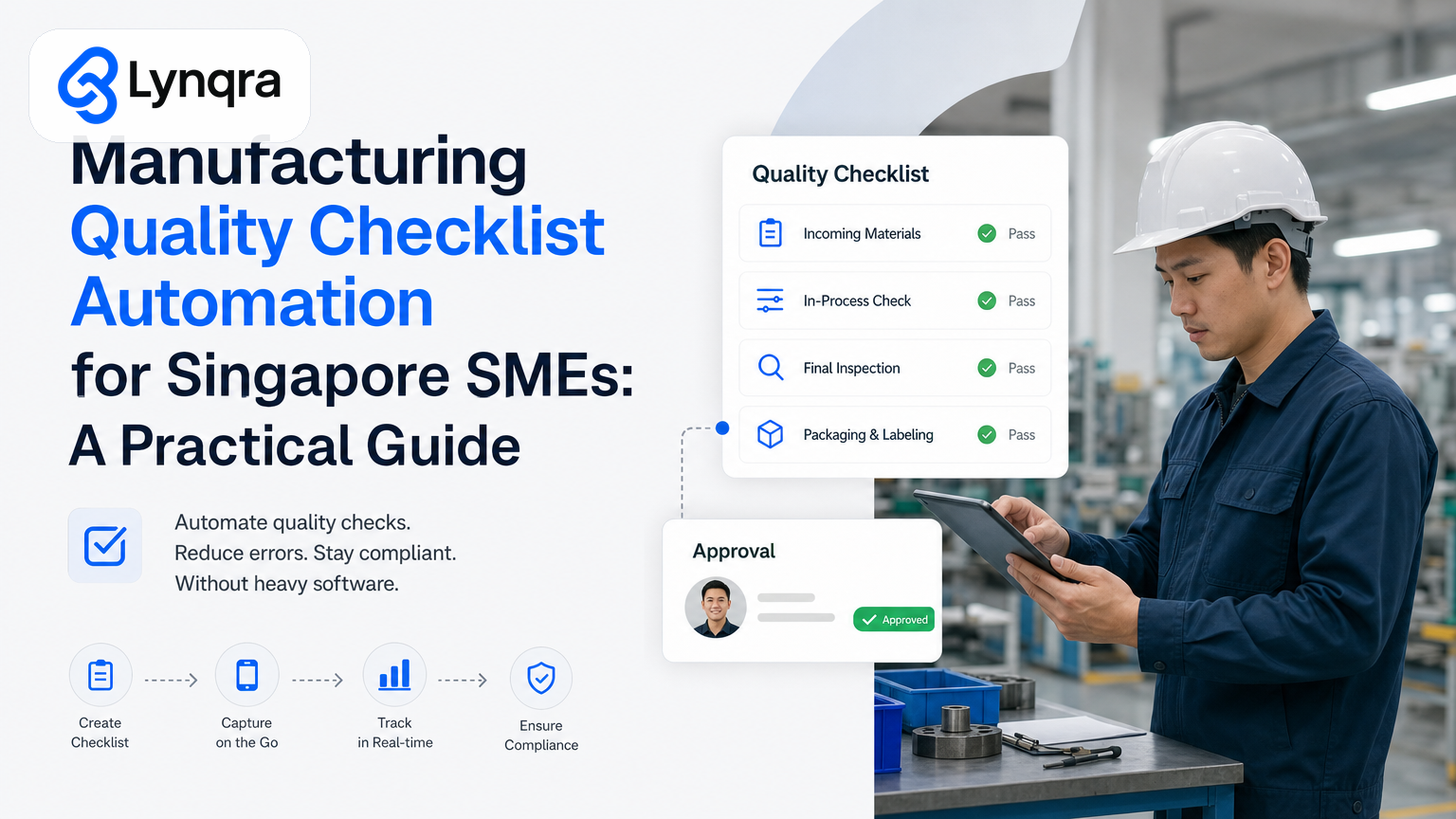
Quality control in manufacturing feels simple until it doesn't. A checklist missed, a defect shipped, a customer complaint, and suddenly your margin evaporates. For Singapore SMEs competing in tight markets where precision matters--electronics, food production, precision engineering, contract manufacturing--manual quality checklists create two problems at once: they consume hours of operator and supervisor time, and they fail when staff get busy or move roles.
This article shows you how to automate quality checklists without replacing your team or forcing adoption of heavy enterprise software. We cover what automation looks like in practice, what actually works for lean Singapore manufacturers, where the cost drivers live, and how to fund it.
For external context, Singapore's Personal Data Protection Act provides guidance on data handling and IMDA supports SMEs adopting digital tools through its SMEs Go Digital initiative are useful references when planning this workflow in Singapore.
What a manufacturing quality checklist actually does
A quality checklist is the record of your manufacturing process working as intended. It captures inspection points, measurement results, approval status, and audit trail. For a food production line, it might check temperature, seal integrity, labeling accuracy, and weight. For precision engineering, it tracks dimensional tolerances, surface finish, assembly completeness.
Manually, a checklist means a form, a clipboard, a pen, and someone walking the line or workbench. Results go into a notebook or a spreadsheet later. If a defect happens, you dig through notes to find when it started. If a customer asks what you checked on their batch, you search for paper or hunt through files.
This works at very small scale. Once you hit consistent volume or multiple production runs, it breaks. Checklist skipping becomes tempting during rush hours. Data entry happens days late. Audit trails disappear. Risk accumulates.
Why Singapore SMEs automate quality checklists
Singapore's manufacturing sector plays a significant role in global supply chains. Advanced manufacturing solutions including robotics, intelligent inspection, and industrial AI have expanded across the region, and that precision and reliability expectation flows down the supply chain to contract manufacturers and component suppliers. Your customers audit your processes. Missing records or inconsistent checks become liability, not just inefficiency.
Automation solves three immediate problems for Singapore manufacturing SMEs:
Consistency without burnout. A digital checklist runs the same way every shift, every operator. Conditional logic routes critical failures to supervisors instantly instead of waiting for a daily review. Temperature out of range in a food production line? Alert fires to Telegram or email in real time, not three hours later.
Faster root cause analysis. When a batch fails, you see exactly which check flagged it, when, and who ran it. You trace back to process changes that week. You isolate variables faster than if you're reading through notebooks.
Compliance and audit readiness. Regulatory bodies and customers increasingly ask for digital audit trails. Automation timestamps every entry, flags deviations, and generates reports that prove your process ran as specified. For food and pharmaceuticals, this is non-negotiable. For electronics, it's competitive advantage.
Time recovery for your team. A line operator or quality inspector spending an hour per shift on checklist entry and data transfer loses production focus. Automate that, and they spot real anomalies instead.
How quality checklist automation works in practice
Manufacturing automation doesn't mean you need a dedicated quality management system (QMS) platform and a full change program. Most Singapore SMEs start by automating what they already use.
Scenario 1: Google Forms + Google Sheets + Automation
An operator completes a form on their phone during each production run. Questions are specific: "Pressure gauge reading in bar?", "Batch temperature stable for 15 minutes?", "Defects found: yes/no?". The form feeds into a Google Sheet. Conditional logic flags out-of-range entries in red and sends an alert to the shift supervisor's Telegram or email. At day's end, a summary report populates automatically, ready for the production manager.
This setup costs almost nothing beyond your internet connection and takes one week to build. An operator learns the form in minutes. No new software passwords to manage.
Scenario 2: WhatsApp or Telegram Check-In
Some manufacturers use structured Telegram messages. An operator sends a photo of the gauge and a timestamp to a dedicated Telegram group. A bot parses the image, extracts the reading, compares it against spec, and stores the result in a linked spreadsheet. The supervisor sees a daily summary without scrolling through 50 messages.
This works for visual inspections: surface finish, packaging quality, assembly alignment. Faster than emailing photos and more traceable than a notebook.
Scenario 3: Quotation or Batch Routing with Embedded Checks
For made-to-order manufacturing, you embed quality checkpoints into your quotation and production workflow. When a customer order enters your system, it auto-populates with the required checks for that product type. Quality staff don't invent checklists; they follow a pre-built one. Approval routing ensures no batch ships until all checks pass.
This is particularly effective for contract manufacturers handling multiple customer specs.
What changes when you automate
Time savings are real but not magical. If quality checks currently consume 8 hours per week of combined operator and supervisor time, automation typically saves 70-80% of that. You recover 5-6 hours per week for actual production or process improvement. That's meaningful but won't pay for a sprawling platform license on its own.
Error reduction is where ROI lives. When checks are digital and gated, missed inspections drop to near zero. When alerts fire in real time, process drift gets caught before it becomes scrap. A single prevented batch failure in food, electronics, or precision work often covers months of automation costs.
Compliance confidence improves immediately. An auditor asks for the quality record for a batch from three months ago. With manual checklists, you search. With automation, you pull a timestamped report in seconds that shows who did what when and what failed or passed. Audit cycle shortens, and risk of non-compliance finding drops sharply.
Your team gets more predictable work. Quality staff move from data entry and searching for lost records to investigating real failures and improving process. Operator morale usually improves because checklist burden lifts.
Common implementation pitfalls and how to avoid them
Pitfall: Over-engineering the checklist. When you first automate, you feel tempted to capture every possible parameter. Resist this. Start with the 4-6 checks that actually predict quality. Too many fields, and operators skip or game the system. Add detail later if data suggests it matters.
How to avoid: List your current manual checks. Keep only the ones you'd catch in an audit or that have caused past failures. Everything else is nice-to-have.
Pitfall: Choosing a tool before understanding the problem. Some SMEs buy a QMS platform because competitors did, only to discover it doesn't integrate with their existing workflow. Then it sits unused, and you're back to manual work plus licensing cost.
How to avoid: Map your actual production flow first. Which tools do you already use? Where does data live currently? Build automation that feeds into what you have, not against it.
Pitfall: No clear owner during implementation. A quality automation project needs one person (often the quality manager or production manager) who cares enough to iterate and debug during the first month. Without that, it stalls when the first edge case hits.
How to avoid: Assign one owner before you build. Give them time to test and refine. Budget four weeks for testing and tuning, not two.
Pitfall: Ignoring compliance requirements specific to your product. Food manufacturers need temperature logging that meets food safety audit trails. Electronics suppliers might need defect photography and traceability. When storing checklist data digitally, you also need to comply with Singapore's Personal Data Protection Act, especially if your checklists capture operator names or batch information linked to customers.
How to avoid: Before building, check what your largest customer or regulator actually requires. Design with that requirement in mind. If you store personal data, ensure your automation process includes the data protection steps outlined in your compliance framework.
Building vs. buying: What makes sense for SMEs
Off-the-shelf QMS platforms (buying): Systems like MES (Manufacturing Execution Systems) or dedicated QMS software handle complex multi-line environments and integrate with enterprise ERP. Cost: typically 1,500-3,000 SGD per month, with implementation taking 3-4 months.
Right for: Manufacturers with 5+ production lines, high regulatory complexity, or multiple facility operations.
Custom automation (building): You hire an automation consultant to build a quality checklist workflow inside your existing tools. Cost: typically 2,000-5,000 SGD depending on complexity, built in 2-4 weeks.
Right for: Singapore SMEs with 1-3 production lines, straightforward processes, and an existing investment in Google Sheets, email, or mobile tools.
For most Singapore manufacturing SMEs, custom automation wins. You avoid migration risk, you keep using familiar tools, and your people adopt it faster because the workflow matches what they already do. If you're considering a broader business process automation strategy for your SME, quality checklist automation is often a strong entry point.
Funding automation in Singapore
If cost is the blocking issue, IMDA supports SMEs adopting digital tools through its SMEs Go Digital initiative, offering support with infrastructure, tools, and capability building. Exact eligibility depends on your business structure, sector, and project scope, so confirm details directly with IMDA.
Many automation consultants work with grant advisory partners who help you navigate what programs apply to your specific situation. This reduces the administrative friction of exploring funding. You can also explore AI automation grants specific to SME ROI to understand what funding paths may apply to your project. Beyond IMDA, Enterprise Singapore offers grants for capability development and process improvement that may cover part of automation implementation costs.
A practical checklist: Is quality checklist automation right for you?
Before you commit, check these points:
- Your current quality checks involve paper, spreadsheets, or unstructured digital notes.
- Quality data often gets entered late or contains gaps.
- You have had at least one incident where a quality failure wasn't caught until after shipment.
- Your team finds it hard to generate audit reports quickly.
- You use Google Sheets, email, SMS, or Telegram for most communication and don't have a dedicated QMS.
- You have someone (production, quality, or ops manager) who can own the implementation for the first month.
- Your production volume or complexity justifies 2-5 hours per week of saved time.
If you checked at least four of these, automation is a reasonable next step.
Automating quality is part of a larger picture
Quality checklist automation often reveals other bottlenecks once it runs smoothly. You spot that approvals are slow, that quotations take hours to generate, or that you're spending time hunting down invoice data. That's actually good; it means you're seeing your real problems instead of just firefighting checklist chaos.
Approval workflow automation often pairs well with quality checks, letting you gate production handoffs automatically. Once quality data flows digitally, you can connect it to downstream processes like shipment authorization, invoicing, and customer reporting.
If you're ready to explore quality automation or want to understand how it fits into your broader operations, start with a discovery conversation. Lynqra works with Singapore SMEs to identify your specific production bottlenecks, design automation that solves them without heavy software, and build it inside tools you already use.
Reach out to discuss your specific situation and schedule a free discovery call.