Your finance team spends Tuesday afternoon manually entering expense receipts into a spreadsheet. Wednesday morning, approvals sit in email limbo. By Friday, someone chases down missing documentation. By month-end, three receipts have gone missing entirely, and you have no audit trail.
This is the default state for most Singapore SMEs. Expense claims automation is not a luxury,it is a practical way to recover time, reduce errors, and build the compliance record you need for tax and audit purposes.
This article explains what expense claims automation is, why it matters for lean Singapore teams, how to set it up without forcing your team onto new platforms, and where to start.
What is expense claims automation?
Expense claims automation uses artificial intelligence and workflow tools to capture, validate, route, and process employee expense claims without manual data entry or chasing.
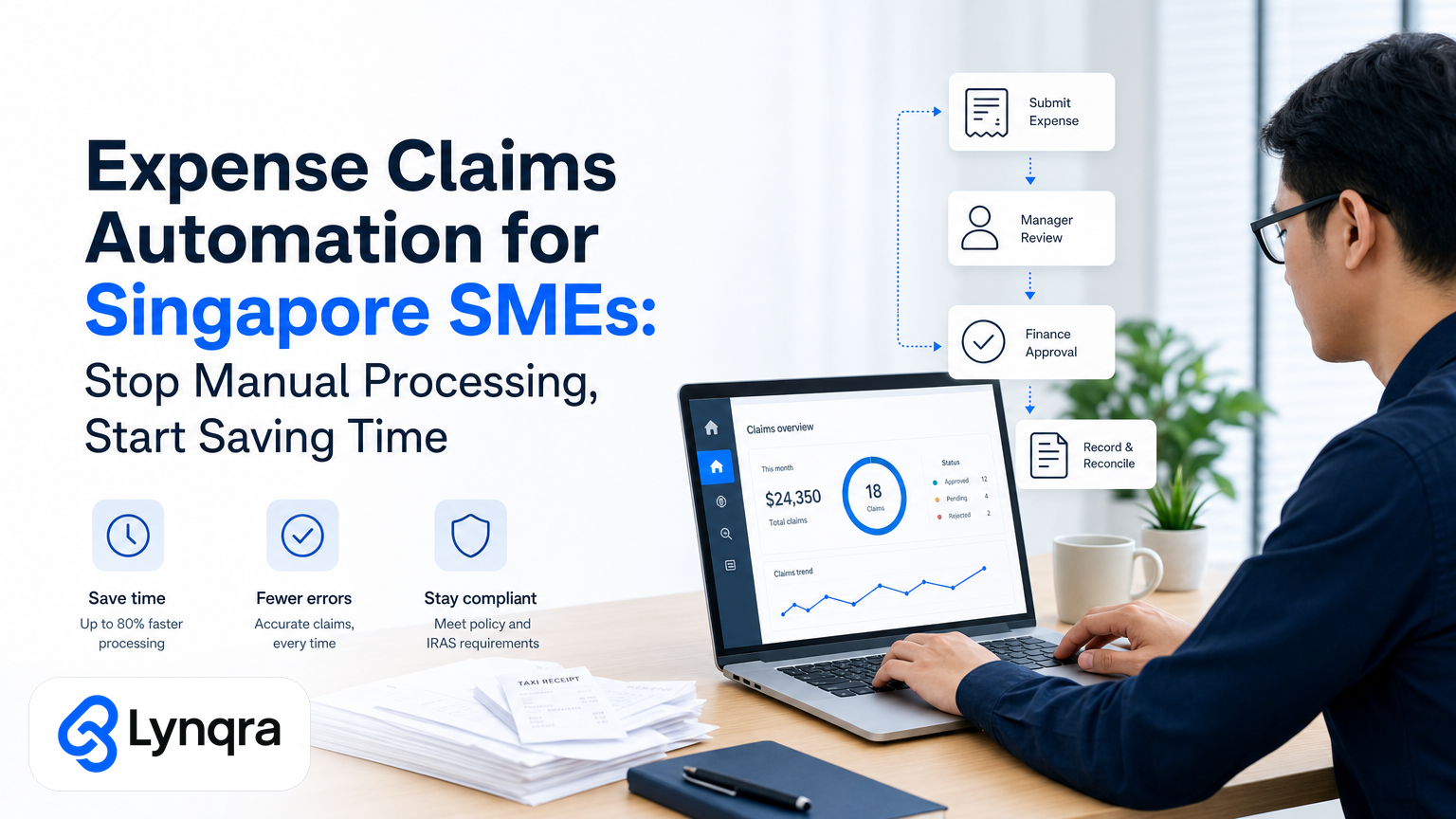
Instead of your employee emailing a receipt, someone printing it, manually typing numbers into a spreadsheet, and then waiting for a manager to sign off, an automated system does this:
- Captures the receipt image, email, or form submission automatically
- Extracts key details (amount, vendor, category, date) using AI
- Routes the claim to the correct approver based on amount, department, or rule
- Flags missing information or policy violations before approval
- Records the entire audit trail for tax and compliance purposes
- Updates your accounting ledger or spreadsheet in real time
The result: claims move from submission to approval in hours, not days. Your team stops re-entering data. You catch duplicate claims and policy breaches before they cost you money.
Why Singapore SMEs need this now
Singapore's business environment rewards speed and accuracy. But most SMEs run on lean teams where one person juggles payables, approvals, and compliance. Manual expense processing drains time that could go toward sales, operations, or strategic work.
Three concrete problems drive this need:
Problem 1: Time waste. A typical manual expense claim takes 15 to 30 minutes to process end-to-end: collecting the receipt, typing it in, chasing approvals, and filing. For an SME processing 50 claims per month, that is 12 to 25 hours of manual work. Automation can cut that to 2 to 4 hours.
Problem 2: Approval delays. Without a clear workflow, expense claims queue in email inboxes. Approvers forget. Employees chase. By the time reimbursement happens, the cash flow impact is real. A structured, automated approval process with notifications and escalation cuts turnaround from 7 to 14 days down to 1 to 2 days.
Problem 3: Compliance and audit risk. When expense data lives in scattered emails, spreadsheets, and paper, you cannot easily prove which claims were approved, by whom, and when. The Inland Revenue Authority of Singapore expects businesses to maintain clear records of expense claims, especially for deductible business expenses. According to IRAS guidance on corporate income tax, you must be able to demonstrate the deductibility of expenses and the allowances available to your company. A documented automated process protects you during tax review and audit.
How expense claims automation works in practice
Let me walk through a real workflow. A sales team member attends a client lunch. They snap a photo of the receipt, email it to an expense submission address, or fill out a form in Google Forms.
An automated system picks up that submission. AI extracts the amount, vendor name, category (meals and entertainment), and date from the receipt image. The system cross-checks against your company's expense policy. If the meal was SGD 150 and your policy caps meals at SGD 120, the system flags it for review. If it passes, the system automatically routes it to the sales manager.
The manager sees a clean summary in their email or a dashboard, not a raw receipt. They approve or reject with one click. If approved, the claim automatically updates your accounting spreadsheet and triggers a reimbursement reminder. The entire history is logged with timestamps.
From the employee's perspective: they submit once and are done. From the finance perspective: the claim moves through the pipeline with no manual typing, no lost emails, and a complete paper trail.
This workflow works even if your team uses Google Sheets, Gmail, Telegram, or WhatsApp for day-to-day work. You do not need to migrate to expensive enterprise software.
Key benefits for Singapore SMEs
Recover 10 to 15 hours per month. Stop manual data entry and chasing. Your finance person or admin team focuses on analysis and strategy instead of typing.
Reduce approval time from days to hours. Automated routing and notifications mean claims move faster. Employees get reimbursed sooner, which improves morale and cash flow visibility.
Catch policy breaches and duplicates early. AI-powered validation flags suspicious claims (missing category, amount over limit, duplicate submission) before approval. You avoid overspending and fraud.
Build a full audit trail. Every claim, approval, and rejection is timestamped and logged. When tax authorities ask for proof of how you managed expenses, you have it. No scrambling through old emails.
Stay compliant with tax deductibility rules. Deductible business expenses are those wholly and exclusively incurred in the production of income, according to Singapore tax law. A clear, documented process helps you prove which expenses meet this standard and which do not.
Lower your cost per claim. Automating a claim that once cost you SGD 5 in labour now costs SGD 0.50. At scale, this adds up.
Common objections and how to address them
"Our team is too small. We only process 30 claims a month."
Even 30 claims a month is 7 to 10 hours of labour. Over a year, that is 84 to 120 hours. If your finance person earns SGD 25 per hour, you are spending SGD 2,100 to SGD 3,000 yearly on manual processing. Automation pays for itself in month one.
"We already use an accounting package. Do we have to switch?"
No. Most automation integrates with the tools you already use. If your team submits expenses via email or a Google Form and tracks approvals in Sheets, we can build automation that works within that stack. No migration, no retraining.
"What if the system misreads a receipt?"
AI is not perfect, but it is good. Modern document extraction tools capture 95 plus percent of data correctly. For the 5 percent, your system flags it for manual review. A quick human check takes 30 seconds, not 15 minutes. You still save 14 minutes per claim.
"Doesn't automation mean we lose control?"
The opposite. Automation enforces your policies consistently. Every claim follows the same rules. You define those rules upfront: approval limits, categories, policy violations. The system applies them every time. You have more control, not less, because the process is transparent and traceable.
What to check before you start
Before implementing expense claims automation, run through this checklist:
- Do you have a clear expense policy in writing? (Categories, limits, what is deductible, approval chain.) If not, write one first. Automation enforces rules only if rules exist.
- Who approves claims now? Map this: claims under SGD 500 go to the department head; claims over SGD 500 go to finance. Approval routing automation works best when you can define these rules clearly.
- How do employees submit claims today? Email, paper, spreadsheet, form? Document the current flow so the automated flow can slot in without disrupting habits.
- What data do you need to capture? Beyond amount and vendor, do you track cost centre, project code, or payment method? List these upfront.
- Who is responsible for payment? Finance, admin, accounting system? Make sure the automation can output data in a format your payment process accepts.
- How long do you currently keep expense records? Ensure your automation can archive claims durably. When handling expense data, remember that your employees' personal information is covered under the Personal Data Protection Act. The PDPC's guide for data protection officers outlines key steps to protect your employees' and customers' data while maintaining compliance, which becomes important when automating receipt and claim data.
How grants and government support can help
Singapore offers practical support for SMEs adopting automation and digital tools. IMDA's SMEs Go Digital program helps businesses like yours adopt technology to drive growth in Singapore's digital economy, offering support with digital transformation initiatives, the Open Innovation Platform, and more.
Under this framework, you can also explore IMDA's Industry Digital Plans, which provide sector-specific guidance on digital adoption. Additionally, Enterprise Singapore offers grants that may cover technology implementation costs.
These programs typically help with:
- Consultancy costs (technology assessment, process design)
- Software licences and integration work
- Training and change management
The exact eligibility criteria, subsidy rates, and application timeline change. Check the official IMDA SMEs Go Digital page for current details before planning your budget.
If you are serious about automation, government support can reduce your out-of-pocket cost by 50 to 70 percent. We work with partners who help you explore which programs suit your business profile and scope.
Practical next steps
Start small. You do not need to automate all expense claims at once.
Month 1: Run a pilot. Pick one team (sales, operations, whatever processes the most claims) and automate their submissions for four weeks. Measure time saved, approval turnaround, and error rate. Use this data to build business case for the rest of the company.
Month 2-3: Expand and refine. Roll out to other teams. Gather feedback. Adjust approval rules or capture fields based on what you learn.
Month 4+: Integrate downstream. Connect expense data to your accounting system so claims feed directly into your ledger. This removes another manual step.
Throughout, keep a document of what worked and what did not. You will use this feedback to improve the process and justify future automation investments to your team.
Related automation opportunities in your workflow
Expense claims automation often sits alongside other operational pain points. If you are automating approvals, you might also benefit from approval workflow automation across multiple business functions, not just expenses. Similarly, exploring business process automation more broadly can help you prioritize which process to automate first based on your business impact.
Other related opportunities include invoice and payment automation, which uses the same approval workflow logic, and data entry automation for handling not just receipts but also invoices, quotations, and purchase orders.
If you are looking to build more sophisticated automation capabilities, you might also explore what AI agents can do for your business, or check whether your company qualifies for AI automation grants available to Singapore SMEs.
Final word
Expense claims automation is not about replacing your team. It is about freeing them to do work that adds value. Your finance person should review policy exceptions and analyse spending trends, not type numbers into a spreadsheet for four hours a week.
The technology is mature. The ROI is clear. Most Singapore SMEs just need help bridging the gap between "this would be nice to have" and "here is how we implement it without disrupting our team."
If you want to explore whether expense claims automation makes sense for your business, the first step is a conversation about your current process, your pain points, and your budget. We run free discovery calls where we map out your workflow, identify where automation saves the most time and money, and give you a clear picture of what is possible.
Reach out at mark@lynqra.com or visit our contact page to book a time that works for you.