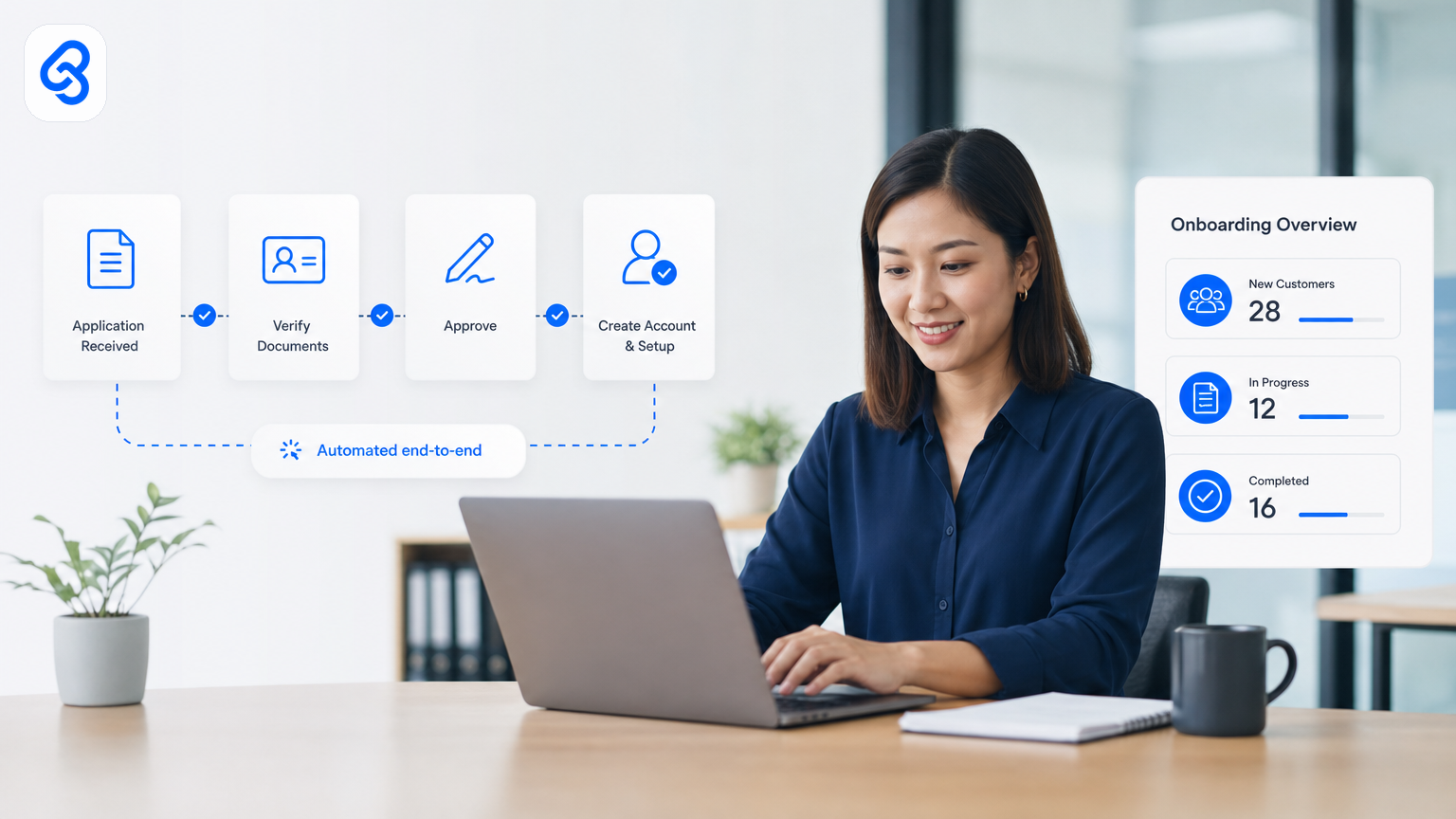
When a new customer lands, what happens next? If you're running an SME in Singapore, the answer probably involves a spreadsheet, email chains, manual data entry, and someone chasing approvals across multiple channels. Every new customer onboarding takes days. Sometimes weeks. Mistakes slip through. Follow-ups get lost.
Customer onboarding automation changes this. Not by forcing you onto a heavy new platform, but by automating the repetitive, manual steps you're already doing inside tools your team already uses.
This guide walks you through why onboarding automation matters for Singapore SMEs, what specific workflows you can automate, how to assess whether you're ready, and how to avoid the common pitfalls that derail implementation.
What Customer Onboarding Really Covers
Onboarding isn't just about welcoming a new customer. It's the entire operational workflow that turns a signed contract into an active, productive relationship. For SMEs, that includes:
- Collecting and validating customer details (company registration, tax ID, payment terms, contact preferences)
- Setting up accounts in your systems (billing, delivery, approval permissions)
- Generating and sending documents (contracts, quotation confirmations, service agreements, payment terms sheets)
- Assigning to teams (sales, operations, finance, support)
- Triggering follow-up tasks (first delivery, payment reminder, check-in calls)
- Recording the handoff so nothing falls between the cracks
In a lean SME, these steps happen across email, Forms, spreadsheets, and messaging apps. Automation removes the manual data re-entry and approval chasing, so your team can focus on actually building the relationship.
Why Onboarding Automation Matters Now
Singapore SMEs operate on tight margins. The Singapore Business Federation has highlighted that SMEs face growing pressure to compete with larger players while managing lean teams. Every hour your team spends on manual customer setup is an hour they cannot spend on sales, delivery, or strategy.
Across SME workflows we work with, manual onboarding typically eats 2 to 4 hours per week per team member involved. For a trading company with 8-10 new customers per month, that's roughly substantial weekly time lost to manual data entry, approval chasing, and document generation alone.
Automation shortens this to 15 to 30 minutes per customer, often with zero errors. That reclaimed time compounds fast. Over a year, you've recovered the equivalent of 2-3 full-time employees worth of capacity.
Specific Workflows You Can Automate Today
1. Customer Data Collection and Validation
Your first touchpoint with a new customer usually involves a form or an email request for company details: company name, UEN, contact person, billing address, payment terms, delivery preferences, compliance notes.
Instead of asking customers to email this in, then manually transcribing it into your system, you can build a smart intake form that:
- Collects information once via a web form, email, or WhatsApp message
- Validates data in real-time (checks UEN format, phone number structure, email address validity)
- Routes incomplete submissions back to the customer automatically
- Feeds validated data directly into your spreadsheets, billing system, or CRM without re-entry
One recruitment agency built an intake form for client company details. The form now auto-validates company UEN and flags missing information before it leaves the customer's hands. Errors dropped to near zero, and the team stopped chasing follow-up emails asking for the missing postcode or tax ID.
2. Quotation and Document Automation
Once you have customer details, you need to generate documents: quotations, service agreements, payment term sheets, delivery schedules, or compliance checklists.
If you're building quotations in a spreadsheet or Word template, automation can:
- Pull customer and product data from your existing sheets or database
- Insert the correct pricing, quantities, and delivery terms based on customer type
- Generate a professional PDF in seconds, not hours
- Send it automatically to the customer and log the send in your system
- Trigger a follow-up if the customer does not respond within 3 days
A food production SME was manually building quotations for each enquiry. Response time averaged 2 hours per quote. After automating quotation generation from their existing Google Sheets, response time dropped to 6 minutes. They landed more deals because they could quote same-day instead of next-day. For more detail on this approach, see our guide on Google Sheets Automation for Singapore SMEs.
3. Approval Routing and Compliance Tracking
New customer approval often requires sign-off from multiple people: credit team, finance, operations, compliance. In many SMEs, this approval chain happens via email, which creates audit risk and slow handoffs.
Automation creates a structured approval workflow that:
- Routes new customer details to the right approver based on rules (e.g., large orders go to finance, new sectors go to compliance)
- Sends reminders if an approval is pending longer than 1 day
- Logs who approved what and when (critical for ACRA records and compliance audits)
- Blocks the next step until all required approvals are in place
- Sends the customer a confirmation only after all internal approvers sign off
A trading company built a Telegram-based approval workflow where new customer details were posted to a private channel, approvers could respond with a tick or cross, and a Google Sheet automatically logged all approvals with timestamps. Approval turnaround fell from 3-4 days to a few hours, and they had an audit trail.
4. Account Setup and Team Assignment
Once approved, the customer needs to be set up in your systems: billing, delivery tracking, support channels, permissions. This often means manual ticket creation, email instructions, or spreadsheet updates across different teams.
Automation can:
- Create a customer record in your billing system automatically
- Generate login credentials or send onboarding instructions via email or SMS
- Add the customer to the right WhatsApp or Telegram group for updates
- Create tasks in your project tracker for the operations and support teams
- Log the setup completion so sales knows the customer is ready
5. Handoff Documentation and Follow-up
After setup, someone needs to document the handoff and ensure the relationship kicks off. This includes sending welcome emails, scheduling first-contact calls, or reminding the customer to pay their initial invoice.
Automation handles this without human intervention:
- Send a templated welcome email with payment instructions, support contact, and first-step actions
- Create a follow-up task for the account manager to call 3 days after onboarding
- Log the handoff in your internal records
- Trigger a payment reminder email 5 days before the first invoice is due
How to Know You're Ready for Onboarding Automation
Not every SME is ready to automate on day one. Before you invest, check these signals:
You handle more than 4-5 new customers per month. Below that volume, the time saved may not justify setup effort. Above it, automation becomes compounding.
Your onboarding process is documented, even roughly. You do not need a formal process map, but you should be able to describe the steps: who does what, in what order, and where decisions happen. If every onboarding is ad-hoc and different, you cannot automate.
You use email, spreadsheets, or messaging apps for approvals or data entry. These are the workflows automation works best in. If you're already locked into a heavy ERP system with rigid workflows, automation becomes harder.
You have budget or can access grants. Automation does not need to be expensive for SMEs (most automations cost SGD 2,000 to 8,000), but it does require some investment. Singapore offers grants to help: the IMDA SMEs Go Digital programme provides support with digital transformation initiatives, including automation projects that help drive growth in Singapore's digital economy. You can also explore Enterprise Singapore grants for broader transformation support.
You have someone who can own the project. Automation is not a set-and-forget tool. It needs a champion in your team who will monitor performance, catch edge cases, and iterate as your business changes.
Common Objections and How to Address Them
"We do not have a budget for new software." You do not need it. Most effective onboarding automations live inside tools you already use: Google Sheets, Gmail, Forms, Telegram, WhatsApp. You build workflows that connect these tools, not replace them.
"Our process changes too much to automate." If your process changes monthly, automation is not the first step. But if it changes quarterly or yearly, automation is worth it. You automate the stable core, then adjust the automation as the process evolves. This is why having a long-term partner matters more than buying a product.
"Automation will break our customer relationships." It will not. Automation removes the boring stuff (data entry, chasing approvals) so your team can spend more time on the human stuff (personalisation, relationship building, problem-solving). Customers prefer faster, error-free onboarding, not slower manual processes.
"We've tried this before and it did not work." Many SMEs buy a tool and expect it to work out of the box. It does not. You need someone to set it up properly, test it with real data, and iterate based on what your team actually does. If your previous attempt failed, it likely lacked this hands-on iteration step.
Data Protection and Compliance
When you automate customer data collection and storage, you're managing personal data. Singapore's Personal Data Protection Act requires you to handle this responsibly. The PDPC's step-by-step guide for organizations outlines key steps to protect your customers' and employees' data while ensuring compliance. Key principles include collecting only the data you actually need, storing it securely, and being transparent about how you use it. This builds trust with your customers and keeps you on the right side of regulation.
The Implementation Path
If you've decided to move forward, here's how implementation typically works:
Week 1: Audit. You describe your current onboarding workflow, step by step. You share sample documents, emails, and spreadsheets. You identify the biggest bottleneck: where do you lose the most time or make the most mistakes?
Week 2-3: Design. We design the automation workflow, show you mockups of forms, approval screens, and generated documents. You review and request changes. We finalize the design based on your feedback.
Week 3-4: Build. We build the automation inside your existing tools. We test with sample data and edge cases.
Week 4-5: Train and iterate. We train your team on the new workflow. You run it live with real customers. We catch bugs, adjust based on what does not work, and iterate.
Week 6 onwards: Monitor and optimize. We check in periodically. As your business evolves, the automation evolves with it. We add new fields, adjust approval rules, or connect new tools as needed.
This is why we call ourselves a partner, not a vendor. Automation is not static. It lives and breathes with your business. For a broader look at how automation fits into your business strategy, read our guide on Business Process Automation in Singapore.
The Numbers: What You Can Expect
Based on work with Singapore SMEs, here's what realistic outcomes look like:
- Time saved per customer onboarded: 2-4 hours down to 15-30 minutes. That compounds fast over 50-100 new customers per year.
- Error rate: Manual data entry typically runs 5-10% error rate. Automation with validation drops this to near zero.
- Approval turnaround: Email approvals average 3-4 days. Structured approval workflows cut this to 4-8 hours.
- Cost per automation: Most SME onboarding automations cost between SGD 2,500 and 8,000 to build and test. That cost recovers within the first 6-12 months of operation, depending on your customer volume.
For a detailed breakdown of how to calculate ROI and explore funding options, read our guide on AI Automation Grants in Singapore: EDGE and SME ROI Guide.
Avoiding the Pitfalls
Pitfall 1: Over-engineering. Do not automate every edge case on day one. Start with 80% of your workflow (the common path), then add edge cases later. This keeps implementation fast and focuses effort where it matters.
Pitfall 2: Forcing a bad process to scale. If your manual onboarding process is broken, automating it will scale the broken process, not fix it. Automate after you've cleaned up the process, not before.
Pitfall 3: Skipping the handoff. Once automation is live, some teams forget to monitor it. Automations can drift: a field changes, a rule stops applying, an approval person leaves. Assign someone to check the automation monthly and report on what's working and what's not.
Pitfall 4: Neglecting data protection. When you automate customer data collection and storage, you're managing personal data. Make sure you comply with Singapore's Personal Data Protection Act and the guidance we covered earlier in this article.
Getting Started: Your Next Step
If your SME is handling 5+ new customers per month and you recognise the manual onboarding grind, automation is worth exploring. You do not need to commit to a full project right away. A simple conversation can clarify whether your process is a good fit, what you could save, and what it would take to build.
Email mark@lynqra.com or visit our contact page to get started.
If you want to explore grant funding first, read our guide to AI Automation Grants in Singapore: EDGE and SME ROI Guide. It walks through the EDGE and other pathways, eligibility signals, and how to work with advisory partners who specialise in this.
Related Reading
For deeper dives into specific automation types we've covered here, you may find these useful:
- Business Process Automation in Singapore: A Practical SME Guide covers the broader framework for identifying and automating bottlenecks across your operations.
- Google Sheets Automation for Singapore SMEs: Keep the Spreadsheet, Remove the Manual Work explains how to keep your spreadsheet workflows but remove the manual work, which is often the fastest path for SMEs.
- Data Entry Automation Singapore: How to Eliminate Manual Keying walks through how to eliminate manual keying and reduce errors in customer and invoice data.
- AI Agent for Business Singapore: What It Is and How to Build It Right explores how intelligent agents can take onboarding automation further, handling customer conversations and decisions autonomously.